|
|
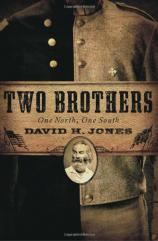
Two Brothers: One North, One South
by David H. Jones
List Price: $24.95
Pages: 320
Format: Hardcover
ISBN: 9780979689857
Publisher: Staghorn Press
Navigated by Walt Whitman and based on real people and events, Two Brothers: One North, One South is the quintessential story of the Civil War.
top of the page

1. Prior to learning about and reading this novel, were you aware of the compassionate care that Walt Whitman provided to sick, wounded, and dying soldiers of both sides in Washington area hospitals during the American Civil War?
2. A Prentiss family genealogist supplied the author with a wealth of information about family members and thereby equipped him to develop, by conjecture, a hypothesis to explain the political beliefs and loyalties of family members. Is the author’s rendition of family dynamics and the friendships and associations of the individuals a rational explanation for the divided loyalties within the household?
3. In May of 1861, William, the youngest son in the Prentiss family, slipped across the Potomac to join the Confederate Maryland Battalion at Harpers Ferry. Could John Prentiss, Sr. (Clifton and William’s father) have been more effective in preventing the schism that developed within his family?
4. Loyalties were sharply divided in Baltimore as the agony of civil war consumed the nation. Was Sarah disloyal to her country and to her husband by assisting Laura in her clandestine activities?
5. During the discussion around Clifton’s bed at Armory Square Hospital, Walt Whitman recalled William’s wartime experiences as told to him by William in the weeks prior to his passing. Clifton talked about his service in the Federal 6th Maryland Infantry. The two elder brothers, John and Melville, contributed their insights and disclosed their attitudes about what their younger brothers had endured. No one character saw, heard, or understood everything. It’s from this conversation in the hospital ward that the experiences of the two brothers are fully revealed. In your opinion, is this an effective and sufficiently dramatic means to tell the story?
6. Elijah Carter is one of the very few created characters in the book. Are his experiences, and those of the 7th United States Colored Troops, a worthwhile added dimension to the story or are they simply a distraction from Clifton and William Prentiss, the principal characters?
7. Hetty, Jenny, and Constance Cary were actual historical figures; the events portrayed in Two Brothers in which they participated are essentially true. The author intertwined their story with the Prentiss brothers to examine the participation of upper-class Southern women on the home front during the war and demonstrate how that experience changed the role of women in American society. Is this a worthy expansion of the story or simply a distraction from the battlefield experiences of Clifton and William?
8. The author based the book on extensive historical research, as his intent was to treat the Prentiss brothers in an even-handed manner. Does the Union viewpoint consistently expressed around Clifton’s bedside and the fact that the perspective shifts to the Northern side in the final chapters compensate for the greater focus on the Southern characters in the first two-thirds of the book? Do you think that the author is biased toward the South? Or do you suspect that he simply found more usable material regarding the Confederate brother?
9. The author integrated extensive narration into the story to provide historical context and background for the experiences and circumstances of the characters. Was there too much narration of this kind? Did you gain a greater understanding and knowledge of the American Civil War from reading this book? If you thought that the amount of narration detracted from the telling of the story, was the knowledge and understanding gained a good tradeoff?
10. Two Brothers is closely based on the actual circumstances and experiences of real people at a difficult time in our nation’s history. Only a few characters and circumstances were created to benefit the telling of the story. Given his respect for the real characters as American patriots, the author limited “character development” to what he actually knew from research about them. Did this writing strategy help or hinder the literary value of the book? In your opinion, is truth sometimes stranger than fiction and, when unembellished, can it make a better story than a more imaginary tale?
11. Was it evident prior to reading the last chapter that Clifton and William would be on the same battlefield at Petersburg at the same time, near the end of the war?
12. How do the battle scenes in Two Brothers compare to those you have read in other Civil War novels or non-fictional accounts?
13. The author chose to write the dialogue and narration of Two Brothers in the formal, ornate, and flowery language of the nineteenth century to create an atmosphere of authenticity for the story. In fact, much of the dialogue is based on the actual words of the participants as recorded in letters, memoirs, veteran’s magazines, and books of the period. Was this language style a help or a hindrance to your reading enjoyment?
14. The author’s premise in Two Brothers was that all of its characters, both North and South, were American patriots. Given the times and their beliefs, do you agree with his assessment?
15. What was the most touching moment for you in this book?
top of the page

"With a diligent handling of the primary sources and a creative approach, David Jones has crafted a fine story of Maryland brothers who are Civil War soldiers, one in blue the other in gray... With a writing style that is direct and to the point, Jones handles the myriad of characters well… Jones has achieved writing an intriguing tale of the nation and several individuals' stories while allowing the individuals to tell them."
Rea Andrew Redd, Associate Professor, Waynesburg University, Adjunct instructor in U.S. history, Civil War Librarian, January 2009
"The now-stilted language of the nineteenth century is reproduced in the novel with care; to his credit, Jones does not follow Michael Shaara in updating the verbiage of the war’s participants. Nor does Jones condescend to the past when describing the beliefs and motivations of his characters, no matter how outdated or wrongheaded those beliefs may seem to modern readers. In these respects, the novel adheres to historical fact --- even if it does sometimes shade into Southern apologia… I can recommend David H. Jones’s Two Brothers to readers new to Civil War fiction and to those for whom the story of the war – no matter how familiar --- bears repeating. Both groups will find profit in the book, less for its portrait of Whitman than for its attention to what the poet-nurse treasured above all else: the humanity that both shaped and cursed America’s most costly war."
Craig A. Warren, Assistant Professor of English & Professional Writing, School of Humanities & Social Sciences, Penn State Erie, Civil War Literature, December 2008
"...a highly dramatic and original storyline... meticulously researched for maximum believability... The characters in Two Brothers read very real, because they are... it is very refreshing to find examples when historians can find a new and exciting way to present these struggles on a personal level. David Jones has managed to do just that with the highly innovative Two Brothers: One North, One South... Two Brothers is a wonderful read that will appeal to history buffs on both sides of the Mason-Dixon Line."
Michael Aubrecht, Historian & Author, Pinstripe Press Blog, June 2008
|
Oprah's Book Club Selection
Contest
Win Copies for your Book Group

This month's prize:
The Cottage at Glass Beach by Heather Barbieri
Click here for more


|