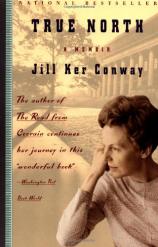
True North
by Jill Ker Conway
List Price: $12.00
Pages: 272
Format: Paperback
ISBN: 0679744614
Publisher: Vintage
The questions, discussion topics, and author biography that follow are
intended to enhance your group's reading of Jill Ker Conway's True
North, the second volume of her autobiography. We hope they will enrich
your understanding of the many themes that Conway weaves into the narrative
that begins where The Road from Coorain,
the story of her childhood and early youth, ended.
Conway begins this second volume with her departure from Australia and her ambivalent feelings toward
the character and traditions of her native country. She settles temporarily
in the United States and enters Radcliffe College as a graduate student
in history, finding there, for the first time in her life, a community
of intellectual women. Realizing that she has a true vocation as a historian,
Conway develops her gifts as a thinker and educator. She marries John
Conway, a fellow historian, and leaves with him for Canada, where she
finds a teaching position at the University of Toronto. She eventually
becomes a Vice President of the University, and while writing and researching
the lives of activist women, she herself develops into an activist, fighting
for improved opportunities and conditions for women in higher education.
The narrative ends in 1974, with Conway about to begin a new job. As the
first woman president of Smith College, she will work to defend the embattled
tradition of the all-women's college in an era when coeducation has become
widely accepted as the cultural ideal.
top of the page

1. Conway comes to think of her work as a "vocation" almost in the religious sense of the word.
What importance does Conway assign work in a woman's life? Does she
consider it more important than love, or less so? How does she reconcile
work with the somewhat abstract concept of duty? In what way does she
redefine her ideas of duty as she grows up? How do she and her Radcliffe
roommates cope with their feelings of guilt at being "different"? Does
Conway succeed in turning her sense of guilt into constructive channels?
How?
2. Conway's narrative opens with her being accepted into a liberating community of young women and
closes with her departure to conserve and foster another such community.
How does Conway use this frame to shape the various themes of the autobiography?
How does she balance the story of her own formation as an individual
with that of her coming to identify herself as part of a group?
3. "Every verbal and visual message of the world I'd grown up in telegraphed that a young female
belonged with somebody else...anything that would signal to the world
that she was going about the business of being a helpful and charming
female bent on caring for the needs of others" [p. x]. Here Conway is
speaking of Australia in the 1950s. How different is the society she
encounters in the United States? How are American attitudes toward women
symbolized in the professional fates of her roommates Barbara and Jana?
4. Upon her arrival in New England, Conway is much struck with its Puritan tradition; essential
contradictions, she notes, are implicit in a society "devoted to the
pursuit of happiness" [p. 21] yet ruled by the "Puritan fear of the
world, and of earthly beauty" [p. 21]. How do these New England moral
preoccupations differ from those she encounters in Canada? How do they
differ from the Australian ethos, with its stoicism and cult of death?
5. Is it possible to explain Mrs. Ker's violent response to her daughter's engagement in social as
well as psychological terms? How does her valuation of her daughter
as an economic asset compare with the centuries-old tradition of looking
on women as property?
6. How does the book's title
convey the essential quality of Jill and John Conway's marriage? Do
the intellectual and spiritual bonds shared by the Conways differ significantly
from those in more traditional marriages? If so, how? Do you find the
Conways' romance unusual, nontraditional? Or should their ideals of
mutual respect and equality be essential ingredients in any successful
marriage?
7. "I thought of my mother, with her strong managerial ability, her drive for power, her restless
energy, sitting alone in her neat suburban house, schooled to believe
she shouldn't be in business, or running an organization" [p. 161].
To what extent does Mrs. Ker function as a cautionary example for her
daughter? How does she inspire (albeit negatively) Conway's quest for
knowledge? Is it possible that Conway's swift professional progress
is to some degree driven by a fear of being caught in the same traps
that have destroyed her mother?
8. How is Conway's thinking about the opposing virtues of action and endurance developed during
her husband's intense battle with mental illness? How does this ordeal
differ from, or resemble, ordeals she has had to undergo in the past?
Are the resources of Australian stoicism sufficient to her emotional
needs?
9. Conway points out that "the dream of a genuine community of scholars, mediating the conflict
between generations, linking young and old in a mutually loving quest
for knowledge, has inspired ideas about academic communities since Greek
times" [pp. 157-58]. To what extent are Conway and her women friends
able to establish such a community at Harvard/Radcliffe? Do the universities
of Harvard and Toronto foster or hinder the creation of such utopias?
How does this ideal direct Conway's career as an administrator?
10. As Vice President of the University of Toronto, Conway began to understand "why the great medieval
historians had studied institutions. They had a life of their own" [pp.
226-27]. How might Conway's new understanding of the University affect
her vision as a historian? In what way is the University of Toronto,
as Conway describes it, representative of the larger society?
11. How does Conway's success in administrative work help her to understand her own character and
abilities? Conway ruefully compares her lack of self-knowledge with
that of Jane Addams and her other subjects. She explains the cultural
reasons for Addams's self-deception. What do you see as the cultural
reasons for Conway's own self-deception?
12. How does Conway present the arguments for women's colleges versus coeducation? Are her arguments
persuasive? Is her use of the nineteenth-century models of Oberlin and
Mt. Holyoke a valid one? Do you feel that the arguments for or against
single-sex education have substantially changed in the twenty years
since Conway began her work at Smith College? Do women's colleges, as
Conway believes, embody "important aspects of modernity" [p. 248]?
13. How does Conway's way of looking at history differ from the diplomatic and constitutional model
she learned as a child? In your view, is this change in outlook representative
of a general change in the way we have come to look at history? How
does Conway's historical vision help her in understanding the peculiarities
of the Australian, American, and Canadian national characters and institutions?
How did it affect her view of the Vietnam war?
14. How does the beauty and variety of the natural world--both in her native Australia and her adopted
countries of Canada and the United States--affect Conway's life and
her personal decisions? How does she use the theme of nature to structure
her autobiography?
15. How does Canadian political philosophy, as described by Conway, differ from that of the United States?
How has the country's geography affected this philosophy? What differences
does Conway see between Canadian and American standards of civic virtue
and communal responsibility? How does "the Canadian sense of romanitas,
the sense of the law and traditon as the basis of civilized society,"
[p. 136] compare with the American ideal of individual rights?
16. What do you learn from Conway's experience of expatriation? As an expatriate, does she feel alienation,
or personal growth and enrichment? Or both? What contributions can the
thoughtful expatriate make to society in today's world of barbaric nationalistic
wars?
17. Conway discovers that although Jane Addams and the other great women reformers she is studying were
all extremely forceful characters, each wrote about herself as "the
ultimate romantic female, all intuition and emotion" [p. 150]. How does
Conway explain this phenomenon? Do you agree with her explanation? How
does Conway's own self-presentation differ from this model? If Addams's
autobiography is written with a 1910s readership in mind, is Conway's
written with a 1990s readership in mind? If so, how does she address
the 1990s reader's expectations?
Courtesy of Random House, Inc.
top of the page