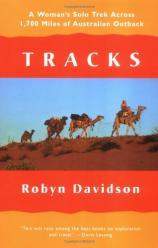
Tracks
by Robyn Davidson
List Price: $12.00
Pages: 272
Format: Paperback
ISBN: 0679762876
Publisher: Vintage
The questions, discussion topics, and author biography that follow are
intended to enhance your group's reading of Robyn Davidson's Tracks.
We hope they will provide you with several new avenues for discussion
about this exhilarating and provocative story of travel, adventure, and
self-discovery.
Robyn Davidson, a young woman
who had "never changed a light-bulb, sewn a dress, mended a sock, changed
a tyre, or used a screwdriver" [p. 93], took a train to Alice Springs
in central Australia with six dollars in her pocket and a wildly unrealistic
ambition: to capture wild camels, train them, and then cross the great
desert of Western Australia with them. Her journey is an exploit in the
extravagant tradition of the great Victorian explorers, but Robyn Davidson
is not only an explorer, but also a young woman who wishes to get past
the negativity and alienation of modern, urban existence and seek fulfillment
in close harmony with the natural world. Testing her physical and emotional
resources to the limit, Davidson crosses half of Australia on foot, in
the process coming to know the desert, the rhythms of traditional Aboriginal
society, and herself. Robyn Davidson seeks transformation, epiphany, and
freedom, and eventually she finds these things. Her story turns out to
be not of a hand-to-hand battle with the forces of nature but of a passionate
love affair with them.
top of the page

1. Davidson begins her book
with a quotation from Doris Lessing's The Golden Notebook. Why
do you think she has chosen this particular passage? What burdens does
Davidson herself shed during the course of her journey? Does she shed
them permanently?
2. "They say paranoia attracts
paranoia: certainly no one else I met ever had such a negative view
of Alice Springs" [p.23]. To what extent do you think that Davidson
colors Alice, its white and black inhabitants, its architecture, and
its social mores with her own pre-judices and preoccupations? What is
it in Robyn Davidson's character that forms her opinion of the city?
3. Davidson is passionately
determined to shed her own sense of herself as traditionally "feminine,"
a quality she sees as arising from "the weakness of animals who have
always been prey" [p.30] and from being trained from birth to be "sweet,
pliable, forgiving, compassionate and door-mattish" [p.48]. Does Davidson's
anger at the way women in her culture are conditioned abate at all during
the course of the narrative? Does she at any point confront her own
ambivalence about the idea of "femininity"? Do you feel that the Australian
tradition of misogyny, as Davidson describes it, is common in American
society?
4. At one point Davidson defines
the substance of her inner world as "desert, purity, fire, air, hot
wind, space, sun, desert desert desert" [p.50]. Why has the desert been
so powerfully attractive to many people, including Davidson? (See the
list of suggested reading below.) What is Davidson's own fantasy about
what she will find in the desert? Does that fantasy come true, or does
the desert offer her different, unexpected gifts?
5. One of the lessons Davidson
learns on her journey is that solitude is a condition to be prized rather
than feared. At what point in her journey did she come to this realization?
What brought it about? Is the value of solitude a universal truth, or
valid only for certain individuals? Does our contemporary Western life-style
engender a fear of solitude? Is such a fear unhealthy or natural?
6. During her trip Davidson
harbors some hostility toward National Geographic, feeling that
her association with the magazine has robbed her trip of the purity
and self-reliance she had originally conceived for it. Do you feel that
her attitude is justified? Do you think that, in the end, she regretted
her decision to accept the financial support of the magazine? Do you
believe that her project was in any way compromised by this association?
7. Aboriginal ideas of nature,
ownership, time, ritual, ceremony, and wisdom differ enormously from
white ones. Why is the subconscious mind so very important in the Aboriginal
way of life? What brings about Davidson's own increasing reliance on
her subconscious? Does the Aborigines' world view mean that they can
never succeed within a Western-style economic and educational system?
Does Davidson imply that the Aborigines' position within the white continent
is finally a hopeless one?
8. What does the word "primitive"
usually imply? Is that word applicable in any way to Aboriginal society?
Is it a word that tends to be subjective, or does it have certain fixed
meanings? And what about the word "superstition"?
9. Sometimes Davidson's friends
accuse her of "anthropomorphism" in dealing with her camels and her
dog. Does this seem a relevant or accurate response to Davidson's way
of thinking? To Aborigines, as to Native Americans, our culture's stricture
against anthropomorphism would seem absurd. Do you believe that the
Western notion of man as being intrinsically different and independent
from the rest of the natural world is valid or invalid?
10. For reasons of her own,
Davidson dislikes photography and photographers. These feelings prejudice
her against Rick from their first meeting: she sees him as the typical
photographer, hiding behind his lens and creating images that are projections
of his own imagination rather than records of reality. Does Davidson
come to change her thinking as she gets to know Rick? How does Rick
himself change? How might Rick's version of this story differ from Davidson's?
11. "Why was everyone so goddamn
affected by this trip, adversely or otherwise? Had I stayed back home...I
would not have been up for all these astounding projections" [p.101].
Why are Davidson's exploits vicariously exciting to some people, threatening
to others? If her journey does indeed "hit some soft spot in this era's
passionless, heartless, aching psyche" [p.237], how can this be explained?
12. Back home in Brisbane, Davidson
writes, I "had been sick of carrying around the self-indulgent negativity
which was so much the malaise of my generation, my sex and my class"
[p.50]. Do you find that the kind of generational negativity she describes
(though she is describing a period almost twenty years ago) manifests
itself in our contemporary American culture--in our attitudes to political
action, to our environment, to our friends and family?
13. One of the goals of Davidson's
personal quest is "freedom." To be free, she writes, "is to learn, to
test yourself constantly, to gamble. It is not safe" [p.222]. Do you
agree with this judgment? How would you yourself define freedom? How
might one achieve real freedom in one's own life without taking steps
as drastic Davidson's? Or is the taking of drastic steps a necessary
part of the process?
14. Davidson gives numerous
examples of the laws, both written and unwritten, that exclude Aboriginal
people from the mainstream of Australian life and ensure their permanent
poverty and marginalization. How do racial attitudes in Australia resemble,
or differ from, those in the United States? Is the social and economic
plight of the Aborigines comparable to that of Native Americans? Davidson
herself compares Australian government policy with that of the earlier
apartheid governments of South Africa. What are the stated purposes
of such policies in all three countries? What do you believe to be the
actual, unstated purposes?
Courtesy of Random House, Inc.
top of the page