Reading Group Guide
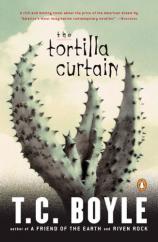
The Tortilla Curtain
by T. Coraghessan Boyle

List Price: $12.95
Pages: 355
Format: Paperback
ISBN: 9780140238280
Publisher: Penguin USA

Click here to buy this book from Amazon.com.
Click here to buy this book from Amazon.ca.


About This Book


In this explosive and timely novel, T. Coraghessan Boyle explores an issue that is at the forefront of the political arena. He confronts the controversy over illegal immigration head-on, illuminating through a poignant, gripping story the people on both sides of the issue, the haves and the have-nots.

In Southern California's Topanga Canyon, two couples live in close proximity and yet are worlds apart. High atop a hill overlooking the canyon, nature writer Delaney Mossbacher and his wife, real estate agent Kyra Menaker-Mossbacher, reside in an exclusive, secluded housing development with their son, Jordan. The Mossbachers are agnostic liberals with a passion for recycling and fitness. Camped out in a ravine at the bottom of the canyon are C·ndido and AmÈrica RincÛn, a Mexican couple who have crossed the border illegally. On the edge of starvation, they search desperately for work in the hope of moving into an apartment before their baby is born. They cling to their vision of the American dream, which, no matter how hard they try to achieve it, manages to elude their grasp at every turn.

A chance, violent encounter brings together Delaney and C·ndido, instigating a chain of events that eventually culminates in a harrowing confrontation. The novel shifts back and forth between the two couples, giving voice to each of the four main characters as their lives become inextricably intertwined and their worlds collide. The RincÛns' search for the American dream, and the Mossbachers' attempts to protect it, comprise the heart of the story. In scenes that are alternately comic, frightening, and satirical, but always all "too real," Boyle confronts not only immigration but social consciousness, environmental awareness, crime, and unemployment in a tale that raises the curtain on the dark side of the American dream.


The United States and Immigration

The debate over immigration continues to escalate across the nation, particularly in California, and this sampling of quotations and statistics from various newspapers
History suggests that those who truly yearn to come to America and stay will find a way to do it. (Newsweek, August 9, 1993)

In November 1994, California passed by a 59% to 41% vote Proposition 187, a bill that denies certain social privileges, mainly welfare, public schooling, and non-emergency medical care, to illegal immigrants. (The New York Times, November 11, 1994)

California hosts about 40% of the nation's estimated 3.4 million illegal immigrants. (Time, November 21, 1994)

"All Americans...are rightly disturbed by the large numbers of illegal aliens entering our country.... We are a nation of immigrants, but we are also a nation of laws. It is wrong and ultimately self-defeating for a nation of immigrants to permit the kind of abuse of our immigration laws we have seen in recent years, and we must do more to stop it." (President Clinton, "We Heard America Shouting," Address to Joint Session of Congress, January 25, 1995)

"Our immigration policy is a measure of who we are as a people. I believe we are a people who draw strength from our diversity and meet our challenges head on. I believe we want and deserve immigration laws that favor those who play by the rules." (Bill Bradley, former U.S. Senator, New Jersey, The New Jersey Record, June 8, 1995)

About 800,000 people follow the rules and enter the United States legally as immigrants each year. An additional 200,000 to 300,000 come to the country illegally. (San Francisco Chronicle, December 5, 1995)

Half of illegal immigrants do not cross the borders unlawfully--they enter legally and overstay their visas. (San Francisco Chronicle, March 18, 1996)

top of the page


rgg_discuss.gif (1294 bytes)


1. At the beginning of the story, Delaney accidentally hits C·ndido with his car. "For a long moment, they stood there, examining each other, unwitting perpetrator and unwitting victim." How does this encounter set the tone for the events that follow? Does it come full circle in the final scene?

2. The novel is forged on the cultural, social, and financial differences between the Mossbachers and the RincÛns. It alternates between the two couples' points of view, allowing the reader to enter the lives of both families. How does this technique propel the story? Do you feel that you got to know each of the couples equally well? Was the author fair in his portrayal of each of the couples? Is he too harsh in his portrayal of the Mossbachers, as one reviewer suggested?

3. C·ndido and AmÈrica crossed the border in search of a better life for themselves and their unborn child. They do not ask for much and are willing to work hard, yet they are constantly met with resistance and failure. There are numerous references to C·ndido's bad luck. Is he unlucky? Is there anything he could have done to have changed his luck? What does this story say about the American dream?

4. The symbol of the coyote appears throughout the novel and represents illegal Mexican immigrants. In his nature column, Delaney writes, "The coyote is not to blame--he is only trying to survive, to make a living, to take advantage of the opportunities available to him." He concludes the same column by writing, "The coyotes keep coming, breeding up to fill in the gaps, moving in where the living is easy. They are cunning, versatile, hungry and unstoppable." How do these passages reflect Delaney's mixed feelings about illegal immigrants? Is he a hypocrite? As the novel progresses, Delaney's humanistic beliefs give way to racism and resentment, and he directs his rage at all illegal immigrants onto C·ndido. When confronted with evidence that C·ndido is not the vandal at Arroyo Blanco, he destroys it. Why does Delaney need to believe that the vandal is C·ndido? How does Delaney evolve from being a "liberal humanist" to a racist?

5. Boundaries--both real and imagined--play a large role in the novel, especially the front gate at Arroyo Blanco Estates. In what other instances do boundaries appear and what do they represent? What roles do the different characters play in constructing these boundaries?

6. In a recent interview Boyle stated, "If it's satire, it has to bite somebody, has to have teeth in it, otherwise it's useless." How does satire affect The Tortilla Curtain and the telling of the story? Is it a successful technique?

7. The novel concludes with Delaney confronting C·ndido with a gun, followed by a mud slide. In an almost simultaneous moment, C·ndido realizes his baby is missing and reaches down to offer Delaney a hand. One is a frightening image and the other an act of generosity. How do these contrasting images play off one another? Did the conclusion leave you with a feeling of hope or despair?

8. During an argument with Jack Jardine, Delaney makes the following statement: "Do you realize what you're saying? Immigrants are the lifeblood of this country--and neither of us would be standing here today if it wasn't." In another instance, Jack says to Delaney, "What do you expect, when all you bleeding hearts want to invite the whole world in here to feed at our trough without a thought as to who's going to pay for it, as if the American taxpayer was like Jesus Christ with his loaves and fishes." How do these two sentiments play out in the novel and in the larger issue of immigration?

9. The author stated in the Conversation section of this guide that he feels it is a novelist's job to inhabit people of other races and sexes, for his own understanding of an issue as well as for the reader's. Did The Tortilla Curtain help you to better understand the issue of immigration and the people involved?

10. The author does not offer a solution to the problem of illegal immigration, for which he was praised by several reviewers. Do you think he should have offered a solution?

top of the page

Critical Praise

"Succeeds in stealing the front page news and bringing it home to the great American tradition of the social novel."
The Boston Globe


"A compelling story of myopic misunderstanding and mutual tragedy."
Chicago Tribune


"Boyle is still America's most imaginative contemporary novelist."
Newsweek


"The Tortilla Curtain qualifies as that rarest of artistic achievements--a truly necessary book."
The San Diego Union-Tribune

 
Back to top.   


Privacy Policy | Contact Us | Advertising | About Us

© Copyright 2001-2008, ReadingGroupGuides.com. All rights reserved.