IndieBound Independent Bookstores BRC Facebook Fan Page
Coming Soon
Reading Group Guide
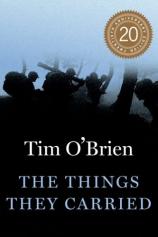
The Things They Carried
by Tim O'Brien

List Price: $13.00
Pages: 246
Format: Paperback
ISBN: 0767902890
Publisher: Broadway

Click here to buy this book from Amazon.com.
Click here to buy this book from Amazon.ca.


About This Book


They carried malaria tablets, love letters, 28-pound mine detectors, dope, illustrated Bibles, each other. And, if they made it home alive, they carried unrelenting images of a nightmarish war that history is only beginning to absorb. Since it was first published, The Things They Carried has become an unparalleled Vietnam testament, a classic work of American literature and a profound study of men at war that illuminates the capacity, and the limits, of the human heart and soul.

top of the page


rgg_discuss.gif (1294 bytes)


The questions that follow are intended to enhance your reading group's discussion of this multi-faceted book, and we hope that they will also help you discover additional lines of inquiry about the equally healing and heartbreaking chapters in The Things They Carried.

1. Why is the first story, "The Things They Carried," written in third person? How does this serve to introduce the rest of the novel? What effect did it have on your experience of the novel when O'Brien switched to first person, and you realized the narrator was one of the soldiers?

2. In the list of all the things the soldiers carried, what item was most surprising? Which item did you find most evocative of the war? Which items stay with you?

3. In "On The Rainy River," we learn the 21-year-old O'Brien's theory of courage: "Courage, I seemed to think, comes to us in finite quantities, like an inheritance, and by being frugal and stashing it away and letting it earn interest, we steadily increase our moral capital in preparation for that day when the account must be drawn down. It was a comforting theory." What might the 43-year-old O'Brien's theory of courage be? Were you surprised when he described his entry into the Vietnam War as an act of cowardice? Do you agree that a person could enter a war as an act of cowardice?

4. What is the role of shame in the lives of these soldiers? Does it drive them to acts of heroism, or stupidity? Or both? What is the relationship between shame and courage, according to O'Brien?

5. Often, in the course of his stories, O'Brien tells us beforehand whether or not the story will have a happy or tragic ending. Why might he do so? How does it affect your attitude towards the narrator?

6. According to O'Brien, how do you tell a true war story? What does he mean when he says that true war stories are never about war? What does he mean when he writes of one story, "That's a true story that never happened"?

7. In "Sweetheart of the Song Tra Bong," what transforms Mary Anne into a predatory killer? Does it matter that Mary Anne is a woman? How so? What does the story tell us about the nature of the Vietnam War?

8. The story Rat tells in "Sweetheart of the Song Tra Bong" is highly fantastical. Does its lack of believability make it any less compelling? Do you believe it? Does it fit O'Brien's criteria for a true war story?

9. Aside from "The Things They Carried," "Speaking of Courage" is the only other story written in third person. Why are these stories set apart in this manner? What does the author achieve by doing so?

10. What is the effect of "Notes," in which O'Brien explains the story behind "Speaking Of Courage"? Does your appreciation of the story change when you learn which parts are "true" and which are the author's invention?

11. In "In The Field," O'Brien writes, "When a man died, there had to be blame." What does this mandate do to the men of O'Brien's company? Are they justified in thinking themselves at fault? How do they cope with their own feelings of culpability?

12. In "Good Form," O'Brien casts doubt on the veracity of the entire novel. Why does he do so? Does it make you more or less interested in the novel? Does it increase or decrease your understanding? What is the difference between "happening-truth" and "story-truth?"

13. On the copyright page of the novel appears the following: "This is a work of fiction. Except for a few details regarding the author's own life, all the incidents, names, and characters are imaginary." How does this statement affect your reading of the novel?

14. Does your opinion of O'Brien change throughout the course of the novel? How so? How do you feel about his actions in "The Ghost Soldiers"?

15. "The Ghost Soldiers" is one of the only stories of The Things They Carried in which we don't know the ending in advance. Why might O'Brien want this story to be particularly suspenseful?

top of the page

Critical Praise


On Sunday, Showtime will present "A Soldier's Sweetheart" an adaptation of a story entitled "Sweetheart of The Song Tra Bong" from Tim O'Brien's acclaimed book, THE THINGS THEY CARRIED.

THE THINGS THEY CARRIED is Tim O'Brien's beautiful, anguished collection of linked stories about Vietnam.  In it, he blends diverse voices and events into an unforgettable portrayal of war and the people who fight it.  Mingling fact with fiction, telling and retelling events from different points of view, the book is as much about war as it is about the difference between truth and reality.

"In many cases a true war story cannot be believed," he writes.  "If you believe it, be skeptical.  It's a question of credibility.  Often the crazy stuff is true and the normal stuff isn't, because the normal stuff is necessary to make you believe the truly incredibly craziness."

What then to make of a story titled "Sweetheart of the Song Tra Bong?"  In the story, a young soldier named Mark Fossie is assigned to a medical detachment near a river called the Song Tra Bong.  Also occupying the camp are a group of six Green Berets with whom the rest of the camp has little contact.

Lonely and tired of the war, Mark concocts a plot to bring his girlfriend, Mary Anne to their camp.  His friends think he's kidding, but one day she arrives.  And she stays.  At first she and Mark are inseparable, but gradually she becomes entranced with the country and fascinated by the war.  She begins going out on patrol with the Green Berets, and one day she disappears into the mountains and is never seen again.

Fact?  Fiction?  Both?  O'Brien convinces us it could have happened, but almost in the same breath he hints that it is pure fable.  It is one of the most fascinating stories in the book, all the more so because it is impossible to know the truth.

Read the book, watch the movie, or, better yet, do both and decide for yourself if it happened, could have happened, or is just one of those crazy war stories that could never have happened.

--- Reviewed by Judith Handschuh (JHSCRIBA)
Courtesy of Random House, Inc.
XXXX


Privacy Policy | Contact Us | Advertising | About Us

© Copyright 2001-2010, ReadingGroupGuides.com. All rights reserved.
The Book Report, Inc. • 250 West 57th Street • Suite 1228 • New York, NY • 10107
Ph: 212-246-3100 • Fax: 212-246-4640

Bookreporter.comReadingGroupGuides.comGraphicNovelReporter.comFaithfulReader.com
Teenreads.comKidsreads.comAuthorsOnTheWeb.comAuthorYellowPages.com