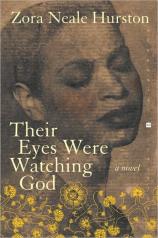
Their Eyes Were Watching God
by Zora Neale Hurston
List Price: $13.00
Pages: 240
Format: Paperback
ISBN: 0060931418
Publisher: HarperCollins
Under "a blossoming pear tree" in West
Florida, sixteen-year-old Janie Mae Crawford dreams of a world that will answer
all her questions and waits "for the world to be made." But her
grandmother, who has raised her from birth, arranges Janie's marriage to an
older local farmer. So begins Janie's journey toward herself and toward the
farthest horizon open to her. Zora Neale Hurston's classic 1937 novel follows
Janie from her Nanny's plantation shack, to Logan Killicks's farm, to all-black
Eatonville, to the Everglades, and back to Eatonville--where she gathers in
"the great fish-net" of her life. Janie's joyless marriage to Killicks
lasts until Joe Starks passes by, on his way to becoming "a big
voice." Joe becomes mayor of Eatonville and is just as determined as
Killicks was to keep Janie in her proper place. Through twenty years with Joe,
she continues to cope, hope, and dream; and after Joe's death, she is once again
"ready for her great journey," a journey she now undertakes with one
Vergible Woods, a.k.a. Tea Cake. Younger than Janie, Tea Cake nevertheless
engages both her heart and her spirit. With him Janie can finally enjoy life
without being one man's mule or another's bauble. Their eventful life together
"on de muck" of the Everglades eventually brings Janie to another of
her life's turning points; and after burying Tea Cake, she returns to a
gossip-filled Eatonville, where she tells her story to her best friend, Pheoby
Watson, and releases Pheoby to tell that story to the others. Janie has
"done been tuh de horizon and back." She has learned what love is; she
has experienced life's joys and sorrows; and she has come home to herself in
peace.
top of the page

1. What kind of God are the eyes of Hurston's characters watching?
What is the nature of that God and of their watching? Do any of them question
God?
2. What is
the importance of the concept of horizon? How do Janie and each of her
men widen her horizons? What is the significance of the novel's final
sentences in this regard?
3. How does
Janie's journey--from West Florida, to Eatonville, to the Everglades--represent
her, and the novel's increasing immersion in black culture and traditions?
What elements of individual action and communal life characterize that
immersion?
4. To what
extent does Janie acquire her own voice and the ability to shape her own
life? How are the two related? Does Janie's telling her story to Pheoby
in flashback undermine her ability to tell her story directly in her own
voice?
5. What are
the differences between the language of the men and that of Janie and
the other women? How do the differences in language reflect the two groups'
approaches to life, power, relationships, and self-realization? How do
the novel's first two paragraphs point to these differences?
6. In what
ways does Janie conform to or diverge from the assumptions that underlie
the men's attitudes toward women? How would you explain Hurston's depiction
of violence toward women? Does the novel substantiate Janie's statement
that "Sometimes God gits familiar wid us womenfolks too and talks
His inside business"?
7. What is
the importance in the novel of the "signifyin'" and "playin'
de dozens" on the front porch of Joe's store and elsewhere? What
purpose do these stories, traded insults, exaggerations, and boasts have
in the lives of these people? How does Janie counter them with her conjuring?
8. Why is adherence
to received tradition so important to nearly all the people in Janie's
world? How does the community deal with those who are "different"?
9. After Joe
Starks's funeral, Janie realizes that "She had been getting ready
for her great journey to the horizons in search of people; it was important
to all the world that she should find them and they find her." Why
is this important "to all the world"? In what ways does Janie's
self-awareness depend on her increased awareness of others?
10. How important
is Hurston's use of vernacular dialect to our understanding of Janie and
the other characters and their way of life? What do speech patterns reveal
about the quality of these lives and the nature of these communities?
In what ways are "their tongues cocked and loaded, the only real
weapon" of these people?
top of the page