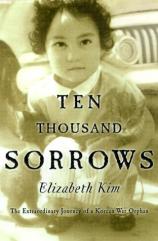
Ten Thousand Sorrows: The Extraordinary Journey of a Korean War Orphan


About the Book
Ten Thousand Sorrows: The Extraordinary Journey of a Korean War Orphan



Nothing has a stronger influence psychologically on their environment, and especially on their children, than the unlived life of the parents.
--Carl Jung, from Paracelsus
Elizabeth Kim knows little of the Korean village where she was born, or the "official" facts of her birth such as its day, month, or year. She knows even less of her father, an American soldier in Korea who deserted her mother, her Omma. But in the four or five or six years that Kim lived in her mother's warm embrace and sheltering shadow, she came to know much about the woman whose love and sorrow, strength and resilience, rebellion and pride, and brutal murder loom large in her life.
A veil of sorrow, slowly parted, is a thing of beauty, an act of faith. And in her memoir, Ten Thousand Sorrows: The Extraordinary Journey of a Korean War Orphan, author Elizabeth Kim shows us how she lifted that veil, and learned to see clearly the sorrows and joys that are the stepping-stones of her life.
Nobody, who has not been in the interior of a family, can say what the difficulties of any individual of that family may be.
--Jane Austen, from Emma
As if witnessing her grandfather and uncle murdering her mother were not trauma enough, Kim is then abandoned at a Korean orphanage where she is a virtual prisoner with little physical or emotional comfort. Months later, Kim's adoption by an American couple puts an end to the physical deprivation and begins a different kind of hardship. Her Fundamentalist adoptive parents may mean well, but they are ill-equipped to give her more than food and shelter, and it is difficult to read their actions as anything but cruel. Kim continues her life having endured more direct trauma by age seventeen than most people have witnessed by age seventy.
It is seldom indeed that one parts on good terms, because if one were on good terms, one would not part.
--Marcel Proust, from Remembrance of Things Past
Kim's tale continues with her arranged marriage to a Fundamentalist deacon who beats, humiliates, and hates her. She returns that last favor. She also has the strength (and as she admits, weakness) to become pregnant by purposely not practicing birth control, something her husband had insisted upon. Ultimately it is her daughter, Leigh, who gives Kim the strength to leave her brutal husband. Like her Omma, Kim is devoted to protecting and nurturing her daughter. Unlike her, Kim is able to take her daughter and flee.
A young child knows Mother as a smelled skin, a halo of light, a strength in the arms, a voice that trembles with feeling.
--Annie Dillard, from An American Childhood
At this point, we see Kim gathering her meager resources and shouldering on to give Leigh what her Omma gave her: a childhood with little money but with her a loving presence. And Kim works hard to make a better life for them both along the way. She takes college classes, and finds reporting jobs, first at small newspapers, and then at bigger ones. She scrapes and scraps and struggles, always with her daughter in mind, and always with an eye out for others who, like her, have been brutalized and ill-used by those who are more powerful. She gives everything she can to her daughter, including the truth.
My religion is loving-kindness.
--Dalai Lama
Once Leigh is in her early teens, Kim begins the journey to her own emotional and spiritual health and healing, which she had, for the most part, disregarded while concentrating on survival. During these years, Kim fights valiantly to reclaim her mother, her dreams, and the child that she was--the child that everyone, even Kim herself, had pushed away. Kim's epiphany of practicing loving-kindness toward herself did not take place in a year or a month or a week or a moment. Instead it was earned and learned over a lifetime of sorrows that she now recognizes travel alongside great joys.


Ten Thousand Sorrows: The Extraordinary Journey of a Korean War Orphan
- Publication Date: September 14, 2012
- Hardcover: 240 pages
- Publisher: Doubleday
- ISBN-10: 0385496338
- ISBN-13: 9780385496339