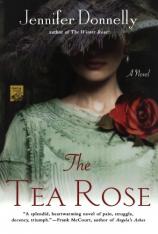
The Tea Rose
A Novel
by Jennifer Donnelly
List Price: $14.95
Pages: 416
Format: Paperback
ISBN: 9780312378028
Publisher: St. Martin's Griffin
East London, 1888 --- a city apart. A place of shadow and light where thieves, whores, and dreamers mingle, where children play in the cobbled streets by day and a killer stalks at night, where bright hopes meet the darkest truths. Here, by the whispering waters of the Thames, a bright and defiant young woman dares to dream of a life beyond tumbledown wharves, gaslit alleys, and the grim and crumbling dwellings of the poor. Fiona Finnegan, a worker in a tea factory, hopes to own a shop one day, together with her lifelong love, Joe Bristow, a costermonger's son. With nothing but their faith in each other to spur them on, Fiona and Joe struggle, save, and sacrifice to achieve their dreams.
But Fiona's dreams are shattered when the actions of a dark and brutal man take from her nearly everything --- and everyone --- she holds dear. Fearing her own death at the dark man's hands, she is forced to flee London for New York. There, her indomitable spirit --- and the ghosts of her past --- propel her rise from a modest west side shopfront to the top of Manhattan's tea trade. Fiona's old ghosts do not rest quietly, however, and to silence them, she must venture back to the London of her childhood, where a deadly confrontation with her past becomes the key to her future.
The Tea Rose is a towering old-fashioned story, imbued with a modern sensibility, of a family's destruction, of murder and revenge, of love lost and won again, and of one determined woman's quest to survive and triumph. Authentic and moving, The Tea Rose is an unforgettable novel --- one certain to take its place beside such enduring epics as A Woman of Substance, The Thornbirds, and The Shell Seekers.
top of the page

1. In a novel, can a city be more than a setting? Can it influence a character? Or be a character itself? In what way does London shape Fiona?
2. Early in The Tea Rose, Paddy tells Fiona that he doesn’t believe in God, he believes that three pounds of meat make a very good stew. Fiona, too, loses her faith in the aftermath of the losses she suffers. Is it more important to have faith in God, or in yourself? Are the two mutually exclusive?
3. Fiona is a person driven by the past. Is that a good or bad thing? Or both?
4. Is there such a thing as true love? A soul mate? What would have happened to Fiona and Joe if they had never been reunited? What sort of person would Fiona have become if she had married Will?
5. Kate’s friend Lily defends the way Jack’s prostitute victims make their living by saying that “Morality is for them who can afford it.” Do you agree? Is a person’s moral code something that’s written in stone, or does it vary with her circumstances? Would your code of conduct change if you were poor and hungry?
6. Nick encounters brutality from his father because of his homosexuality. He feels he cannot be open about his identity in New York and eventually gets into a great deal of trouble for visiting a gay bar. How have attitudes toward gay people changed over the last century? Do you think a marriage between a gay man and straight woman is realistic? Could it work?
7. When Fiona returns to Whitechapel, she realizes that even with all the success and wealth she’s achieved as an adult, she has never been happier than when she lived on Montague Street. Once you leave the place where you grew up, is it possible to go home again?
8. Both Fiona and Joe are fighters. What makes one person accept her circumstances and another fight to better them? Ambition? Damage? Loss? Fear? If Fiona and Joe had married as teenagers, would each have achieved all that they did?
9. Though The Tea Rose is set in the past, Fiona has a very modern sensibility and faces many problems that 21st century women face. Do you think that women today are different from their late 19th century counterparts? In what ways? In what ways are they the same?
top of the page

"It's so much fun ...this is London in the 1880s, the London of Charles Dickens and Edward Rutherfurd, a teeming, messy place full of business, dirt and poverty. Once in New York, we trip from the tenements of the Lower East Side to elegant dining at Delmonico's, with hardly a paragraph to catch our breath... the atmosphere of both starring cities is created in satisfying detail. One can walk the streets and listen to the people chat in the company of Jennifer Donnelly, who has done her historical homework... she delivers."
Washington Post
"When you start reading Jennifer Donnelly's The Tea Rose give yourself plenty of time because this is a most seductive novel. You will travel from the rough, often savage, back streets of London to the glossy sophistication of New York's Fifth Avenue. You'll be charmed by the novel's heroine, Fiona Finnegan --- her intelligence, her courage, her great heart. Despite her suffering --- a lost love, a tragic family-there are moments you will want to cheer. It's the kind of novel where the writing is so fluid you feel the author simply loves telling her story. This is a splendid heartwarming novel of pain, struggle, decency, triumph --- and just what we need in these times."
Frank McCourt
"I loved this vividly atmospheric and wonderfully rambunctious yarn --- brilliantly told, great fun to read."
Simon Winchester, author of The Professor and the Madman
"The novel's lively plotting, big cast of warmly drawn characters and long-deferred romantic denouement make this a ripping yarn."
Publishers Weekly