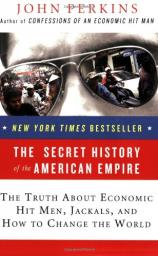
The Secret History of the American Empire
by John Perkins
List Price: $15.00
Pages: 384
Format: Paperback
ISBN: 9780452289574
Publisher: Plume
A riveting exposé of international corruption --- and what we can do about it, from the author of Confessions of an Economic Hit Man, which spent over a year on the New York Times bestseller list.
In his stunning memoir, Confessions of an Economic Hit Man, John Perkins detailed his former role as an “economic hit man” in the international corporate skullduggery of a de facto American Empire. This riveting, behind-the-scenes exposé unfolded like a cinematic blockbuster told through the eyes of a man who once helped shape that empire. Now, in The Secret History of the American Empire, Perkins zeroes in on hot spots around the world and, drawing on interviews with other hit men, jackals, reporters, and activists, examines the current geopolitical crisis. Instability is the norm: It’s clear that the world we’ve created is dangerous and no longer sustainable. How did we get here? Who’s responsible? What good have we done and at what cost? And what can we do to change things for the next generations? Addressing these questions and more, Perkins reveals the secret history behind the events that have created the American Empire, including:
• The current Latin-American revolution and its lessons for democracy
• How the “defeats” in Vietnam and Iraq benefited big business
• The role of Israel as “Fortress America” in the Middle East
• Tragic repercussions of the IMF’s “Asian Economic Collapse”
• U.S. blunders in Tibet, Congo, Lebanon, and Venezuela
• Jackal (CIA operatives) forays to assassinate democratic presidents
From the U.S. military in Iraq to infrastructure development in Indonesia, from Peace Corps volunteers in Africa to jackals in Venezuela, Perkins exposes a conspiracy of corruption that has fueled instability and anti-Americanism around the globe. Alarming yet hopeful, this book provides a compassionate plan to reimagine our world.
top of the page

1. Do you agree with Perkins’ statement that the corporatocracy is in fact an empire? If so, why? If not, why not?
2. Perkins’ characterization of Hugo Chavez, president of Venezuela, is markedly different from the way he has been depicted in the mainstream media. How do you account for these differences? Which, if either, characterization do you find more plausible? Why?
3. The United States’ war in Iraq is now in its fifth year. Perkins considers this war more dangerous to U.S. interests abroad than was the Vietnam war --- he describes the Iraq war as a “clash of ideologies” rather than simply a regional conflict. What is your position on the Iraq war? Which, if any, of Perkins’ opinions on the subject do you find valid? Why?
4. Perkins contends that the Central Intelligence Agency and the National Security Agency, which report to the executive branch of the United States government, authorized and in some cases carried out a number of assassinations of democratically elected leaders in Latin America and Africa who had refused to allow the corporatocracy to continue to do business as usual. Do you believe that any of these allegations are true? If so, why? If not, why not?
5. Perkins says that foreign governments that decline to be intimidated by the corporatocracy are routinely labeled “communist” by the U.S. government. What purpose would using the word “communist” serve in this context?
6. He also contends that most such governments, particularly those in Latin America, are trying to ensure that their national resources are used to benefit their own citizens rather than foreign countries and businesses. Would you describe such actions as “communistic”? Regardless of how they are labeled, do you believe that the resources of foreign countries should be fair game for acquisition by those with the most money and/or political clout?
7. Perkins says that the increased number of democratically elected leaders in Latin America who are systematically opposing the corporatocracy is proof that nations need not bow to foreign exploitation. What is your view on the subject?
8. Perkins charges that international corporations such as Nike are responsible for making the lives of sweatshop workers miserable. He cites the work of documentary filmmakers who have lived in the same conditions as Indonesian workers as proof. Do you think such information is valid? If so, how will it affect you personally?
9. Which of the incidents that Perkins describes in his book do you find the most disturbing? Why?
10. Several places in the book, Perkins states that male domination of the corporatocracy leads to its indiscriminate raping and pillaging of Third World cultures and the environment. On page 69, he describes the attitudes of the Shuar people of the Amazon, who believe that men are responsible for hunting, gathering firewood, and protecting their people from threatening tribes, and women are responsible for raising children, growing crops, looking after the home, and telling the men when they need to stop what they are doing. Do you think that giving women more say in running corporations, governments, and the media would improve the quality of life for the planet’s inhabitants? Why or why not?
11. Perkins ends his book with a list of actions individuals can take to thwart the corporatocracy and bring about a more just and peaceful world. Interestingly, most of the items on his list are also recommended by organizations that strive to protect the environment and produce sustainable energy and agricultural resources. Why do you suppose this is so? What, if any, of the actions Perkins lists are you prepared to undertake yourself? Why?
top of the page