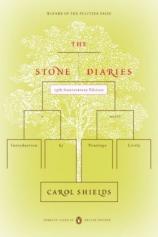
The Stone Diaries
by Carol Shields
List Price: $12.95
Pages: 361
Format: Paperback
ISBN: 0553378589
Publisher: Penguin USA
"She enlarges on the available
material, extends, shrinks, reshapes what's offered; this mixed potion
is her life. She swirls it one way or the other, depending on - who knows
what it depends on? - the fulcrum of desire, or of necessity. She might
drop in a ripe plum from a library book she's reading or something out
of a soap opera or a dream."
The life in question belongs
to Daisy Goodwill Flett, "a middle-class woman, a woman of moderate
intelligence and medium-sized ego and average good luck." In other
words, a woman so commonplace that her story would seem barely worth remarking,
were it not, perhaps, for her own determination to tell it. And in telling
it, give it shape and meaning - even if she must supply these herself.
This is the problem that Carol
Shields addresses in The Stone Diaries: how do small lives, the
kind most women were once assumed to lead, assume significance and coherence?
How closely do our versions of those lives correspond to objective facts?
Can facts be said to exist at all in the context of something as changeable
and arbitrary as a life? To what extent do "our" stories really
belong to us, considering the tendency that other people - parents, spouses,
children - have to intrude in them, interpret them, claim them?
The Stone Diaries approaches
these problems with seductive prose, a serene wit and an artfulness that
is all the more dazzling given the novel's apparent insistence on the
ordinary. Indeed, one of Shields' conceits has been to disguise her fiction
as a "real" biography, complete with period photographs and
a family tree. But beneath the scrupulous - if spurious - documentation
and bland rural and suburban settings lie incidents as fantastic as the
inventions of Gabriel García Márquez: a hugely fat woman dies in childbirth
without ever realizing that she was pregnant; a dour Orkneyman journeys
back to the island he left decades before, severing ties, jettisoning
possessions, and living on to the age of 115 (with the uncanny ability
to recite Jane Eyre from memory); a young husband falls to his
death ten days after his wedding, possibly as the result of an unexpected
sneeze, and his wife, who did the sneezing, never mentions her marriage
and its grotesque ending to another soul. Strangest of all, the heroine
of this novel passes through her life without ever fully occupying it
- an absence that this beautiful and haunting book attempts to redeem.
top of the page

1.The first chapter of this novel is the only one that is narrated entirely in the first person. Why might the author have chosen to shift narrative voices? At what points in the book does the narrative "I" return? Who do you think is telling Daisy's story?
2. What irony is implicit in the fact that Mercy Goodwill is unaware of her own pregnancy? Compare this near-virgin birth to Daisy's own catastrophically chaste honeymoon. How do this novel's female characters experience sex, pregnancy and childbirth?
3.Although Daisy describes her mother as "extraordinarily obese" and taller than her husband, a photo reveals that Mercy Goodwill is actually shorter than Cuyler and no more than ordinarily husky. Is Daisy lying? Or does she merely have "a little trouble with getting things straight?" Where else are there discrepancies between Daisy's version of her life and the book's "documentation?"
4. From the passionate Cuyler Goodwill to Barker Flett, who is smitten with Daisy while she is still a child, the men in this novel are both erotically enthralled by women and fulfilled by their relationships with them. In contrast, their wives seem bewildered by, indifferent to, or at best serenely tolerant of their husbands' ardor. Does The Stone Diaries subvert traditional sex roles? Where do Daisy and the novel's other female characters derive their greatest pleasure and fulfillment? How badly do Shields's women need men?
5.When Cuyler Goodwill loses his wife he builds her a tower. When his daughter loses her first husband, she never tells the story to another soul. What might account for her reticence? How deeply does Daisy seem to love either of her husbands? On the other hand, how trustworthy are these characters' public displays of emotion?
6. "Life is an endless recruiting of witnesses." This observation in the first chapter seems borne out by the constant stream of secondary characters who intrude into Daisy's life story and at times commandeer it. What role does Daisy - or Carol Shields - assign "witnesses" like the Jewish peddler Abram Gozhdë Skutari, the bicyclist who kills Clarentine Flett, or Cuyler Goodwill's housekeeper? Why might these characters reappear in the narrative years after their initial entrances? How trustworthy are their interpretations of Daisy's life and character?
7. Although Cuyler Goodwill builds a tower in his wife's memory, he is unable to remember her name at the time of his own death. Magnus Flett is able to recite much of Jane Eyre from memory well into his hundreds. And, even as small children, Alice, Warren and Joan Flett "take turns comparing and repeating their separate and shared memories and shivering with pleasure every time a fresh fragment from the past is unearthed." What role does memory play in The Stone Diaries? How much of Daisy's diary is remembered, and how much imagined?
8. In the chapter entitled "Sorrow," a number of characters offer explanations for Daisy's depression. How accurate are any of these? Are we given any reason to trust one interpretation over others? How well do any of Daisy's intimates really know her? How well does the reader know her by the book's close?
9. How does Daisy influence her children or determine the choices they make in their own lives? Does she seem to do so at all? What kinds of lessons does she impart to them? Is Daisy Flett a "good" mother, a "good" wife or daughter? Does The Stone Diaries allow us to make such easy judgments about its protagonist?
top of the page

"A kind of family album made into a work of art "
New York Newsday