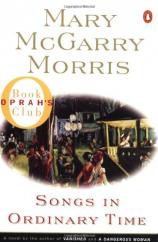
Songs in Ordinary Time


About the Book
Songs in Ordinary Time




In Mary McGarry Morris' intricately constructed novel, many lives intersect and connect, much like the strains of a symphonic ode. But it is the Fermoyle family who lends the story its resonance and presents the reader with a multitude of passions, ironies, tragedies, poor choices, and triumphs from which one can trace every element of the human condition. Marie Fermoyle's life is a daily struggle not only to feed and clothe her children, but to imbue them with the strength and determination she knows they will need to forge their way in the hardscrabble world they inhabit. And though she seems thwarted at every turn – by her alcoholic ex-husband's embarrassing public displays, her shabby eyesore of a house, the explosive temper of her oldest son, or the pathetic passivity of her youngest – Marie never gives up.
Omar Duvall enters the lives of Atkinson's citizens with the impact of a car crashing through a plate glass window. Although he is deceitful, unctuous, and sly, he manages to ingratiate himself into the hearts and homes of the town's lost souls, as well as its more upstanding citizens. From Benjy's fervent belief that Omar, messiah-like, will rescue his mother from her profound unhappiness, to Bernadette Mansaw's pragmatic and untrusting embrace, to Marie's blind yearnings for the attentions of a man who seems truly devoted to her, the citizens of Atkinson find what they are looking for in Duvall's promises of wealth and good fortune. All it takes is a little faith, and a lot of their hard-earned cash.
We find Atkinson on the brink of a new era. It's 1960 – a relatively calm year with only hints of the tumult and disorder – assassination, war, and civil unrest – that are near at hand. The complacent acceptance of authority that dominated the previous decade is coming to an end. The signs of economic imbalance, sexual freedom, and rebellion against the status quo are everywhere: in Father Gannon's un-priest like demeanor, in Renie LaChance's failing appliance store, in the provocative sway of Jessie Klubock's hips, in Carol Stoner's stoic acceptance of her husband's infidelity. These are ordinary people, and certainly Atkinson is a typical American town. But the struggles we witness during this long and eventful summer are as fundamental and epic as those found in the works of Dickens and Steinbeck. And as the citizens of Atkinson contend with their deepest fears and their strongest desires, they offer us an extraordinary portrait of the human condition at its most frail and its most triumphant. Taken individually their songs are bittersweet strains of disappointment and longing; together they form a lyrical masterwork of hope, perseverance and spirit.
Cast of Characters
Arkaday, Kathleen: Housekeeper at St. Mary's Rectory.
Bonifante, Eunice: Runs luncheonette. Widow. Was married to brother of Mrs. Stoner.
Brastus, Lucille: Landlady of the Menka twins. Runs Holy Articles Shoppe downstairs.
Briscoe, Ferdinand: Marie Fermoyle's boss at Briscoe's Sporting Goods.
Burke, Msgr. Thomas: Pastor, St. Mary's parish.
Carper, Anthology: Cousin of Blue Mooney. A & X cook.
Carper, Hildie: Mother of Blue Mooney, Kyle, Peter, and Carl.
Carson, Grondine: Garbage man. Runs pig farm in the Flatts.
Clay, Judge Henry: Attorney for Bridget Fermoyle. Long-ago Atkinson mayor.
Corbett, Luther: Magazine-selling crew.
Coughlin, Jerry: A & X manager.
Doyle, Kenny: Foreman of Norm's work crew.
Duvall, Omar: Itinerant salesman.
Earlie: Earl Lapham Jones. Magazine-selling crew. Grandson of Rev. Pease.
Fermoyle, Alice: Teenage daughter of Marie and Sam Fermoyle.
Fermoyle, Benjamin: Son of Marie and Sam Fermoyle.
Fermoyle, Bridget: Mother of Sam Fermoyle and Helen Fermoyle LaChance.
Fermoyle, Marie: Mother of Alice, Norm, and Benjy. Divorced from Sam.
Fermoyle, Norman: Teenage son of Marie and Sam Fermoyle.
Fermoyle, Sam: Marie's ex-husband. Father of Alice, Norm, and Benjy.
Gannon, Father Joe: New priest at St. Mary's parish.
Gold, Roy: Runs Gold Mine Enterprises: Presto Soap franchiser.
Greene, Jarden: Head of the Department of Public Works. Band concert conductor.
Haddad, Astrid: Works at Briscoe's Sporting Goods. Married to Robert Haddad. Former Las Vegas showgirl.
Haddad, Robert: Insurance man. Married to Astrid.
Hinds, Cleveland: Bank president. Married to Nora Cushing.
Hinds, Nora Cushing: Former fianc bot="HTMLMarkup" endspan -->e of Sam Fermoyle. Cousin of Msgr. Burke.
Jones, Earl Lapham: See Earlie.
Klubock, Harvey: Next door neighbor of Marie Fermoyle.
Klubock, Jessie: Married to Harvey.
Klubock, Louie: Six-year-old son of Jessie and Harvey.
LaChance, Helen: Sister of Sam Fermoyle. Married to Renie.
LaChance, Renie: Brother-in-law of Sam Fermoyle.
Litchfield, Arnold: Psychiatrist at Applegate.
Mansaw, Bernadette: Works at bowling alley. Teenage mother of Blue Mooney's nieces.
Mayo, Claire: Runs boarding house with sister, May.
Mayo, May: Older sister of Claire.
Menka, Howard: Handyman at St. Mary's Rectory.
Menka, Jozia: Housekeeper for Bridget Fermoyle for thirty years. Twin sister of Howard.
Miller, Janice: Sister of Weeb. College student.
Miller, Mr.: Father of Weeb.
Miller, Mrs.: Mother of Weeb. Nurse to Mrs. Stoner.
Miller, Weeb: Norm's best friend.
Mooney, Blue: Ex-Marine. Son of Hildie Carper.
O'Rourke, Bishop: Superior of Msgr. Burke and Father Gannon.
Pease, Rev. Montague: Magazine-selling crew. Grandfather of Earlie.
Seldon, Joey: Blind. Runs popcorn stand in the park. Former Chief of Police.
Stoner, Carol: Wife of Chief Stoner. Mother of Lester.
Stoner, Lester: Boyfriend of Alice Fermoyle. Son of Carol and Chief Stoner.
Stoner, Sonny: Chief of Police. Married to Carol. Father of Lester.
Towler, Ark: Bootlegger. Married to Winnie. Long-ago friend of Joey Seldon.
Towler, Winnie: Married to Ark.
Mary McGarry Morris is married and the mother of five children. She lives in Massachusetts. She is the author of two earlier novels: Vanished, nominated for the National Book Award and the PEN/Faulkner Award, and A Dangerous Woman, which was made into a major motion picture. Both books are available in Penguin paperback editions.


Songs in Ordinary Time
- Publication Date: August 1, 1996
- Paperback: 752 pages
- Publisher: Penguin (Non-Classics)
- ISBN-10: 0140244824
- ISBN-13: 9780140244823