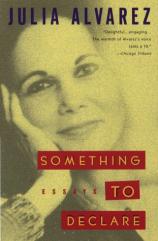
Something to Declare


About the Book
Something to Declare



In this two-part collection of essays, Alvarez chronicles her abiding passions: the drama of family and history, and the art of writing. For Alvarez the two go hand-in-hand. In the first section ("Customs"), Alvarez describes first hearing the strains of the language that would become the lingua franca of her writing in her U.S.-educated diplomat grandfather's perfectly enunciated English. In the essay "My English," she describes how English went from being what her parents spoke to keep secrets from her to her ticket into a new world and a career. Conversely, in the essay, "Family Matters" Alvarez describes how Spanish remains a strong influence on her writing. She writes: "What surprises me is to discover how much of my verbal rhythm, my word choices, my attention to the sound of my prose comes from my native language as spoken by la familia." Alvarez's family is ever present in these essays. Few contemporary authors have written as keenly about the relationships between sisters, and between daughters and fathers and mothers as Alvarez does. Alvarez's doctor father is a lone, proud man among five women; at peace with his family and yet rooted in his culture's code of male privilege and domination. Alvarez's mother tries to keep her four girls from plunging headlong into a culture that mocks the rules of the old world and la familiaóa land of private schools, rebellion, boyfriends, bell-bottoms, marriages, divorces, and careers as farfetched as a that of a writer living in Vermont.
In the second half of Something to Declare ("Declarations"), Alvarez tackles the business of writing itself. She talks openly about the personal sacrifices she has made for writing. She describes how she chooses which story to tell, why some of her projects have been stillborn, and how her career as a well-known writer living in the United States has "played" (and not played) with her extended family in the Dominican Republic. Among the gems in here is a description of Alvarez making a keynote address to the Caribbean Studies Association in Santo Domingo only to receive a tongue lashing from an elderly Dominican writer for writing in English. Alvarez's response is a powerful proclamation of a writer's sense of identity, roots, and the need to live in many worlds at once.
In the essay, First Muse, Alvarez describes her discovery of The Arabian Nights and Scheherazade. Seeing herself reflected in the dark-haired, almond-eyed girl on the book's cover, Alvarez identified with the bright, ambitious girl stuck in a kingdom that didn't think females were very important. It was Scheherazade who gave Alvarez the courage to explore the cross currents of sexual politics in the Caribbean and introduced her to the power storytelling gave her within her culture and family. The title of Something to Declare captures with typical Alvarez wit the dual dramas she describes in the book's pages. While she often feels like a stranger, passing through customs of a strange world, her passport is the writer's voice: ringing out with clarity, commitment and the will to declare the truth as she sees it, wherever it is to be found. People magazine wrote of Something to Declare: "Reading Julia Alvarez's new collection of essays is like curling up with a glass of wine in one hand and the phone in the other, listening to a big-hearted, wisecracking friend share the hard-earned wisdom about family, identity, and the art of writing."


Something to Declare
- Publication Date: September 1, 1999
- Paperback: 320 pages
- Publisher: Plume
- ISBN-10: 0452280672
- ISBN-13: 9780452280670