Reading Group Guide
The Solitaire Mystery
by Jostein Gaarder

List Price: $Pages:
Pages: 368
Format: Paperback
ISBN: 042515999X
Publisher: Berkley Pub Group

Click here to buy this book from Amazon.com.
Click here to buy this book from Amazon.ca.


About This Book


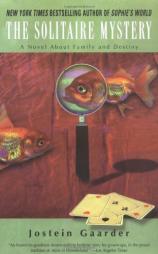
When twelve-year-old Hans Thomas and his father set out by car from Norway to search for Hans Thomas's mother in Greece, he is unaware that his life will be changed forever. The bewildering disappearance of his mother many years earlier to "find herself" is just the first of many mysteries he will encounter.

Punctuated by frequent cigarette stops that allow Hans Thomas's father both to smoke and to philosophize about the universe, the journey also features some unusual occurrences: a midget presents Hans Thomas with a magnifying glass and gives them directions that take them miles out of their way to a village named Dorf; the baker in Dorf gives Hans Thomas a bag of sticky-buns, the largest containing a miniature book that is the memoir of a sailor shipwrecked in 1842; and a strange man reappears inexplicably several times along the way. Hans Thomas begins to read the tiny book with the magnifying glass and discovers an amazing connection between himself and the sailor, who describes finding himself on an island where a deck of cards has come to life. Gradually Hans Thomas unravels the mystery of the cards, and the knowledge he gains of the distant past sheds a surprising light on his own life.

The Solitaire Mystery ----the follow-up to the New York Times bestselling Sophie's World---- ingeniously incorporates fantasy and philosophy, fairy tale and family history. It will leave the reader filled with wonder at our very existence, and dazzled by the Great Solitaire that is the story of humankind.

top of the page


rgg_discuss.gif (1294 bytes)


1. Despite the fact that the novel recounts the progress of several journeys, Hans Thomas begins his story with these words: "My advice to all those who are going to find themselves is: Stay exactly where you are" (p. 9). How has his experience inspired him to make this recommendation? Do you think he will be content as an adult with a life of little adventure? Are you adventurous? Why, or why not?

2. Hans Thomas is afraid that his wife may "drown in a fashion fairy tale" (p. 10). What other characters are in danger of metaphorically "drowning," and what is similar about the way each is saved?

3. Do you agree with Hans Thomas's father that very few people are interested in probing the deep mysteries of life? If yes, why do you think this is so? If no, why do you think he believes this to be true? Do you consider yourself a philosopher/ joker? If yes, what are the difficulties and rewards of living the life of "a fool" --- the one who "sees too deeply and too much" (p. 270)?

4. Reread Hans Thomas's father's lecture on "the ravages of time" (pp. 244-248). How does the concept of the soul counteract the ravages of time, and why do you think so many of the world's religions incorporate this idea in one way or another? What does the Joker have in common with the soul, and does this explain Hans Thomas's father's attraction to the Joker?

5. Why does Hans Thomas consider his moment of maturation to be his realization that his father dreads meeting his mother again? What do you remember to be the incident that finally made you an adult? Do you think the coming-of-age process must always involve sorrow? Why, or why not?

6. How has Ludwig's and Stine's "original sin" affected subsequent generations of the family? Compare their tragic story to that of Oedipus (pp 203-207). What is meant by the King of Spades's pronouncement: "The one who sees through destiny must also live through it" (p. 256)? Do you think it is possible to escape one's destiny?

7. Discuss the significance of the Rainbow Soda throughout the novel. How can something so seductively delicious have such drastic side effects? Could Hans Thomas and the other major characters have made their discoveries without it? How can "getting drunk on sensory experience" (p. 325) contribute to an individual's taking life for granted?

8. Did you find reading this "fairy tale" an interesting new way to look at the world? What other books (or films) have strongly influenced your philosophy of life? Are there things that fiction can accomplish in this regard that nonfiction cannot? Did the novel provide you with a "close encounter of the fourth kind" (see pp. 94-96) and leave you with a renewed sense of wonder?

9. Discuss the meaning of the Ace of Hearts's declaration: "The inner box unpacks the outer box at the same as the outer box unpacks the inner" (p. 121). How does this idea illuminate the connection between Hans Thomas's trip to Greece and the experience recounted in the sticky-bun book? How does the author enhance the reader's enjoyment and understanding of the novel by employing clever literary devices (e.g. using palindromes and backward speaking , constructing characters and chapters from decks of cards)?

10. Do you believe human beings to be "lively, living fantasies" (p. 222) just like Frode's card figures? If so, what is the origin of these fantasies --- God? Our families? Destiny? And what are the dangers or benefits inherent in not knowing who is dealing the cards in the "great solitaire" (p. 302)?

11. Why do you think the author makes the sticky-bun book disappear at the end of the novel? How does this contribute to the "unsolved" nature of The Solitaire Mystery, and did you find the novel's conclusion appropriate? Satisfying? Convincing?

top of the page

Critical Praise

"A welcome blend of whimsy and wisdom... A delightful hybrid between Robert Pirsig's Zen and the Art of Motorcycle Maintenance and Michael Ende's The Neverending Story. "
—San Francisco Sunday Examiner and Chronicle
Book Review

"Fascinating... A playful, ingenious, frequently moving celebration of our persistent search for answers to the ultimate questions. "
Kirkus Reviews

"An honest—to—goodness dream—making bedtime story for grown—ups... The bright eyed former philosophy professor knows how to craft a plot plausible enough to support his Mad—hatter characters and flexible enough to allow his wild imagination to splash off the page. "
Los Angeles Times
 
Back to top.   


Privacy Policy | Contact Us | Advertising | About Us

© Copyright 2001-2009, ReadingGroupGuides.com. All rights reserved.
The Book Report, Inc. • 250 West 57th Street • Suite 1228 • New York, NY • 10107
Ph: 212-246-3100 • Fax: 212-246-4640

Bookreporter.comReadingGroupGuides.comGraphicNovelReporter.comFaithfulReader.com
Teenreads.comKidsreads.comAuthorsOnTheWeb.comAuthorYellowPages.com