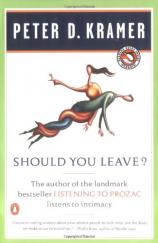
Should You Leave?


About the Book
Should You Leave?



"When a psychiatrist writes a bestseller, he is then urged to write a book of advice. But I think our culture's awash in advice. The problem is we don't know whether it applies to us or whether we're an exception."
-- Peter D. Kramer, from an interview with the Detroit News
In Should You Leave? Dr. Peter Kramer explains why therapists often refuse to give patients answers to questions. In contrast to the self-help books that crowd the shelves, Should You Leave? questions the very existence of objective advice -- for giver and receiver. What masquerades as advice, he argues, is often little more than a general transmission of values. Real advice can begin only with a thorough understanding of the individual advice seeker, who may or may not share the same values or belief system as the adviser.
In what he describes as "a hybrid of fiction, non-fiction, and self-help," he spotlights a wide range of fictional patients -- all close to breaking up with their partners -- from a kaleidoscopic series of viewpoints, speaking simply to "you," the composite patient. Whether any of these individuals should leave is no easy question.
First, the variables of personality and the dynamics of relationships and circumstances invite an endless array of interpretations, scenarios, and solutions (just as in the best of fiction, which Kramer calls "the most serious attempt to understand the human condition").
Second, the entire concept of relationships is rooted in an interplay between values of self and other. To this debate, filtered through his fictional mentor, "Lou," Dr. Kramer introduces major perspectives from philosophy and clinical psychiatric thought. They range from Freud's theories of the early family to Murray Bowen's championship of individualism in context; and from Leston Havens's pathology of possessor and possessed to Martin Buber's view of personhood as indivisible from relationship. Each patient inShould You Leave? can be viewed through the lens of one or more of these theories.
Iris, a self-made and flamboyant editor, is confronted with a cruel betrayal by Randall, whom she feels to be her ideal partner. To stay would be, according to Ivan Boszormenyi-Nagy's "relational ethics," investing in a love with no payback. Murray Bowen would want Iris to assert her autonomy. Jean Baker Miller, with her stress on "relational awareness," might see the strength of Iris's attachment as a greater personal and social good. Whereas Kramer wonders if she might translate her autonomy skills in business into a relationship with Randall that could foster similar growth in him.
Rose, a feisty but nurturing Irishwoman, and Abie, a Jew of Mediterranean heritage, have fed into their ethnic stereotypes of each other. To Melanie Klein or Henry Dicks, the pioneer of couple therapy, their "mutual projective identification" is cause for a breakup. But Kramer speculates on a cluster of factors: on the real balance of power in the relationship; on whether Rose could leave if the courts denied her child custody; on whether she will settle for staying because Abie, though violent, is the best deal she's yet found in a man.
From these psychiatric masters, and writers from Shakespeare and Ralph Waldo Emerson to James Joyce and John Updike -- even from a cultural about-face by Ann Landers -- Should You Leave? draws lessons on the importance of everyday detail and "selective inattention," emotional maturity in the context of conflicting ideals, and how to distinguish a truly independent self from its manifestation in a relationship. Kramer moves us beyond a simplistic "Mars and Venus" image of men and women toward a more subtle review of the intricacies of communication in general. How do mood states -- including, so often, depression -- affect our assessment of each other? What does "working on a relationship" entail? When should we work to improve a relationship, and when should we walk away?
Ultimately, this book places the personal balancing act of autonomy, connection, and community in a larger context. It also challenges conventional ideas of intimacy: Has our culture miscast marriage as an entitlement to happiness? Are gender differences an intrinsic roadblock toward intimacy? How far will personal growth go toward saving and transforming a relationship? Can our society, in fact, survive with autonomy as its ideal -- or are we overripe for a return to connectedness and contractual responsibility?
Should you leave? In the end, concludes Dr. Kramer, the only valid advice will be found in a garment woven from threads explored in this book -- tailored exclusively to each one of us.


Should You Leave?
- Publication Date: January 1, 1999
- Paperback: 320 pages
- Publisher: Penguin (Non-Classics)
- ISBN-10: 0140272798
- ISBN-13: 9780140272796