IndieBound Independent Bookstores

Barnes & Noble

Loading
Reading Group Guide
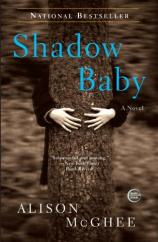
Shadow Baby
by Alison McGhee

List Price: $14.00
Pages: 256
Format: Paperback
ISBN: 9780307462282
Publisher: Three Rivers Press

Click here to buy this book from Amazon.com.
Click here to buy this book from Amazon.ca.


About This Book

Clara first spies him through the crack in the stained-glass window of her church, lighting a string of handmade lanterns in the Adirondack woods. A lone old man, Georg Kominsky moves stealthily among the shadow world of his hanging, glittering creations.

In Alison McGhee's stunning novel Shadow Baby, eleven-year-old Clara is struggling to find the truth about her missing father and grandfather and her twin sister, dead at birth, but her mother steadfastly refuses to talk about these people who are lost to her daughter. When Clara begins interviewing Georg Kominsky for a school biography assignment, she finds that he is equally reticent about his own concealed history. Precocious and imaginative, the girl invents version upon version of Mr. Kominsky's past, just as she invents lives for the people missing from her own shadowy past.

The journey of discovery that these two oddly matched people embark upon is at the heart of this beautiful story about friendship and communion, about discovering what matters most in life, and about the search to find the missing pieces of ourselves. McGhee's prose glistens with shrewd truth and wild imaginings, creating a fine novel that will reverberate in the hearts and minds of readers long after the book is finished.

top of the page


rgg_discuss.gif (1294 bytes)

1. One of the underlying themes in Shadow Baby is art, what it is, the people who make it, the people who appreciate it. (Think about, for example, Clara's soliloquy on book reports vs. actual books.) Clara believes that the old man has taught her the "art of possibility, and the possibility of beauty." What do you think the book is saying about the process of creating art? What are your own feelings on that subject?

2. In many ways the novel is a study in opposites. For example, Clara lives for words, while the old man is illiterate. In what ways do such contrasts serve to illuminate and deepen Clara's understanding of life?

3. In what ways do Clara's fake book reports mirror her world? In what ways do they represent her inner psyche? Why does she burn them all up in the end?

4. Shadow Baby opens with this line, "Now that the old man is gone, I think about him much of the time." Clara is twelve years old as she narrates the book, looking back on the past year of her life. Because she is still very young, she is not capable of having a long perspective of time, yet the book ends with this line, "But I was a child then." Think about other fictional child narrators, e.g., Holden Caulfield in A Catcher in the Rye and Laura Ingalls Wilder in the Little House books, and discuss the events behind their transition into adulthood. Compare and contrast to Clara's.

5. Clara's mother Tamar practices weekly in a church choir. Yet Tamar never attends church, nor do the old man or Clara. Is there nonetheless some religious significance in the book?

6. What is the significance of the title?

7. While it is true that the mother-daughter relationship in the novel is difficult, did youfind it believable and real? Why does Tamar refuse to answer Clara's questions?

8. To Clara, "real life" is often indistinguishable from her fantasy life. What purpose does her wild imagination serve?

9. The story of Clara's relationship with CJ Wilson is intertwined with the story of her chickens. How do the two stories both reflect and enlarge each other?

10. In the book, one person looks at a dented tin can and sees garbage, another looks at the same can and sees the possibility of beauty in the form of a lantern or cookie cutters. How does the book play with ideas of how individual ways of seeing influence one's experience of the world?

11. Clara is obsessed with pioneers, their stories of incredible hardship and triumph over adversity. Can the book in some ways be viewed as a metaphor (or possibly an anti-metaphor) for the traditional American mythology surrounding its immigrant past?

12. Think about the opening scene of the book, in which Clara glimpses the old man hanging lanterns in the woods. Think about the ending scene, in which she is burning her fake book reports in the snow. How do these two scenes, which 'bookend' the novel, mirror each other? What do they tell us about how Clara has changed in the interim?

top of the page

Critical Praise

"Suspenseful and moving."
The New York Times


"This is one of those novels in which the quality of the writing lulls a reader... the way beauty does in real life."
Los Angeles Times Book Review


"Perfectly constructed and beautifully written."
The Dallas News


"A feisty little heroine who often seems equal parts Huck Finn, Eloise, and... well, maybe Shakespeare's Beatrice-to-be... At once witty, tender, funny, touching, and, by the end, tragic in a way that perfectly brings all to a close, if never to an end. Bound for success, or else the world has gone mad."
Kirkus Reviews

 
Facebook Fan Page  Follow us on Twitter


Add Your Guide to ReadingGroupGuides.com!

Bookreporter.com Bets On...: Books We're Betting You'll Love


Privacy Policy | Contact Us | Advertising | About Us

© Copyright 2001-2012, ReadingGroupGuides.com. All rights reserved.
The Book Report, Inc. • 250 West 57th Street • Suite 1228 • New York, NY • 10107
Ph: 212-246-3100 • Fax: 212-246-4640

Bookreporter.comReadingGroupGuides.comGraphicNovelReporter.comFaithfulReader.com
Teenreads.comKidsreads.comAuthorsOnTheWeb.com