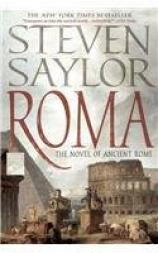
Roma
The Novel of Ancient Rome
by Steven Saylor
List Price: $15.95
Pages: 592
Format: Paperback
ISBN: 9780312377625
Publisher: St. Martin's Griffin
Spanning a thousand years, and following the shifting fortunes of two families though the ages, this is the epic saga of Rome, the city and its people.
Weaving history, legend, and new archaeological discoveries into a spellbinding narrative, critically acclaimed novelist Steven Saylor gives new life to the drama of the city’s first thousand years --- from the founding of the city by the ill-fated twins Romulus and Remus, through Rome’s astonishing ascent to become the capitol of the most powerful empire in history. Roma recounts the tragedy of the hero-traitor Coriolanus, the capture of the city by the Gauls, the invasion of Hannibal, the bitter political struggles of the patricians and plebeians, and the ultimate death of Rome’s republic with the triumph, and assassination, of Julius Caesar.
Witnessing this history, and sometimes playing key roles, are the descendents of two of Rome’s first families, the Potitius and Pinarius clans: One is the confidant of Romulus. One is born a slave and tempts a Vestal virgin to break her vows. One becomes a mass murderer. And one becomes the heir of Julius Caesar. Linking the generations is a mysterious talisman as ancient as the city itself.
Epic in every sense of the word, Roma is a panoramic historical saga and Saylor’s finest achievement to date.
top of the page

1. What did you know about ancient Rome before reading this novel? Did this book teach you something new or change your impression of this important chapter in the world’s history of civilization?
2. Which characters in the book are the most memorable, and why? Which characters were makers of history? Which characters were victims of history?
3. In what ways is the city of Rome itself a character in this novel?
4. Why do modern readers enjoy novels about the past? Which is more important, the ability of a historical novel to educate or to entertain? How does Roma compare with other historical novels you’ve read (as a group or on your own)?
5. What comparisons can be drawn between Roman politics, religion, and foreign policy and those of the United States? The Romans overthrew their monarchy and established a republic, but the Roman Republic ended with the rise of an all-powerful autocrat. Do you think the American 'republic' could ever come to an end as well?
6. In Roma, certain ceremonies --- like the celebration of the sacred geese and ritual punishment of a dog to mark an episode in the capture of the city by the Gauls --- endure through the centuries, even when their original significance becomes hazy. Are there any rituals we practice today, even though we can’t explain what they mean or how they began?
7. Two thousand years later, why is there still such a widespread fascination with Rome? What elements of that enduring fascination are captured or evoked by the novel?
8. We are taught, as young readers, that every story has a moral. Is there a “moral”to Roma? What can we learn about our world --- and ourselves --- from this book?
top of the page