IndieBound Independent Bookstores BRC Facebook Fan Page
Coming Soon
Reading Group Guide
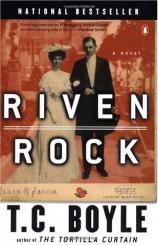
Riven Rock
by T. Coraghessan Boyle

List Price: $13.95
Pages: 466
Format: Paperback
ISBN: 014027166X
Publisher: Penguin USA

Click here to buy this book from Amazon.com.
Click here to buy this book from Amazon.ca.


About This Book


Poor Stanley McCormick. The depraved son of one of the greatest inventors of the nineteenth century, Stanley is doomed to spend most of his life confined to an enormous estate in Southern California while his wife, Katherine, spares no expense searching for the doctor who can cure him. For two decades Stanley leads a limited existence at Riven Rock, accompanied by a group of well-paid nurses, gardeners, cooks, and psychologists. And as the world outside struggles with war and disease, survives physical and economic disaster, and witnesses dramatic social change, Stanley continues to make diminutive steps toward achieving a normal life while his millions continue to pile up. Unfortunately, even Stanley's considerable wealth won't buy him his sanity or freedom from the luxurious prison that he helped build.

But Stanley's palatial prison is just one of many ironies contained in this whimsical work of historical fiction -- and which characterize it as a truly Boyle-esque tale. There is Katherine's steadfast fidelity to a marriage that was never consummated; Eddie, the philandering playboy, who tosses his conquests aside as soon as he tires of them, but who hungers for the one woman he can't have; and Stanley's violent, sexual aggression towards women, whom he loves with "an incendiary passion that is indistinguishable from hate." Boyle also manages to inject notes of high hilarity into what is basically a very sad story. The various doctors with their respective theories and styles could have stepped out of a Marx Brothers musical, as could the scene in which Katherine accompanies Julius the ape to an elegant hotel. And Stanley's treatment of the poor German teacher he drags home to please Katherine is as comical as it is heartbreaking. Another technique typically employed by Boyle is hyperbole. The author often populates his novels with larger-than-life figures: the richest man in America, the most clueless of doctors, the most overbearing of mothers, and, in the case of Katherine, a woman possessing the kind of intellectual brilliance and strength of character that, almost by necessity, accompanies a blind insensitivity to the needs of someone as fragile as Stanley. Irony, comedy, and hyperbole render this and Boyle's other novels unforgettable, transforming an historic footnote into a luminous, illuminating work of fiction that says as much about contemporary America as it does about the historical figures it depicts.

It is the role of the literary historian to paint a vivid picture from the outlines that fact provides. But the writer who chooses to use true life as a springboard toward a largely imagined story faces, perhaps, a greater challenge. He or she must impose on the facts moods and themes that feel organic to the history they represent. T. C. Boyle has a wonderful talent for turning history into fiction. In Riven Rock, as with his earlier novel, The Road to Wellville, Boyle starts with a germ of fact and a few larger-than-life personalities and spins a marvelous tale -- the details of which can strain credulity. (According to Boyle, some of the most outrageous incidents in this novel are actually true.) But he has chosen to keep his readers in the dark about where history ends and fiction begins. So be it. In his capable hands, deft as a magician's, we are willing to suspend disbelief.

top of the page


rgg_discuss.gif (1294 bytes)


1. How does Boyle introduce historical facts into the novel to move it along? Which of the period's prevalent issues does he bring to light? What, if anything, did you learn about America in the early part of this century? Do you think fiction is a good way to teach history?

2. Discuss your feelings toward Stanley McCormick. Does his particular type of insanity -- with its manifestations of lewd behavior and violence toward women -- make him less sympathetic? Do you feel sorry for Stanley? Do you think he is unhappy?

3. Compare the characters of Stanley and Eddie. Is Stanley's treatment of women different and/or worse than Eddie's? When Eddie is in the throes of alcoholism, is he any more sane than Stanley? Do you think Eddie is good for Stanley? Vice versa?

4. How real is Katherine's love for Stanley? Why is she so insistent on preserving their marriage? Why do you think she fell in love with Stanley in the first place? How do you reconcile her feminist views with her steadfast loyalty to a man with so many problems?

5. Issues of fidelity and loyalty figure prominently in the book. How are each of the major characters -- Katherine, Stanley, and Eddie -- alternately faithful and unfaithful, loyal and disloyal to others in their lives? Who is the most faithful? Who is the most loyal?

6. What do you think of the different doctors hired to treat Stanley? Aside from the comic relief they provide, what schools of thought does each represent?

7. Discuss Boyle's use of flashbacks in the novel. Do these passages detract from the story or promote its progress? How would the novel have been different if it were presented chronologically?

8. Like many of Boyle's novels, Riven Rock is filled with examples of opposite extremes -- Puritanism and overt sexuality, refined and extremely base behavior, honesty and dishonesty, poverty and wealth -- and with incidents that can strain credulity. What do you think of Boyle's use of hyperbole?

9. How does knowing that Boyle's book is based on history alter the way you read the novel? Did you wonder which incidents were based on fact and which on fiction? Would you prefer to know or are you satisfied not knowing?

10. Riven Rock is the actual name of the McCormick estate in California, yet Boyle manages to wrap the narrative around the image its name conjures up. How does he incorporate into the novel the metaphor of a rock split in two? What -- or who -- are the novel's "riven rocks"?

top of the page

Critical Praise

"A sustained, wise and enthralling portrait of America's lost past. . . . The author's best and perhaps most unusual book. "
—— San Francisco Chronicle


"Filled with good writing and richly observed scenes; it has humanity and humor in abundance. "
—— D. M. Thomas, The New York Times Book Review


"Boyle combines his gift for historical re-creation with his dazzling powers as a storyteller. . . . Riven Rock is as romantic as it is informative, as colorful as it is convincing. "
—— The Boston Sunday Globe


"Boyle's most affecting book. . . . His dialogue is tone-perfect. His storytelling . . . is mesmerizing. "
—— New York Newsday


"Deftly plotted. . . The craziest love story imaginable, but a love story nevertheless. . . one that chills the bones as you read . . . . Vintage Boyle. "
—— Kirkus Reviews
 

Privacy Policy | Contact Us | Advertising | About Us

© Copyright 2001-2010, ReadingGroupGuides.com. All rights reserved.
The Book Report, Inc. • 250 West 57th Street • Suite 1228 • New York, NY • 10107
Ph: 212-246-3100 • Fax: 212-246-4640

Bookreporter.comReadingGroupGuides.comGraphicNovelReporter.comFaithfulReader.com
Teenreads.comKidsreads.comAuthorsOnTheWeb.comAuthorYellowPages.com