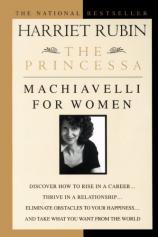
The Princessa: Machiavelli for Women


About the Book
The Princessa: Machiavelli for Women



In 1513, Niccolo Machiavelli wrote The Prince as a primer for young men of that starkly brutal era. At the core of every true prince, Machiavelli claimed, lay the wherewithal and the willingness to exercise power, preferably with ruthless cunning. A prince's life was enriched by conscience-free conflict. To the winner went all the spoils.
While also concerned with power, in its broadest sense, Harriet Rubin's The Princessa points the way to very different strategies to gain and maintain power. It begins with the premise that women, as a group, have historically been excluded from positions of power. In many cases, those individualswho have gained access are allowed in as tokens. Or they break through barriers using warlike tactics. Or they squirm in using a combination of compromise, cooperation, and negotiation. And they seem always to give so much more than they get. Well, not anymore!
The Princessa also works from the assumption that a woman's kind of power is very distinct from a man's. A woman's power is subtler, more nuanced. Instead of using conflict to annihilate, the princessa uses conflict to reshape alliances. Instead of competition, there is provocation. To a princessa, love is a kind of power and power is a kind of love.
Let there be no doubt--this book is not for the fainthearted. It is a book about conflict. A book about power--how to embrace it, use it, and gain what you want from it. No more compromise and negotiation. As Machiavella warns, "For a woman to triumph, she cannot play by the rules of the game. They are not her rules, designed to enhance her strengths. She has to change the game."
Machiavella shows how to ensure victory by adhering to one's principles, not to arbitrary rules or laws. She is unapologetic about the princessa's need to engage in conflict on her own terms.
Machiavella cuts a clear path, lighting the way with stories of princessas throughout history--Joan of Arc, the Russian poet Anna Akhmatova, Scheherazade, Dian Fossey. The Princessa gives specifics--strategy, the why, and tactics, the how--so that women can shape their lives according totheir own designs. It cautions women to do more than merely "win." Instead, they must "best," and impart, as Machiavella adds, "a sense of Olympic-style triumph: an achievement that leaves losers not defeated so much as breathless, awestruck."


The Princessa: Machiavelli for Women
- Publication Date: March 9, 1998
- Paperback: 208 pages
- Publisher: Dell
- ISBN-10: 0440508320
- ISBN-13: 9780440508328