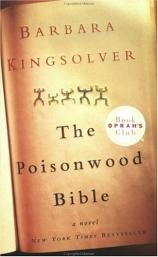
The Poisonwood Bible


Review
The Poisonwood Bible




As America traipsed giddily down the aisle toward Camelot on the coattails of post-World War II smugness, the rest of the world "turned on an axis called the Congo." It was a culture foreign and forbidding to the nations outside Africa itself. Yet, the Congo beckoned so seductively with its diamond-heavy finger that Western greed held a choke-hold on the Congolese until 1960, when Patrice Lumumba rallied his people to revolution and independence.
In THE POISONWOOD BIBLE, Kingsolver leads us through the labyrinth of the Congo by using one fictional family as our guide. Orleanna Price is the wife of Nathan, a zealous Baptist missionary, who in 1959 self-righteously drags his family from Bethlehem, Georgia, to the Congo. Suffering from the stigma of wartime cowardice, Nathan is a bitter man so obsessed with what he believes God wants of him that he is oblivious to the hardships his own family endures in the village of Kilanga. While Nathan is intent on baptizing the unwilling villagers, the overwhelmed Price children try to adapt to their jungle surroundings, learn a new language and culture, and still maintain the united front that their father requires. Meanwhile, the determined Orleanna mainly tries to keep her family alive as disease, starvation, the foment of revolution, and even her husband's physical presence threaten their very existence.
"I had washed up there on the riptide of my husband's confidence and the undertow of my children's needs. That's my excuse..." Orleanna begins the story of the Price family in flashback, claiming "I rode in with the horsemen and beheld the apocalypse, but still I'll insist I was only a captive witness. What is the conqueror's wife, if not a conquest herself?" From there, the compelling story of Orleanna and Nathan's family is fleshed out through the revolving narration of their four daughters.
Leah, the healthy half of 14-year-old twins, begins the sojourn "bearing Betty Crocker cake mixes into the jungle" and matures into an understanding of the Congolese culture that far outstrips that of her family. The villagers' interpretations of her father's Bible-thumping help Leah down a timeworn path from idolatry to downright defiance of the man who alternately abuses and ignores his progeny.
Ruth, a "stubborn child of five," reflects that "God says the Africans are the Tribes of Ham... the worst one of Noah's three boys," worries that she will be boiled in a cannibal's pot, and yet becomes the first to communicate with the village children through a fearless game of Mother-May-I.
"Man oh man, are we in for it now, was my thinking about the Congo from the instant we first set foot" proclaims Rachel, the oldest at 15. She's a platinum blonde with blue eyes who earns the derisive nickname "Termite" from the villagers. Self-indulgent and self-absorbed, Rachel imbues her viewpoint with a biting wit riddled with malapropisms and a poignant vanity.
Some of the more lyrical insights into the Prices' new world shine through the eyes of Adah, the silent and crippled twin who writes in palindromes, reads books back to front, spies on the people around her, and understands far more than anyone credits. "Sunrise tantalize, evil eyes hypnotize: that is the morning, Congo pink."
The Congo's complexities are so densely woven as to deny most of us even partial comprehension of its transformation into Zaire. To tackle the subject is a herculean task for any writer; to illuminate its subtleties through fiction requires a deft pen that only an artist of Barbara Kingsolver's caliber could wield so well. She brilliantly synthesizes all the varying viewpoints into a visceral whole. THE POISONWOOD BIBLE compels us to smell the "ripe fruits, acrid sweat, urine, flowers, dark spices, and other things I've never even seen" that make up the Africa into which this family falls headlong. We journey step by step with the Price girls and their mother as they painfully discover the beauty and ugliness of being white Americans in the Congo during such tumultuous times. All is never revealed nor ever can be in this ongoing process of what Kingsolver calls "a path of exploring the great, shifting terrain between righteousness and what's right."
This is not the Kingsolver we were introduced to in THE BEAN TREES. A body of work in and of itself --- full and extravagant --- THE POISONWOOD BIBLE bespeaks a wiser Kingsolver. She's become an extraordinary storyteller who takes a leap of faith across oceans of cultural differences to a continent that holds us in thrall even as it repulses our sanitized sensibilities. She forces us to face full frontal our own murky democratic images in the mirror of international culpability for the travesties inflicted upon the Congo and its people.
Orleanna tells us early on that "Once every few years, even now, I catch the scent of Africa. It makes me want to keen, sing, clap up thunder, lie down at the foot of a tree and let the worms take whatever of me they can still use. I find it impossible to bear." In the beginning we may find ourselves idly sniffing for a languid breeze redolent with exotic perfumes. But by the end, we are ready to keen and sing right along with her, finding it almost impossible to bear... or ever to forget... the heavy and tantalizing fruit of THE POISONWOOD BIBLE.
Reviewed by Jami Edwards on October 1, 1999


The Poisonwood Bible
- Publication Date: October 1, 1999
- Genres: Fiction
- Paperback: 560 pages
- Publisher: Harper Perennial
- ISBN-10: 0060930535
- ISBN-13: 9780060930530