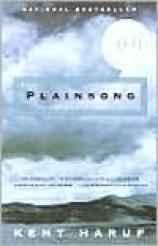
Plainsong
by Kent Haruf
List Price: $13.00
Pages: 301
Format: Paperback
ISBN: 0375705856
Publisher: Vintage Books
The questions, discussion topics, and suggested reading
list that follow are intended to enhance your group's reading of Kent
Haruf's Plainsong. We hope they will provide you with new angles from
which to approach and discuss this powerful tale of seven lonely lives
set on the stark but beautiful High Plains of Colorado.
In the small town of Holt, Tom Guthrie, a high school teacher, fights to keep his life together
and to raise his two boys after their depressed mother first retreats
into her bedroom, and then moves away to her sister's house. The boys,
not yet adolescents, struggle to make sense of adult behavior and their
mother's apparent abandonment. A pregnant teenage girl, kicked out by
her mother and rejected by the father of her child, searches for a secure
place in the world. And far out in the country, two elderly bachelor brothers
work the family farm as they have their entire lives, all but isolated
from life beyond their own community.
From these separate strands emerges a vision of life--and of the community and landscape that
bind them together--that is both luminous and enduring. Plainsong is a
story of the abandonment, grief, and stoicism that bring these people
together, and it is a story of the kindness, hope, and dignity that redeem
their lives. Utterly true to the rhythms and patterns of life, Plainsong
is an American classic: a novel to care about, believe in, and learn from.
top of the page

1. Why might Kent Haruf have chosen Plainsong as the title for this novel? What
meaning, or meanings, does the title have in relation to Haruf's story
and characters?
2. How does Haruf characterize the landscape of Holt and its surroundings, and how does
he use landscape to set the emotional scene? In what ways are his characters
shaped and formed by the land around them?
3. Few hints are given in the novel about what life might have been like for the Guthrie family
before Ella left. What do you imagine that life to have been like? What
sort of a marriage did Tom and Ella have, and what made it go wrong?
What might account for Ella's nearly total withdrawal even from the
children she seems to love?
4. How do the three teenagers having sex in the abandoned house inform and affect Ike and
Bobby? What does this sight tell them about sex? About love? About the
relationships and power struggle between men and women?
5. Do you believe there are marked differences between Raymond and Harold McPheron? If
so, what are they?
6. Why do you think the McPheron brothers have chosen to spend their lives together rather
than start families of their own? Are they lonely or unhappy before
Victoria's arrival, or do they feel sufficient in themselves? What does
Maggie mean when she tells them, "This is your chance" [p. 110]?
7. What parallels can you draw between the McPheron brothers and the young Guthrie boys?
Why is the relationship so close in each case? What sort of a future
do you see for the Guthrie boys? Do you think they will marry and have
families?
8. The McPheron brothers think they know nothing about young girls. Is that the case? Has their
solitary life close to the earth handicapped them so far as human relations
go, or has it, in fact, provided them with hidden advantages?
9. What examples of parents abandoning children--either by desertion, emotional withdrawal,
or death--can be found in this novel? What do these incidents have in
common? How does abandonment affect children, and how does it shape
their lives and relationships?
10. It is usually women who are portrayed as nurturers, but in this novel, men--Tom Guthrie
and the McPheron brothers--provide shelter and comfort. How do men differ
from women in this respect? What do these men offer that a woman might
not be able to?
11. "These are crazy times," Maggie Jones says. "I sometimes believe these must be the craziest
times ever" [p. 124]. What does she mean by this? In what way are our
times "crazier" than earlier eras? How does such "craziness" affect
the lives of young people such as Victoria, Ike, and Bobby?
12. What motives and feelings might have driven Tom to sleep with Judy when it was really
Maggie he was interested in? Why might Maggie have seemed momentarily
frightening or intimidating to him?
13. Why do the Guthrie boys befriend Iva Stearns? What are they looking for in this tentative
friendship? Do they find what they are seeking?
14. Why do the Guthrie boys go to the McPheron brothers after Iva's death rather than to someone
closer to home, like their father or Maggie? Is there any indication
that they connect Iva's death with their mother's abandonment? Why do
they place their mother's bracelet on the train tracks, then bury it?
15. The inhabitants of Holt and its surroundings are extremely laconic: they speak only
sparingly, as though they mistrust words. What might cause this? In
what way does it affect the characters' relationships with one another?
16. How would you describe Holt, Colorado? What are its limitations, its disadvantages, and what
are its strengths? In what ways is it typical of any American small
town, and in what ways is it different? What help does it provide for
people who need healing, like the characters in this book?
17. Plainsong depicts some unusual "family" groups. How might Kent Haruf define family?
top of the page

"A novel so foursquare, so delicate and lovely . . . it has the power to exalt the reader."The New York Times Book Review
"Resonant and meaningful
. . . . A song of praise in honor of the lives it chronicles [and] a story about people's ability to adapt and redeem themselves, to heal the wounds of isolation by moving, gropingly and imperfectly, toward community."Richard Tillinghast, The Washington Post Book World