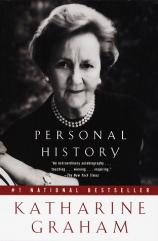
Personal History


Review
Personal History




I've never met Katharine Graham. But I always wanted to thank her for keeping me from becoming a lawyer.
That's what my Republican Party-activist parents had planned for me, with the hope that I might end up in Washington. Around my junior high school in Michigan, there were even jokes that I might become the first woman president.
But after I began following the story of Watergate --- and hearing about the ladylike but gutsy publisher who faced down the Nixon Administration --- the only thing about Washington that interested me was the Post.
Now, more than 20 years after the story that made her a journalism icon and inspired my reporting career, Katharine Graham has written her memoirs. Entitled PERSONAL HISTORY, her book has shot to the top of the bestseller lists, which might lead some people to dismiss it as simply another famous person's superficial tome.
But her book's popularity masks its depth and insight. The last time a book of this sort sold in such magnitude was TRUMAN, David McCullough's deserved success. Like McCullough's book, Graham's is an extremely well thought-out, detailed look at the last 70 years of American journalism, politics and social history. And like TRUMAN (which took me three weeks to get through), this is not a fast read, even given the exciting times in which Graham lived and participated. To appreciate it, the book demands a reader's time and deliberation.
To anyone who has followed Graham's career, the basic details are well-known. Katharine Meyer, daughter of publisher Eugene Meyer and eccentric writer and artist Agnes Meyer, was born in 1917 and grew up in a wealthy, liberal family that divided its time between sprawling homes in New York and Washington. Her mother ignored Katharine and her other children to pursue her own interests, which included friendships with photographer Edward Steichen and art collector Charles Freer (for whom the Freer Gallery at the Smithsonian Institution is named.)
After a whirlwind courtship, Katharine married up-and-coming lawyer Philip Graham, who not long after their marriage joined her father in running the Post, which Meyer had bought at an auction. It was then one of a half-dozen Washington newspapers, and hardly a shadow of the paper it was to become. Children followed; then the ground is laid for tragedy.
As Graham writes of her married life, you can smell trouble. After her third child, she gave up her own career at the newspaper for a stilted life as a society matron. (Graham apologizes for the choice repeatedly in the book, but as she points out, women in her stratus in the 1950s were emphatically discouraged from holding jobs.)
You need only glance through one of the photo inserts to see how much damage her charming, unpredictable and ultimately abusive husband did to her psyche. There is one chilling shot of the Grahams: he gazing authoritatively into the camera, she looking like a deer caught in headlights. Contrast it to the smiling photo of Graham at her debut, or even her happy wedding photo, and it serves to illustrate the increasingly sad story that Graham outlines in painful pages that tell of her husband's metal breakdown, his intention to divorce her, and finally his suicide.
It's remarkable that she is able to tell of her husband's disintegration so objectively, even writing about the girlfriend he planned to abandon her for. But what became remarkable was the life that his death transformed.
In just a few days after finding her husband's body, she was named publisher of the Washington Post. Within just a few years, the Post had risen to join the New York Times as a journalistic powerhouse. And less than a decade after taking charge, Graham was at the helm of a newspaper that had broken the Watergate story, stood with the Times in publishing the Pentagon Papers, and had played a central role in the downfall of Richard Nixon.
It is those years that form the true center of the book. Filled with anecdotes and details, they provide valuable insights into events that shaped the last third of the twentieth century. Every famous figure imaginable, from John F. Kennedy to Warren Buffett to David Bruce and Adlai Stevenson, appears. And there is a true sense for what it was like inside the upper echalon of the Post newsroom, where dynamic editor Ben Bradlee was king to Graham's queen.
If there is any flaw at all in these pages, it is that the book suffers from "Filofax-itis" ---the feeling that Graham has gone through decades of meticulously kept personal agendas and somehow included every entry in the pages of her book. Some judicious editing wouldn't have been a bad idea, if only to keep the narrative flowing at an even pace from Graham's youth to marriage to publishing career.
But the wrong editor would have eliminated some of the delightful personal details that give us a picture of just how different Graham's life has been from the rest of ours. Graham is first to poke fun at herself, telling a series of tales that are reminiscent of George Bush encountering a supermarket scanner for the first time.
Graham writes that she wore the same cashmere sweater to college classes every day until Thanksgiving, when a classmate suggested that she wash it. Graham says she had no idea how to wash a sweater -- at home, they simply appeared, clean, in her drawers, sudsed by invisible hands. Even when she was a housewife, at home with small children, her wealth meant she always had the kind of domestic help that other young mothers pine for. "To this day, I have never ironed a dress," Graham writes.
Equally delightful is the story of her brief job as a labor reporter in San Francisco. She writes of her ability to wheedle her way into the trust of the city's labor leaders --- and of joining them for shots and beers. "If you bought two, the third was free --- pretty heady stuff for a 21-year-old," she writes. Even later in life, when she is thrust into the public spotlight by her husband's death, Graham seems charmingly perplexed and secretly delighted about the attention. In telling the story of Truman Capote's legendary 1966 Black and White Ball in her honor, Graham admits that she was being used by Capote, whom she barely knew. But "for me, the party was just great pleasure, maybe doubly so because it was so unlike my real life. I was flattered, and although it may have not been my style, for one magic night I was transformed."
It is this combination of sweeping events and personal confidences that makes PERSONAL HISTORY an enjoyable book. It transforms Graham herself from a giant of twentieth-century journalism to someone you would like to have lunch with, if only to talk about labor writing and Woolite.
Micheline Maynard is USA TODAY's Detroit bureau chief and author of COLLISION COURSE: Inside the Battle for General Motors (Birch Lane Press).
Reviewed by Micheline Maynard on January 22, 2011


Personal History
- Publication Date: February 24, 1998
- Genres: Nonfiction
- Paperback: 688 pages
- Publisher: Vintage
- ISBN-10: 0375701044
- ISBN-13: 9780375701047