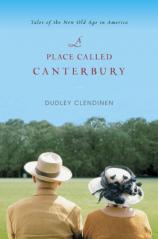
A Place Called Canterbury


About the Book
A Place Called Canterbury




Like so many members of the post–World War II generation, Dudley Clendinen sometimes imagined that his parents would live forever. It was an expectation he had to revise as his mother and father, who had once seemed so invincible, began to surrender to the passage of time. Yet even as they aged, they did not do so in the same ways as earlier generations. Thanks to advances in diet, medication, and elder care, people who grew up during the Depression and fought in World War II --- the Americans known as the Greatest Generation --- are living much longer than any generation before them. The longer they live, the more their children are drawn into their lives. Women and men who never expected to see their eightieth birthday are now celebrating their ninetieth or hundredth. They have become part of an unprecedented demographic phenomenon that Clendinen calls the New Old Age --- an experience for which neither they nor their children have been prepared.
In his work as a journalist and author, Dudley Clendinen has long been engaged in telling the stories of people in America who, like the rest of us, are too often invisible. In his latest book, A Place Called Canterbury, he has written a warm, witty, painful, real-life account of the challenges that face older people, as well as the children who become responsible for them, in a society that has enabled us to live longer without saying how.
A Place Called Canterbury is a nonfiction soap opera about two hundred feisty old people who have come together from across America, and the world, to live at Canterbury Tower in Tampa, Florida --- and about the staff that cares for them to the end. With all the compassion, sensitivity, and conflicted feelings of a devoted but sometimes bumbling son, Clendinen chronicles the last years of his mother, who, though felled by a pair of debilitating strokes, evinces no desire to let slip her hold on life. Trying to communicate with her, reliving memories of earlier, more vibrant times, Clendinen struggles to come to terms with the person his mother was and has now become --- someone who only partly resembles the charming, complicated, controlling woman he knew, but who still exerts a hold on him and still stirs depths of admiration, love, and frustration.
The unfolding relationship of mother and son is just one of many tales and themes in A Place Called Canterbury. In these exquisitely rendered, dramatic, and often very funny pages, we meet people like Karl Richter, the “Archrabbi of Canterbury,” who escaped Nazi Germany as the storm clouds of World War II were preparing to burst; Emily Moody, a.k.a. the Emyfish, the arch, theatrical old New Yorker who spurs a movement to have the aged women of the complex pose nude for a calendar; the Sweetso, Canterbury’s combative, liberal, book-loving atheist from Pennsylvania; and Wilber Davis, the confused, gentle hearted ninety-year-old from Tampa who loves to dance, and who urinates in his roommate’s closet, misses his wife, and chases women around the nursing wing. Thoughtful, witty, and heartbreaking, Dudley Clendinen’s book is a microcosm of life, a story told by a son who chose to live out these last comic and painful years with his mother and her friends and keepers in a very special place, A Place Called Canterbury.


A Place Called Canterbury
- Publication Date: May 1, 2008
- Hardcover: 400 pages
- Publisher: Viking Adult
- ISBN-10: 0670018848
- ISBN-13: 9780670018840