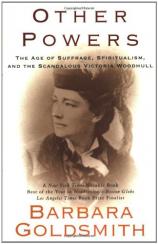
Other Powers


About the Book
Other Powers




Other Powers: The Age of Suffrage, Spiritualism, and the Scandalous Victoria Woodhull is a portrait of the tumultuous last half of the nineteenth century, when the United States experienced the Civil War, Reconstruction, Andrew Johnson's impeachment trial, and the 1869 collapse of the gold market.
A stunning combination of history and biography, Other Powers interweaves the stories of the important social, political, and religious players of America's Victorian era with the scandalous life of Victoria Woodhull--Spiritualist, woman's rights crusader, free-love advocate, stockbroker, prostitute, and presidential candidate. This is history at its most vivid, set amid the battle for woman suffrage, the Spiritualist movement that swept across the nation in the age of Radical Reconstruction following the Civil War, and the bitter fight that pitted black men against white women in the struggle for the right to vote.
The book's cast:
Victoria Woodhull, billed as a clairvoyant and magnetic healer--a devotee and priestess of those "other powers" that were gaining acceptance across America--in her father's traveling medicine show . . . spiritual and financial advisor to Commodore Vanderbilt . . . the first woman to address a joint session of Congress, where--backed by Elizabeth Cady Stanton and Susan B. Anthony--she presents an argument that women, as citizens, should have the right to vote . . . becoming the "high priestess" of free love in America (fiercely believing the then-heretical idea that women should have complete sexual equality with men) . . . making a run for the presidency of the United States against Horace Greeley and Ulysses S. Grant, and felled when her past career as a prostitute finally catches up with her.
Tennessee Claflin, sister of Victoria, also a clairvoyant, mistress to Commodore Vanderbilt . . . indicted for manslaughter in connection with the death of a woman in a bogus cancer clinic run by her father during the Civil War.
Henry Ward Beecher, the great preacher of Brooklyn's Plymouth Church--the most influential church in the country . . . brother of Harriet Beecher Stowe . . . caught up in the scandal of the century (first revealed in Victoria Woodhull's own newspaper): his affair with Lib Tilton, the wife of his parishioner and best friend.
Lib Tilton, angelic, obedient wife of Theodore Tilton who believed her philandering husband's insistence that she was sexless and arid--until Henry Ward Beecher fell under her thrall and their affair exploded into the shocking Tilton-Beecher Scandal Trial that dominated the headlines for two years, made radical inroads toward the idea of acceptable sexual relations between men and women, and inspired the first questioning of the sanctity of the middle-class American Victorian home.
Elizabeth Cady Stanton, discontented housewife who, bolstered by the great black activist Frederick Douglass, put forth a Declaration of Rights and Sentiments to empower women at the first woman's rights convention in Seneca Falls. Anna Dickinson, lecturer extraordinaire, feminist heroine to thousands of women across the country, the model for Verena Tarrant in Henry James's The Bostonians.
Horace Greeley, editor of the Tribune, whose campaign for the presidency of the United States was centered on his opposition to the policies of Reconstruction . . . who helped to undermine the suffrage movement by writing editorials denouncing Victoria Woodhull.
Anthony Comstock, U.S. special postal agent, enthusiastically in charge of stamping out obscenity and pornography (he compared erotic feelings to "electrical wires connected to the inner dynamite of obscene thoughts"), who arrested Victoria Woodhull and Tennessee Claflin on charges of sending obscene material through the mail and was determined to bring his crusade against vice to the forefront of American thought, and to be hailed as a "paladin of American purity."


Other Powers
- Publication Date: March 24, 1999
- Paperback: 560 pages
- Publisher: Harper Perennial
- ISBN-10: 0060953322
- ISBN-13: 9780060953324