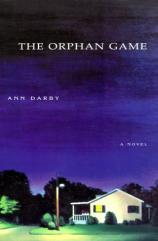
The Orphan Game
by Ann Darby
List Price: $13.00
Pages: 336
Format: Paperback
ISBN: 0688177824
Publisher: HarperCollins
It was 1965 going on '66, a dry year, and on the radio we kept hearing about brush fires out of control in the foothills of the San Gabriel Mountains. A few times we heard the fires burned so close to yards and houses that the people who lived there had to abandon their homes and wait it out in one church or another. And though the fires seemed far away, they were close. Close enough that in the right wind we could smell brush burning. Close enough that on Saturdays when my father wanted to see how I handled a car, he had me drive him toward Azusa, where we could view the range of charred hills.
Thus Maggie's story begins, against the ominous backdrop of burning
hills, the Vietnam War, and huge social upheaval looming on the horizon.
In many ways Maggie's is a familiar predicament - a 16-year old girl gets
pregnant, her boyfriend goes off to war, and getting married is not in
the cards. But The Orphan Game is a finely nuanced, beautifully
wrought tale, and while the premise may sound simple, the novel itself
is as richly complicated as life itself.
Much of The Orphan Game revolves around the themes of sex, individuality,
and family. The novel's protagonist, Maggie, muses about sex endlessly
- what she likes about it, what she doesn't, and what she doesn't understand.
She likes the legitimacy and attention that having an older boyfriend
gives her, and constantly worries about what her life without him might
be like. She understands that to be a girl who "does it, does it, does
it" marginalizes her in some important way, but she's not exactly sure
why. She slips Bruce's school ring on her wedding finger when her parents
aren't around, though she isn't certain she would really want to marry
him. It's a complex and changing world that Maggie inhabits in 1965 and,
like her parents, she feels the tug of both the liberalism and the conservatism
of the times.
Maggie's parents are baffled by their daughter's budding sexuality. When her father voices his displeasure about Maggie's relationship with Bruce, he sexualizes the conversation, using blunt terms in an unflattering, degrading way. He feels acutely his inability to control his daughter's behavior and is concerned about the negative image Maggie could cast on the family because of her relationship with Bruce. But Jim is unaware that trying to verbally humiliate Maggie into submission only erodes her self-confidence and pushes her toward, rather than away from, Bruce. Maggie's mother, on the other hand, is paralyzed by the subject of sex, emotionally unable to offer her any insight into her daughter's predicament, though at times she wishes she could. When Marian discovers Maggie is pregnant, she finds herself in the double bind of wanting to help but lacking the courage to do so.
It is ultimately Maggie's Aunt, Evelyn Rumsen, who shows the way into
a world where intimacy, sex, and self-acceptance are all linked. She offers
the friendship and support Maggie will need to navigate the contrary forces
of her world and undergo the difficult transformation, told so compellingly
in The Orphan Game, from girl to woman.
top of the page

1. Sandra Scofield observed that everyone in The Orphan Game
must "learn the difference between wanting and striving" and that
"longing is a palpable presence" in the novel. What kinds of longings
motivate Maggie? Jim? Marian? Mrs. Rumsen? Whom do you feel suffers the
most trying to learn the difference between wanting and striving? Is there
anyone you feel does not learn the difference?
2. How does the title illuminate the themes of the novel? Is
there a character that never seems to feel orphaned in the midst of family?
What are some other interpretations of the title's meaning?
3. The Orphan Game is rich with metaphors that involve
driving; indeed, the turning point of the novel occurs because of a car
accident. What do the driving scenes with Maggie and her father come to
signify? Is there any foreshadowing of what will happen to Jamie? What
does Maggie mean when she says, "My father had faith in roads, that's
what I believe. He revered freeways"?
4. The narrative is told largely from Maggie's point of view,
with contributions from Mrs. Rumsen, Maggie's mother, and briefly, Jamie
and Allison. How does Darby distinguish their voices? What effect does
the lack of narration from Jim have on the story? Maggie's voice matures
considerably over the course of the novel. How does the author distinguish
young Maggie's voice from the older, more experienced Maggie?
5. Mrs. Rumsen's character could be described as the happiest
in the story. Do you agree? What sets her apart her from the others in
the story? What do you feel is the significance of her love to dance?
Though we never meet John Rumsen in the first person, how does Darby characterize
him?
6. How does the setting - a quiet Southern California town in
1965 - enhance the story that is told? What about the significance of
the Vietnam war being fought in the background? Is there metaphorical
significance to the brush fires threatening the California foothills and
the fact that Mrs. Rumsen's house is the final destination they destroy?
7. How does The Orphan Game explore, through Maggie's
pregnancy, radical changes in women's sexuality, motherhood, and the nuclear
family? Has Maggie's pregnancy liberated her in some ways?
8. There are a number of crucial points where Maggie's father
could have changed the course of events had he acted differently. What
about his character makes him so dangerous to himself and those around
him? What about Maggie's mother?
9. What is Darby trying to suggest by making Jamie's death so
sudden and unexpected? Why do you think Maggie intermittently speaks of
her "opponent" and Jamie in the scene after his funeral?
10. Ownership is a recurring theme in The Orphan Game.
In what ways do we see this theme played out? Is Maggie's mother as enthralled
with ownership as her father? Is it significant that Mrs. Rumsen is the
least concerned with possessions, and that the loss of them in the fire
does not seem to bother her at all?
top of the page

"Smart, sharply observant . . . [Darby] constructs each line beautifully. . . . Some of the novel's best lines attain a rhythmic intensity and power through their very simplicity... The language hits just the right note."New York Times Book Review
"[Darby's] prose is tightly controlled ... sometimes microscopically observant, sometimes musical. Her attention to every detail of the period is faultless. . . . Such virtues and bursts of brilliance provide evidence that this accomplished short story writer can spin memorable fiction at length."Publishers Weekly
"Striking ... utterly individual ... exudes its own special atmosphere and intentions. Ann Darby writes with an old-fashioned storyteller's ripe attention to scene and scope ... [and) with sensitivity about the brave new world [her] heroine must traverse .... [Darby's] story of love, loss, and the need for connection makes for a page-turner."Elle
"Thoughtful ... a haunting picture ... particularly arresting."Entertainment Weekly