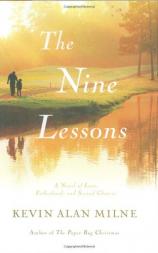
The Nine Lessons
by Kevin Alan Milne
List Price: $14.99
Pages: 240
Format: Hardcover
ISBN: 9781599950747
Publisher: Center Street
August Witte is firmly against having children. But after seven years of marriage, his wife is delighted when she realizes she is unexpectedly pregnant. August is terrified, recognizing he never learned the first thing about being a good parent from his father London. A widower since August was a toddler, London has always valued the game of golf --- a sport August has never had any talent for --- more than his son.
In spite of how he hates the game, when August confronts his father, he finds himself agreeing to meet each month of the pregnancy for a round of golf. In exchange, London will give him the only thing that could make August agree to pick up a club again --- memories of his mother, which he has written on golf scorecards since the day he met her. But August quickly realizes that his father's motive is not to teach him about golf, but to teach him about life --- and he may discover that the old man just might know something about it worth sharing.
top of the page

1. The passing on of knowledge from one generation to the next plays a key role in the telling of The Nine Lessons. What nuggets of wisdom did you learn from your parents that you hope to pass on (or already have passed on) to your own children?
2. Are there things you wish you’d learned growing up that you might have found useful later on in life?
3. August makes the argument to his father that “golf is not life,” pointing out that life has no course directions telling you where to go, no maps to point out hazards, and that you can’t practice before you play the game. In what ways do you agree or disagree with his argument?
4. The author used golf quotes at the beginning of each chapter to further extend the golf-life metaphor. Which quote is your favorite, and why?
5. One such quote, by Mark Twain, says, “It’s good sportsmanship not to pick up lost balls while they are still rolling.” Would you characterize Magnolia Steele as a “lost ball,” or is she “still rolling?”
6. Erin, Augusta’s wife, is arguably one of the more grounded and likeable characters in the book, but even she has her own shortcomings. What are some of her flaws? How does her character grow throughout the story?
7. How do the experiences of Augusta and Erin parallel those of London and Jessalynn?
8. In the prologue, Augusta describes fate as a pendulum: “the further we try to push it away, the harder it swings back to hit us.” Whether or not we ascribe it to fate, do you think there are things in life that we must all unavoidably experience, no matter how hard we try to avoid them?
9. Do any of London’s golf lessons apply to experiences you’ve had in your own life? Which lesson is your favorite, and why?
10. Originally, The Nine Lessons was planned to be called Waiting For Mulligans, referring to the story’s theme of second chances and forgiveness. When was the last time you gave or received a mulligan?
11. Which relationship in the book was more compelling? That of Augusta and London, or Augusta and Erin? Why?
12. Both in life and golf, Augusta thinks of himself as “a duffer.” What evidence either supports or refutes his assertion? Do you consider yourself a duffer?
top of the page