IndieBound Independent Bookstores

Barnes & Noble


Loading
Reading Group Guide
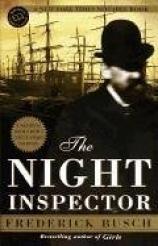
The Night Inspector
by Frederick Busch

List Price: $14.00
Pages: 240
Format: Paperback
ISBN: 0449006158
Publisher: Ballantine

Click here to buy this book from Amazon.com.
Click here to buy this book from Amazon.ca.


About This Book


An immensely powerful story, The Night Inspector follows the extraordinary life of William Bartholomew, a maimed veteran of the Civil War, as he returns from the battlefields to New York City, bent on reversing his fortunes. It is there he meets Jessie, a Creole prostitute who engages him in a venture that has its origins in the complexities and despair of the conflict he has left behind. He also befriends a deputy inspector of customs named Herman Melville who, largely forgotten as a writer, is condemned to live in the wake of his vanished literary success and in the turmoil of his fractured family.

Delving into the depths of this country's heart and soul, Frederick Busch's stunning novel is a gripping portrait of a nation trying to heal from the ravages of war--and of one man's attempt to recapture a taste for life through the surging currents of his own emotions, ambitions, and shattered conscience.

top of the page


rgg_discuss.gif (1294 bytes)


1. Of all American authors, Herman Melville is perhaps most closely associated with the phrase "The Great American Novel." What do you know about Melville and his work? About the book for which he is most celebrated, Moby-Dick? How does this knowledge affect your understanding of Busch's novel?

2. On a similar note, what do you know of Busch's work, particularly his most recent novels? What themes and motifs do you see present here that build upon his earlier work? What departures do you detect?

3. The Melville we meet in this novel is a man disgraced and ruined--abandoned by his publishers, forgotten by his readers, consigned to a grim job as an inspector of cargoes in the Port of New York. His career is all but over and ironically, the source of his misery is the commercial failure of Moby-Dick--the very novel for which he is now most remembered. Why do you think Busch has chosen this inglorious phase in the author's life as his focus? And what do you make of the use of the letter M in place of Melville's name?

4. The novel's narrator, William Bartholomew, is a Civil War sniper-a trained assassin, skillful at his job. What is your impression of him? Is he a cold-blooded killer? Despite this background, do you find him to be a sympathetic character? Why do you think Busch has chosen him to tell the tale?

5. Bartholomew knows Melville by reputation and early in the novel arranges a chance meeting over dinner. Initially, Bartholomew's intentions in seeking out the novelist are less than noble: "One could turn a powerful profit if the night inspector turned his head at the right moment," he says. "It was chancy, of course, but a businessman must never close his eyes to chance." But their connection soon grows deeper. What is the nature of this affinity? What bout Melville seems to be attractive or intriguing to Bartholomew, and vice-versa?

6. Since the war, Bartholomew has remade himself as a financier, "a student of the markets, and therefore a man watchful of human needs." How does this role complement his character and background? In what other ways does his postwar life seem linked to this past? Bartholomew is also a literary man, educated at Yale. What purpose does this serve in the tale?

7. Later in the novel we learn about the first man Bartholomew ever killed--his uncle and stand-in stepfather, who he drowns in the effluent of an outhouse. Why do you think Busch includes this scene in the novel. With its particularly gruesome form of death and killing?

8. The novel begins with Bartholomew's mask. At other times in the novel, he wears a veil. How do masks and concealment function as a theme in the novel? What other forms of concealment or masquerading do you find? Are there moments when these masks are lifted? Bartholomew's veil could also be understood as a garment of mourning. What is being mourned--by Bartholomew, by Melville, by the novel?

9. The scenes in the novel that describe Bartholomew's experiences in the Civil War paint a grim picture of that conflict. How does Busch's portrayal of life-at-arms differ from your expectations, and from other accounts of the Civil War that you have read or experienced?

10. One of the most poignant and horrifying moments in the novel occurs when Bartholomew and his fellow soldiers come upon a massacre: a shed full of men, women, and children--whole families--cut down in haste by advancing Union soldiers. Why does Busch include this scene, especially the image of the tiny doll's head? How does this scene prepare us for later events in the novel?

11. What do you understand Melville's son Malcolm's role in the novel to be? What do you make of his desire to be a soldier? How does his suicide advance the story and its themes?

12. The weapon that Malcolm uses to kill himself is the Colt revolver provided by Bartholomew at his father's request. Does this implicate Bartholomew in his suicide? Does it implicate Melville, who arranged for the gun?

13. The children of Chun Ho call Bartholomew gui meaning "ghost." How is this reflective of a larger truth? In what ways is The Night Inspector a ghost story? A detective story? A war story? A family story?

14. Throughout the novel, Bartholomew maintains that he Civil War is a purely economic conflict, a practical contest between two competing economic cultures, guided by no overarching moral purpose. He tells his friend Sam Mordecai, "It's about money Agrarians need slave labor. Industrialists need cheap labor. If we make the slaves free of Rebels, then the North will use your Negroes in any way they can. We're fighting for the opportunity for men of business, manufacturers, to get their hands on black men, Jews, and broad shouldered girls. It's money, Sam, they're waging the War about." What do you make of his interpretation? Is it cynical, or realistic? What motivates his understanding, and does it seem entirely sincere? How does it square with your own?

15. The main characters of the novel are all outsiders--men and women who in one way or another exist on the margins of society: a forgotten artist, a Creole prostitute, a widowed Chinese laundress, a Negro day-laborer, a Jewish journalist, a faceless war veteran. What do you make of this commonality, and what is your assessment of Busch's intentions in assembling this band?

16. Bartholomew arranges for a tour of New York's Tenderloin District for Mordecai, a "voyage into darkest New York." Melville joins them on this trip, as does the Negro Adam, who Melville describes as "our dusky Virgil," a reference to Dante's Divine Comedy, in which the Roman poet Virgil plays the role of Dante's tour guide to an imagined underworld. What seem to be Bartholomew's intentions in staging this grim outing? Does he want to educate Mordecai, and , if so, what does he want him to see and learn? Is the trip a success?

17. When their outing concludes, Adam refuses payment and professes regret at his role as guide. He tells Bartholomew, "I showed you a look at bad behavior and sorrow. Like it was minstrels kicking and strumming just for you." What do you make of this moment, and especially of Adam's pain? Do you believe that Bartholomew has taken unfair advantage of Adam's debt to him? In what larger sense does Adam act as a kind of guide--morally, spiritually--for the novel?

18. Many of Busch's novels deal with the subject of endangered or lost children, and certainly this is true of The Night Inspector. Driving the story forward is the plan to rescue a shipload of black children, a scheme that brings all the major characters together at the tale's climax. How does this plot crystallize the novel and its concerns? Is it an effective engine for the tale? What does it show about Bartholomew?

19. Throughout the novel, Busch brings to bear the sense of smell--the stench of war and earth, of animal waste and effluent, of the filthy New York streets and the sewers snaking beneath them. What do you think of this strategy? Is it effective? In what other ways has Busch worked to create a sense of the past, and of 1860s New York?

20. From her early appearance as a minor character, the widowed laundress Chun Ho gradually assumes a greater importance to the novel, culminating in the scene in chapter six in which she makes love to the maskless Bartholomew in his bath. Did this turn of events surprise you? What do you make of their blossoming affinity for one another? What is Chun Ho asking at the end of the chapter when she says to Bartholomew, "Tell me--teach me--you"?

21. The plan to rescue the cargo of black children is ultimately mistaken and thwarted and culminates in a vision of abject horror: a boatload of children drugged and stuffed into barrels to die. How did you react to this scent? Why do you think the writer chose to avoid anything like a "happy ending"?

22. In the chase on the Hudson that follows, Bartholomew is called upon once again to employ his skills as a marksman. Does this occasion differ from those in the past?

23. What do you make of Jessie's role as the Judas figure in the plot? Is her death deserved? After her body is recovered from the river, Bartholomew tells Adam, "At the endÉI think she must have thought of the children. "Why do you think he says this? Does this seem true to you, or is it naive?

24. The novel provides us with a pair of epilogues: A public reading of A Christmas Carol by the English novelist Charles Dickens, and a brief glimpse of Bartholomew with Chun Ho, walking together on the New York City streets. What does each scene accomplish? Taken together, do they bring about an effective sense of closure to the tale?

25. Does the meaning of the novel's title evolve for you over the course of reading the book? Who or what is a "night inspector"?

top of the page

Critical Praise

"A sublimely dark work of almost unbearable beauty. An exploration of evil, hidden identities and the dehumanizing forces of commerce, The Night Inspector has a moral heft and stylistic grace not unlike the work of [Herman Melville]."
The Wall Street Journal


"A stylistic gem of a book, flawlessly plotted and philosophically rich . . . Busch has followed his remarkable novel, Girls, not with a merely effective novel, but an essential one. . . . Stunning."
Boston Globe


"This haunting and intense narrative's writing explodes on each page with precise ferocity."
Dallas Morning News


"The Night Inspector is a tough, horrific, exciting novel, well-crafted and operating on several levels at once. Busch is as dazzling a writer as ever, weaving seamless transitions from the war flashbacks to Bartholomew's 1867 exploits, along with serious meditations on the use of artifice and the meaning of fiction. The novel also has a boat chase on the Judson as gripping as any since Sherlock Holmes went down the Thames in The Sign of Four...Than any writer might surpass the achievement of a novel as good as Girls would be unexpected. But with The Night Inspector, Frederick Busch has done it, and it's astonishing. Right now, he may be the best writer in America."
Philadelphia Inquirer

 
Facebook Fan Page  Follow us on Twitter


Add Your Guide to ReadingGroupGuides.com!

Bookreporter.com Bets On...: Books We're Betting You'll Love


Privacy Policy | Contact Us | Advertising | About Us

© Copyright 2001-2013, ReadingGroupGuides.com. All rights reserved.
The Book Report, Inc. • 250 West 57th Street • Suite 1228 • New York, NY • 10107
Ph: 212-246-3100 • Fax: 212-246-4640

Bookreporter.comReadingGroupGuides.comGraphicNovelReporter.comFaithfulReader.com
Teenreads.comKidsreads.comAuthorsOnTheWeb.com