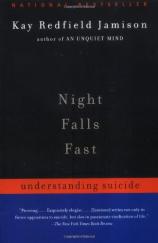
Night Falls Fast
by Kay Redfield Jamison
List Price: $14.00
Pages: 448
Format: Paperback
ISBN: 0375701478
Publisher: Vintage
From the author of the best-selling memoir An Unquiet Mind, comes the
first major book in a quarter century on suicide, and its terrible pull
on the young in particular. Night Falls Fast is tragically timely: suicide
has become one of the most common killers of Americans between the ages
of fifteen and forty-five.
An internationally acknowledged authority on depressive illnesses, Dr. Jamison has also known suicide
firsthand: after years of struggling with manic-depression, she tried
at age twenty-eight to kill herself. Weaving together a historical and
scientific exploration of the subject with personal essays on individual
suicides, she brings not only her remarkable compassion and literary skill
but also all of her knowledge and research to bear on this devastating
problem. This is a book that helps us to understand the suicidal mind,
to recognize and come to the aid of those at risk, and to comprehend the
profound effects on those left behind. It is critical reading for parents,
educators, and anyone wanting to understand this tragic epidemic.
top of the page

1. Jamison writes, "My hope
was to maintain an individual perspective--through an emphasis on the
psychology of suicide and an extensive use of the words and experiences
of those who seriously attempted to, or eventually did, kill themselves"
[p. 20]. In other words, she attempts to write about her subject with
an intimacy and immediacy that will engage the reader, despite the painful
nature of her topic. How well does she succeed in what she sets out
to do? How does this book change your thinking about those who kill
themselves?
2. Jamison reports that the
rate of suicide has tripled among young people in the past forty years,
and that suicide is now the second leading cause of death among American
college students. What are some of the forces in our society, according
to studies Jamison cites, that might be causing this alarming trend?
What point is Jamison making about the variety of styles and feelings
expressed in suicide notes? Only one in four people who kill themselves,
she says, is likely to leave a note. What in the state of a suicidal
mind would account for this unwillingness to communicate their intentions?
3. In his suicide note, British
painter Benjamin Haydon left a quote from Shakespeare's King Lear: "Stretch
me no longer on this rough world" [p. 83]. If this is a feeling shared
by most people who commit suicide, doesn't it seem entirely understandable,
and forgivable, that they should end their lives? Why then have most
societies been so insistent that suicide be considered a crime and a
grave sin, involving forfeiture of property, exclusion from hallowed
graveyards, etc.?
4. What is the cumulative effect
upon you, as a reader, of the use of statistics throughout the book?
Are you surprised, for instance, that while 30,000 Americans die from
suicide each year, 500,000 make suicide attempts? How does Jamison bridge
the gap between scientific studies and the emotion surrounding the issue
of suicide?
5. Jamison tells with care
and great empathy the tragic stories of Dawn Befano, Drew Sopirak, and
Meriwether Lewis, among others. Do these stories successfully provide
a window into the tumultuous and shattered minds of those who suffer
from mood disorders? What makes them so compelling? Do you believe that
these deaths were avoidable?
6. Jamison uses the story of
the unknown woman who climbed into the lions' enclosure at the Washington
Zoo to point out the urgent problems of the homeless mentally ill. She
writes, "They make us uncomfortable, but not so uncomfortable that we
protect or house, insure or tend or heal them" [p. 158]. Do you agree
with Jamison that American society is irresponsible and cruel in its
policies regarding the homeless mentally ill?
7. Jamison uses the examples
of the Japanese volcano Mount Mihara, San Francisco's Golden Gate Bridge,
and other popular sites for those who choose to end their lives, to
illustrate the odd fact that suicide sometimes has a dramatic allure
that can be contagious. Why do you suppose this is so? Do you think
that young people are especially vulnerable to a "copycat" phenomenon
in suicide?
8. How do you feel about the
poem on pages 90-91, written by a fifteen-year-old boy who killed himself
two years later? Does it seem predictive of his fate? Do you think this
was a masked cry for help?
9. The story of Washington
political figure John Wilson shows that the social stigma surrounding
mental illness is still strong enough to put an end to political hopes.
Is this bias justified? Should the public demand that those who hold
public office be free of mental instability? Or is this a lingering
prejudice that will eventually be outgrown?
10. Surgeon General David Sacher
has said, "As a society, we do not like to talk about suicide" [p. 264].
Why, in a society which is so permissive and so open, should suicide,
depression and related forms of mental illness be hard to talk about?
To what degree does a sense of shame prevent the suicidal individual
from seeking help? Do you agree with Jamison when she argues that educating
the public about mental illness will bring about a change in thinking,
treatment, and public policy regarding suicide?
11. Until the publication of
An Unquiet Mind, Jamison had kept her own illness a secret. Had
it been known, do you think she could have had a successful career as
a professor of psychiatry, or that she would have been chosen to write
an important standard textbook on the subject of manic depression? Would
you consider the sacrifice of Jamison's own privacy ultimately worth
the exposure, considering that she wants to save lives? Do you think
that her books will have a definite effect in reducing the suffering
of the mentally ill and the toll of suicide in this country?
12. Jamison points out that
the field of psychiatry is turning ever more strongly towards pharmacological
management and away from psychotherapy, and that "there remains a pervasive
belief in many psychiatric and research quarters that medication by
itself is sufficient to deal with serious mental illness" [p. 252].
What is the danger of trying to manage mood disorders solely through
medication? What does Jamison suggest is the ideal approach to the treatment
of these illnesses?
13. What do you think of psychiatrist
Thomas Szasz's views on mental illness and suicide [pp. 253-54]? Was
the court correct in making him pay damages to the wife of a patient
of his who killed himself after Szasz instructed him to stop taking
lithium? Should someone who holds such views be made to stop practicing
medicine?
14. Jamison quotes the writer
Joseph Conrad, who suffered from major depression and survived a suicide
attempt, as saying: "Suicide, I suspect, is very often the outcome of
mere mental weariness--not an act of savage energy but the final symptom
of complete collapse" [p. 198]. Yet, as she points out, most people
are able to survive the stresses of life without "complete collapse,"
and others are not. Why is this so? How important a role does the biochemistry
of the brain play in our response to life's troubles?
15. Josephine Pesaresi's description
[pp. 301Ð302] of the response to her husband's suicide underscores the
lack of real empathy that people often have for the survivors of people
who kill themselves. Do you think that her family's sense of isolation
was unusual? Do the immediate survivors of a person who kills himself
or herself need a different kind of concern and care from the people
around them than, say, the survivors of a death by cancer?
16. What does Jamison mean when
she writes, in her epilogue: "I am by temperament an optimist, and I
thought from the beginning that there was much to be written about suicide
that was strangely heartening" [p. 309]?
17. Reflecting on the emotional
toll it took to write this book, Jamison writes ruefully, "Mostly, I
have been impressed by how little value our society puts on saving the
lives of those who are in such despair as to want to end them. It is
a societal illusion that suicide is rare. It is not" [p. 310]. The staggering
fact is that "every seventeen minutes in America, someone commits suicide"
[p. 309]. Does this book leave you with a new sense of what an urgent
and tragic public health issue suicide is? Do you come away with some
ideas about what can be done to save the lives of potential suicides?
top of the page

"Jamison writes with authority, clarity and clinical reserve--. Powerful as her medicine is, her poetic accounting of this dark death is more affecting still."Baltimore Sun
"Jamison brings us face to face with the suicidal mind in a manner so intense and penetrating that, paradoxically, the immersion in despair she offers is a source of great pleasure."Washington Post Book World
"This powerful book will change people's lives--and, doubtless, save a few."Newsday