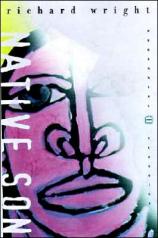
Native Son
by Richard Wright
List Price: $12.00
Pages: 528
Format: Paperback
ISBN: 0060929804
Publisher: HarperCollins
Impoverished, angry, and poorly educated, Bigger Thomas drifts around
the seedy South Side of Chicago until he finds work chauffeuring a
wealthy, liberal white family named the Daltons. On his first evening of
work, Bigger drives the Daltons' college-age daughter Mary and her
Communist boyfriend Jan Erlone around town while the two of them get
drunk. Bigger carries the intoxicated Mary to her bedroom and becomes
sexually aroused while putting her to bed; when Mrs. Dalton, who is blind,
comes to the door, Bigger silences Mary by covering her face with a pillow
and inadvertently smothers her to death. He burns her corpse in the
furnace and desperately tries to destroy evidence of the crime and frame
Erlone for it, but when a reporter discovers Mary's bones in the furnace,
the police quickly close in on Bigger and take him to jail.
The final section of the book recounts Bigger's trial. His lawyer, a
Jewish-American Communist named Boris Max, pleads that Bigger is not
responsible for his violent actions because social forces drove him to
crime, and he urges the judge to spare Bigger the death penalty. The
state's prosecutor responds that Bigger is a cold-hearted, depraved
criminal and must die as the law requires. The judge rules for the
prosecution and sentences Bigger to death. In the final scene, Max
attempts to console Bigger, but Bigger rebuffs him. "What I killed for, I am!"
Bigger insists, and Max leaves him to his fate.
top of the page

1. Wright writes of Bigger Thomas: "These were the rhythms of his life:
indifference and violence; periods of abstract brooding and periods of
intense desire; moments of silence and moments of anger--like water
ebbing and flowing from the tug of a far-away, invisible force." Does Wright
intend us to relate to Bigger as a human being--or has he deliberately
made him an unconscious embodiment of oppressive social and political
forces? Is there anything admirable about Bigger? Does he change by the
end of the book?
2. James Baldwin, an early protege of Wright's, later attacked the older
writer for his self-righteousness and reliance on stereotypes, especially in
the character of Bigger. In his famous essay "Everybody's Protest Novel,"
Baldwin compared Bigger to Harriet Beecher Stowe's Uncle Tom and
dismissed Native Son as "protest" fiction with a naked and simplistic
political agenda. Do you agree?
3. When Bigger stands confronted with his family in jail, he thinks to
himself that they ought to be glad that he was a murderer: "Had he not
taken fully upon himself the crime of being black?" Talk about Bigger as a
victim and sacrificial figure. If Wright wanted us to pity Bigger, why did he
portray him as so brutal?
4. Bigger repeatedly says to himself that the accidental killing holds "the
hidden meaning of his life": "He had murdered and had created a new life
for himself. It was something that was all his own, and it was the first time
in his life he had anything that others could not take from him." Discuss
the disturbing concept of killing as a "supreme and meaningful act." Is this
Wright's own view of the killing--or are we meant to see it only as Bigger's
internal conclusion?
5. When first confronted with the accusation that he raped Mary, Bigger thinks: "rape was not what one did to women. Rape was what one felt when one's back was against a wall and one had to strike out." Discuss the group's reactions to this controversial passage. Does this redefinition of rape reveal an insensitivity on Wright's part to women and the oppressions that they experience in American society? 6. How dated does this book seem in its depiction of racial hatred and guilt? Have we as a society moved beyond the rage and hostility that Wright depicts between blacks and whites? Or are we still living in a culture that could produce a figure like Bigger Thomas?
top of the page

"The Library of America has insured that most of Wright's major texts are now available as he wanted them to be read."Alfred Kazin, New York Times Book Review
"This new edition gives us a Native Son in which the key line in the key scene is restored to the great good fortune of American letters. The scene as we now have it is central both to an ongoing conversation among African-American writers and critics and to the consciousness among all American readers of what it means to live in a multi-racial society in which power splits among racial lines."Jack Miles, Los Angeles Times