IndieBound Independent Bookstores BRC Facebook Fan Page
Coming Soon
Reading Group Guide
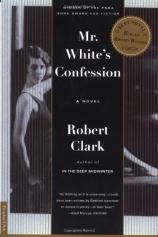
Mr. White's Confession
by Robert Clark

List Price: $14.00
Pages: 341
Format: Paperback
ISBN: 0312204264
Publisher: Picador USA

Click here to buy this book from Amazon.com.
Click here to buy this book from Amazon.ca.


About This Book


St. Paul, Minnesota, 1939. The body of a beautiful dime-a-dance girl is found on a hillside, and Police Lieutenant Wesley Horner, struggling and alone after his wife’s recent death, heads the investigation into her murder. His chief suspect is Herbert White, an eccentric recluse and hobby photographer who spends his days recording his life in detailed journal entries and scrapbooks. In Mr. White’s Confession, Robert Clark illuminates the complex relationships between truth and fiction, past and present, faith and memory.

top of the page


rgg_discuss.gif (1294 bytes)


1. Because of his faulty memory, Herbert White can only recollect the formative experiences of his distant past--his father leaving to serve in World War I, and Nanna’s death--and the events of the immediate past--incidents that happened a few hours ago or perhaps the day before. Can what Herbert remembers be trusted? Is your memory any more trustworthy than his?

2. Mr. White’s Confession is in many respects an examination of good and evil. In Herbert’s world, what form does evil take? How does his understanding of it differ from Wesley’s? From Maggie’s? On page 22, Farrell, the newspaper reporter, says to Wesley, “Like the book says, none of us is without stain.” Does that statement hold true even for Herbert, or is his character purely innocent?

3. Both Herbert and Wesley have unconventional relationships with women. .What role does Maggie play in Wesley’s life? How does Ruby affect Herbert? What is the importance of Herbert’s “relationships” with film starlets like Veronica Galvin?

4. On page 122, Herbert says to Ruby, “I rather wish I remembered more, for your sake. So I could have more of a personality, more of a past.” In what ways has Herbert’s perception of his past formed him? How does Herbert’s imperfect memory speak to the ways in which our own pasts, and our ability to remember them, shape who we are?

5. Most would agree that Herbert White’s written confession to the murders of the two dancers was coerced and therefore not altogether true. Why do you think Herbert confessed?

6. On page 24, Herbert writes, “When I am making a print, when I am dodging or burning an exposure, I am gilding [places of beauty], illuminating them, or protecting the tenderest places from the scald of light, burnishing them with shadow. It is as close as I ever come to touching them, but I am helping them be--or rather become, for a photograph is only a moment of becoming.” What do you make of Herbert White’s hobby--what is the importance of his photography in relation to the novel as a whole? How does it relate to his problems with memory?

7. Robert Clark wrote Wesley Horner’s sections of the novel using the conventions of hard-boiled, pulp fiction. How does this technique fit with Wesley’s character? How does this kind of writing differ from the journal entries of Mr. White? What kind of effect does this contrast have?

8. As the novel progresses, Herbert White comes to think about God more and more as his own circumstances steadily deteriorate. What do we learn from Herbert about faith? How does he come to his understanding of God? How does his relationship with God change throughout the course of the novel? What about Wesley? Although he doesn’t think about God as intensely as Herbert does, he does experience a rebirth of faith? How does that come about?

top of the page

Critical Praise

"The long ruminations of Mr. White…give the book its intensity and mystery. "
——The New Yorker


"As thrilling as it is unnerving…Could have been written by Dashiell Hammett or James Crumley--at their best. "
——Greil Marcus, Esquire


"Strong, brooding…Clark’s most striking achievement is Herbert’s ambiguity, making it appear at once vulnerable and threatening. "
——Dan Cryer, Newsday


"Complex…intriguing…a fascinating and timely journey into the American psyche. "
——Barbara Lloyd McMichael, Seattle Times


"A novel of substance…reveals the subtlety of [Robert Clark’s] artistry and the profundity of his vision. "
——Merle Rubin, The Wall Street Journal


Become a Fan of ReadingGroupGuides.com on Facebook!


Bookreporter.com Bets On...: Books We're Betting You'll Love

Add Your Guide to ReadingGroupGuides.com!


Privacy Policy | Contact Us | Advertising | About Us

© Copyright 2001-2010, ReadingGroupGuides.com. All rights reserved.
The Book Report, Inc. • 250 West 57th Street • Suite 1228 • New York, NY • 10107
Ph: 212-246-3100 • Fax: 212-246-4640

Bookreporter.comReadingGroupGuides.comGraphicNovelReporter.comFaithfulReader.com
Teenreads.comKidsreads.comAuthorsOnTheWeb.comAuthorYellowPages.com