Reading Group Guide
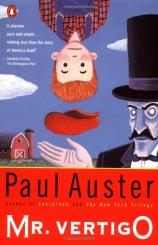
Mr. Vertigo
by Paul Auster

List Price: $12.95
Pages: 304
Format: Paperback
ISBN: 0140231900
Publisher: Penguin USA

Click here to buy this book from Amazon.com.
Click here to buy this book from Amazon.ca.


About This Book


Critics describe Paul Auster as a storyteller with few modern equals. Auster himself looks to "the anonymous men and women who invented the fairy tales we still tell each other today" as an unending source of inspiration. The debt is clear and welcome in this, his eighth novel, a delight for any reader willing to sit back and give herself up into the hands of a master storyteller. Mr. Vertigo is a genuinely fabulous tale, a page-turner as mythic as the American tall tale and as down-to-earth as a Kansas wheat field, as American as Prohibition and baseball, and as alien as a spiritual quest to conquer gravity itself.

It's the story of Walter Rawley, a wisecracking street urchin from St. Louis who is taken in hand by Master Yehudi, a quasi-religious master who hails from Budapest via Brooklyn. Walt, endearingly described early on by Master Yehudi as a "pus-brained ragamuffin from honky-tonk row," has a hard head, a sharp tongue, and a gift the master has been searching for for years: properly taught, he can levitate. Sometimes cruel, often unnerving, and deeply moving, theirs is one of the most original and unorthodox partnerships in American letters. The story careens between the sublime to the ridiculous, as Master Yehudi and Walt the Wonder Boy take their act on the potholed back roads of the Midwest, their eyes on fame, fortune, and the Great White Way. Walt's reversals of fortune at the hands of his hormones, the Ku Klux Klan, the Chicago mob, and his own perversity are too many to count, and every inch of them entertains and illuminates. To appreciate the precision and cadence of Auster's writing, try reading Mr. Vertigo aloud. Be careful at the very end, where Walt, now an old man looking back, explains how to fly.

top of the page


rgg_discuss.gif (1294 bytes)


1. At their first meeting, Master Yehudi says to Walt, "You're the answer to my prayers, son. That's why I want you. Because you have the gift." What is the gift? Is it a blessing or a curse?

2. "She may be fat and toothless, but she's the closest thing to a mother you'll ever have," says Master Yehudi when he introduces Walt to Mother Sioux. Certainly the strange trinity of Mother Sioux, Aesop, and Master Yehudi is the closest Walt comes to having a family. Do they qualify? What roles do Aesop and Mother Sioux fulfill for Walt?

3. After Walt's escape into the snowstorm, Master Yehudi diagnoses Walt with a case of the Ache of Being, provoked by being "jolted into submission." Why does Walt wake up to discover that "the hatred festering inside me had been transformed into love?" What do you think submission--or, for that matter, Mother Sioux's magic--had to do with it?

4. There's nothing otherworldly about Walt and Master Yehudi's daily lives or dreams of riches, and the Master warns his student never to look down on the bumpkins they entertain. Yet the Master rhapsodizes, "Not like a bird, my little man. Like a god. You'd be the wonder of wonders, Walt, the holy of holies. As long as men walked the earth, they'd worship you as the greatest man among them." Do you think Master Yehudi believes these grand promises? Why does he make them?

5. Two years into his tutelage, Walt says of Master Yehudi, "I had learned that everything I was flowed directly from him. He had made me in his own image...." Master Yehudi paints quite a different picture as he lies dying.

He says: "Whatever you are it's because of me. Isn't that so, Walt?"

"Of course it is. I was a no-good bum before you found me."

"I just want you to know that it works both ways. Whatever I am, it's because of you."

How do Master Yehudi's and Walt's views of their relationship differ? How do these feelings change over time?

6. Walt feels no qualms about becoming a Jazz Age swell because "without the Master I was no one, and I wasn't going anywhere." He says, "Every time I took another step forward, I drifted farther away from the person I'd been with Master Yehudi. The best part of me was lying under the ground with him." At times Master Yehudi was far from benevolent; do you see him as a force for good in Walt's life? How would he feel about the turn Walt's life has taken?

7. Sex is important to all the main characters in Mr. Vertigo - after all, it's puberty, not lack of talent or spirituality that does in Walt the Wonder Boy - but romantic love doesn't really pan out for any of them. Were you surprised when Walt finds happiness with Molly Fitzsimmons? What's Mrs. Witherspoon's role in the novel?

8. Mr. Vertigo could be read as a parable about striving and success, celebrity and the price exacted for it. Is what Walt gains worth the suffering he goes through?

9. Paul Auster has described Mr. Vertigo as "a spiritual quest as much as anything." The Holy Grail Walt pursues as an adult is one of revenge and self-destruction, not life or grace. What kind of spiritual quest is this? How many transformations does Walt actually undergo? Would you call them spiritual?

10. What do you think are Walt's real talents in life? What might he have become if flying had not made him feel possessed of a special destiny, "set apart from others" for his whole life. Do you think you'd like Walt if you met him in person?

top of the page

 
Back to top.   


Privacy Policy | Contact Us | Advertising | About Us

<© Copyright 2001-2008, ReadingGroupGuides.com. All rights reserved.