IndieBound Independent Bookstores BRC Facebook Fan Page
Reading Group Guide
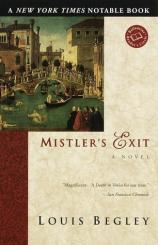
Mistler's Exit
by Louis Begley

List Price: $12.00
Pages: 224
Format: Paperback
ISBN: 0449004228
Publisher: Fawcett

Click here to buy this book from Amazon.com.
Click here to buy this book from Amazon.ca.


About This Book


A self-made New Yorker well into his middle age, Thomas Mistler has long been a lion of Madison Avenue's powerful advertising world. Now, poised to sell his company for a luxurious sum, Mistler receives alarming news: He has only months to live. But his reaction is not what one would expect. Rather than hysteria, Mistler experiences a sense of clarity and a feeling of being set free. From what, he is unsure. In a decision that breaks the mold of his superbly organized routine, Mistler conceals his illness from his family and seeks a moment of grace to be savored alone in the decadent splendor of Venice. There, he meets a young, lustful photographer and, later, a love from his youth. But his attempts to recapture passion only magnify the reconciliations he has yet to make--with the father to whom he sacrificed his own dreams, the son with whom he has never truly accepted, and the wife to whom he has given everything but respect.

A startling blend of grace and satire, Mistler's Exit is charged with unexpected moments of beauty and eroticism, pathos and humor. Like the city of Venice itself, it is a creation of timeless appeal.

top of the page


rgg_discuss.gif (1294 bytes)


1. Mistler considers himself "a happy man, as the world goes," yet when he receives his fatal diagnosis, we are told "preposterously, unmistakably he began to rejoice . . . [feeling] he had been set free." How are we to account for this strange reaction? How does it take on meaning as the novel develops?

2. Once he learns about his illness, Mistler tries to change the terms of his firm’s merger deal without informing Jock Burns of the reason. How unethical do you find his actions? How typical of your experience in business? Do you accept Mistler’s implication that business ethics are different from personal ethics?

3. When Mistler exposes Peter Berry’s betrayal of him, Peter is unrepentant, citing Mistler’s mistreatment. Which man do you find more blameworthy in this broken friendship? Is either more sinned against than sinning?

4. Mistler confesses he has "ruined" Clara’s life. What does he mean? Why has their marriage proved a disappointment to each? In what way does it typify the mistakes he believes he has made in life?

5. Mistler describes Mme Portes as "the only woman [he] ever loved," a woman he "never had and never lost." How do you understand his feelings for his father’s mistress? Why do you suppose he has never known another love despite his many romantic opportunities?

6. How is Mistler’s relationship with his father different from Sam’s relationship with Mistler? How do Mistler and Sam’s respective character traits inform and limit their relationship?

7. What motivates Mistler to go see Bella a second time? Why does the encounter unfold as it does?

8. How do you interpret Mistler’s decision to purchase the wherry? How might we see this as a coda for his story?

9. The book’s epigraph’s may be translated as "Too bad about what men will lose; they’ll never notice it. Everything ends well because everything ends." Mme Portes echoes this statement. How might we understand the novel in relation to this maxim?

10. Some critics have found Mistler difficult to like. How do you feel about him? How do your feelings affect your response to the book?

top of the page

 
Back to top.   


Privacy Policy | Contact Us | Advertising | About Us

© Copyright 2001-2009, ReadingGroupGuides.com. All rights reserved.
The Book Report, Inc. • 250 West 57th Street • Suite 1228 • New York, NY • 10107
Ph: 212-246-3100 • Fax: 212-246-4640

Bookreporter.comReadingGroupGuides.comGraphicNovelReporter.comFaithfulReader.com
Teenreads.comKidsreads.comAuthorsOnTheWeb.comAuthorYellowPages.com