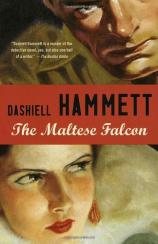
The Maltese Falcon
by Dashiell Hammett
List Price: $9.00
Pages: 224
Format: Paperback
ISBN: 0679722645
Publisher: Vintage
Published in 1930, The Maltese Falcon was Dashiell Hammett's third
novel in two years. Here he creates a new detective, Sam Spade. When the
intriguing Miss Wonderly appears in his office and asks him to tail a
fellow named Floyd Thursby, Spade puts his partner, Miles Archer, on the
case. In short order, Thursby and Archer turn up dead, and the beautiful
woman is back in his office, this time telling him her real name, Brigid
O'Shaughnessy, and imploring him, in a dramatic plea, to help her. Spade
replies, "You won't need much of anybody's help. You're good. You're very
good. It's chiefly your eyes, I think, and that throb you get into your
voice when you say things like 'Be generous, Mr. Spade'" [p. 35]. Spade
relents, though not before extracting a hefty retainer--almost all her
money. Then a "small-boned man" named Joel Cairo calls on Spade. He has
his own special interest in Thursby, and to Thursby's relationship to
a missing statuette of a black bird. Cairo makes the mistake of pulling
a gun on Spade, who easily knocks him out. The encounter leads the detective,
all the while clumsily trailed by the young gunsel Wilmer, to the third
main character, Casper Gutman. The fat man reveals the value of the Maltese
falcon, and the treasure hunt is on.
This greedy and ruthless trio
of characters bent on finding the statuette meet their match in Sam Spade.
The plot, characters, and dialogue in The Maltese Falcon are perfectly
controlled by Hammett, incorporating a vigor and style that became the
paradigm for hard-boiled crime fiction.
top of the page

1. Sam Spade's attitude toward authority is patently clear in remarks like "It's a long while since I burst out crying because policemen didn't like me" [p. 19] or "At one time or another I've had to tell everyone from the Supreme Court down to go to hell, and I've got away with it" [p. 170]. How is Spade's distrust of power manifested in his actions? How important is distrust as an aspect of his character?
2. Of the three women in the book--Brigid O'Shaughnessy, Effie Perine, and Iva Archer--are any fully realized, or are perhaps all three, as stereotypes, three sides of one woman? As a stereotype, what does each woman represent? What does Spade mean, and what does it say about Spade, when he tells Effie, "You're a damned good man, sister" [p. 160]?
3. A blatant stereotype is Joel Cairo: "This guy is queer" [p. 42], Effie informs Spade when the perfumed Cairo comes to the office. Is a homosexual character effective or necessary in the plot? Would he be as effective without sterotyping? Why do you think Hammett created him?
4. Near the end of the story, Spade says to Brigid, "Don't be too sure I'm as crooked as I'm supposed to be" [p. 215]. What evidence is there that he's not crooked? Does honor temper greed in his negotiations with the others in the hunt for the black bird? How are greed and ruthlessness packaged here so that ultimately we might not care whether the characters are crooked or not? Does style compensate for all in the hard-boiled genre?
5. "By Gad, sir, you're a character" [p. 178], says Gutman, laughing, when Spade suggests making Wilmer the fall-guy. Is the Spade-Gutman relationship one of justice versus corrupt wealth or one of equals competing for the same prize? How does Gutman's sophistication and erudition reveal another side of Spade?
6. When Spade returns to the office in the last scene, Effie does not greet him with her usual verve. What has happened to the breezily affectionate bond between them? What is Effie's relationship to Brigid? Will Effie forgive Spade, or do we not know enough about her to make predictions?
top of the page

"Dashiell Hammett. . . is a master of the detective novel, yes, but also one hell of a writer. "
The Boston Globe
"The Maltese Falcon is not only probably the best detective story we have ever read, it is an exceedingly well written novel. "
The Times Literary Supplement
(London)
"Hammett's prose [is] clean and entirely unique. His characters [are] as sharply and economically defined as any in American fiction. "
The New York Times