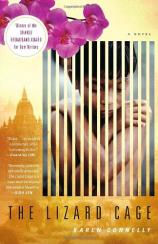
The Lizard Cage
by Karen Connelly
List Price: $14.00
Pages: 464
Format: Paperback
ISBN: 9780385525039
Publisher: Spiegel & Grau
Beautifully written and taking us into an exotic land, Karen Connelly’s debut novel The Lizard Cage is a celebration of the resilience of the human spirit.
Teza once electrified the people of Burma with his protest songs against the dictatorship. Arrested by the Burmese secret police in the days of mass protest, he is seven years into a twenty-year sentence in solitary confinement. Cut off from his family and contact with other prisoners, he applies his acute intelligence, Buddhist patience, and humor to find meaning in the interminable days, and searches for news in every being and object that is grudgingly allowed into his cell.
Despite his isolation, Teza has a profound influence on the people around him. His very existence challenges the brutal authority of the jailers, and his steadfast spirit inspires radical change. Even when Teza’s criminal server tries to compromise the singer for his own gain, Teza befriends him and risks falling into the trap of forbidden conversation, food, and the most dangerous contraband of all: paper and pen.
Yet, it is through Teza’s relationship with Little Brother, a twelve-year-old orphan who’s grown up inside the walls, that we ultimately come to understand the importance of hope and human connection in the midst of injustice and violence. Teza and the boy are prisoners of different orders: only one of them dreams of escape and only one of them will achieve it --- their extraordinary friendship frees both of them in utterly surprising ways.
top of the page

1. During a meditation, Teza reflects on the following Buddhist principles:
Metta.
Karuna.
Mudita.
Upekkha.
These are the Four Divine Abidings. Love. Compassion. Joy in the good fortune of others. Equanimity.
How are these principles depicted in the novel, and in what way do they help Teza cope with his imprisonment? Does he always succeed in living by these principles? How does he impart them to Little Brother?
2. How do Teza’s experiences inside the Lizard Cage represent the larger political turmoil in Burma (now Myanmar)? Despite the inhuman conditions, does hope still reside inside the prison?
3. “Words are like the ants. They work their way through the thickest walls, eating through bricks and feeding off the very silence intended to stifle them.” How is the irrepressibility of truth evident in The Lizard Cage? What parallels can you draw from other civil rights conflicts in the world?
4. Brothers Teza and Aung Min chose different paths of resistance, the former peaceful protest and the latter armed revolution. In your opinion, whose choice was more effective? How does Teza keep their relationship alive through memory? In what ways is Teza’s friendship with Little Brother similar to his relationship with Aung Min?
5. Why are pen and paper contraband in the Lizard Cage? Even Little Brother, who cannot read and write, understands their power. How is language a powerful weapon against oppression?
6. “From solitary, the whole cage is a foreign country to him. He lives on the very edge of it, straining to hear the other voices.” While confined, Teza reflects on life, from his family and first love to his education and political actions. Can memories be both freedom from captivity and a torturous reminder of a life not lived? When have you experienced this paradox?
7. Little Brother is referred to by various names, most commonly the boy, rat killer, Free El Salvador, Nyi Lay, and his real name, Zaw Gyi. Why is Teza comforted to know the boy has such a strong name? What does one’s name signify in terms of social hierarchy and character?
8. Animals, particularly lizards, play an important role in The Lizard Cage. What is the significance of the characters’ relationships with animals? How are those relationships spiritual, and what do they teach us about human relationships?
9. How are jailers Handsome and Chit Naing products of the environment in which they live? Why do they have such different attitudes toward Teza even though they have the same occupation? Are they motivated by survival, loyalty, or ambition?
10. In what way does Teza achieve freedom through Little Brother? What does the novel say about the resilience of the human spirit?
top of the page

“In a feat of epic vision, Karen Connelly uses her every art to tell the urgent story of what the New York Times calls ‘Myanmar, arguably the most repressive regime in the world.’ The suspense never relents. Hope is small, but it lives, strengthened by this powerful book.”
Maxine Hong Kingston
“The Lizard Cage combines a thrillerlike pace with finely etched portraits that show how each character takes control of his own freedom.”
Publishers Weekly
“The Lizard Cage ranks with the best books written about Southeast Asia . . . It is a compassionate, honest and moving exploration of faith and endurance.”
Globe and Mail
“The Lizard Cage is an exquisite example of the art of storytelling at its best.”
Weekend Post