IndieBound Independent Bookstores

Barnes & Noble

Loading
Reading Group Guide
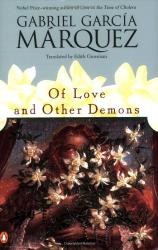
Of Love and Other Demons
by Gabriel García Márquez

List Price: $13.00
Pages: 160
Format: Paperback
ISBN: 0140256369
Publisher: Penguin USA

Click here to buy this book from Amazon.com.
Click here to buy this book from Amazon.ca.


About This Book


Of Love and Other Demons opens with a letter from the author explaining the genesis of the story. As a young cub reporter working in Cartagena, Colombia in 1949, García Márquez was asked to cover the emptying of the burial crypts of a historic convent called Santa Clara, where generations of bishops and abbesses had been laid to rest. While witnessing this event, García Márquez recalls, "the stone shattered at the first blow of the pickax, and a stream of living hair the intense color of copper spilled out of the crypt...attached to the skull of a young girl." Startled by the discovery, he remembers the legend his grandmother told him as boy about "a little twelve-year-old marquise with hair that trailed behind her like a bridal train, who had died of rabies caused by a dog bite and was venerated in the towns along the Caribbean coast for the many miracles she had performed."

Against the background of the lush, coastal tropics, García Márquez creates the story of an impossible, yet undeniable, love. Of Love and Other Demons is set in a South American seaport during the colonial era, the home of bishops and viceroys, enlightened thinkers and Inquisitors, lepers and pirates. Sierva María de Todos los Ángeles, the rebellious only child of a decaying noble family, has been raised by her father's slaves in their quarters behind his mansion. On her twelfth birthday she is bitten by a rabid dog and made to withstand therapies indistinguishable from tortures. Believed to be possessed, Sierva María is imprisoned in a convent, where she meets Father Cayetano Delaura, who has been sent to oversee her exorcism. Father Delaura, a protégé of the bishop, is unprepared for the transfiguring passion that Sierva María awakens in his soul. Of Love and Other Demons is the story of their love: improbable, deeply moving, and defying - even in death - the constraints of reason and faith.

top of the page


rgg_discuss.gif (1294 bytes)


1. Of Love and Other Demonsis based on two occurrences from Gabriel García Márquez's past, one an event he covered as a reporter and the other a legend told to him by his grandmother. Why does he choose to root the novella partly in his own history and experience and partly on a legend? How does this merging of a factual event and a fantasy help create the magical realism that forms the novella's foundation? What elements of magical realism do you see throughout the novella?

2. Sierva María favors pickled iguana and armadillo stew, learns to dance before she can speak, sings in Yoruban, Congolese, and Mandingo, and wears a Santería necklace over her baptism scapular. Dominga de Adviento, the formidable black woman who runs the household, happily practices both Catholic and Yoruban beliefs because "what she did not find in one faith was there in the other." Does Sierva María also find comfort in both faiths? At one point Sierva María's mother, Bernarda, remarks in annoyance, "The only thing white about that child is her skin." Is Bernarda right? Is Sierva María at home in both cultures or neither?

3. Depressed, idle, effeminate, and uneducated, Don Ygnacio is "as pale as a lily because the bats drained his blood while he slept." During his daughter's cruel treatment for rabies, the Marquis awakens to "the new joy of knowing he loved her as he had never loved in this world." Yet he delivers her that day to the Convent of Santa Clara. Why does he relinquish his daughter and ultimately leave her deliverance in the hands of Father Cayetano Delaura and the physician Abrenuncio? Is Sierva María aware of her father's love? Why, in the convent, does she declare she would rather die than see him?

4. In contrast to her husband, Bernarda is ravaged by her addictions, vomits bile, breaks wind "in pestilential explosions that startled the mastiffs," and turns her back on her "freak" of a daughter. Why does García

5.Márquez portray Sierva María's mother as such a grotesque? In the beginning of the story, Bernarda states that Sierva María "wouldn't tell the truth even by mistake." When Sierva María first enters the convent she meets Martina, "one of the few white women to whom she had told the truth." Later she names for Martina six demons that are supposedly inside of her and takes "delight in the deception." Why does Sierva María lie? Is it merely childish behavior? In what other instances does she lie, and how relevant are her lies to the story?

6. When assigned to exorcise Sierva María, Delaura is reminded of his painful awkwardness with women. To him they seem "endowed with an untransferable use of reason that allowed them to navigate without difficulty among the hazards of reality." What does this mean? Are the female characters in the

7.book more rational than the male ones? Are they as fully rendered? García Márquez evokes a time in Spanish American history when even the colonial magistrates, sent by the Spanish king to govern the colonies, have been affected by the Enlightenment. However, the colonies are ruled, in effect, by viceroys and powerful clerics, and by a belief in the supernatural. In this brief exchange the Bishop confesses his homesickness to Delaura: "The very idea that they have already slept tonight in Spain fills me with terror." "We cannot intervene in the rotation of the earth," said Delaura. "But we could be unaware of it so that it does not cause us grief," said the Bishop. "More than faith, what Galileo lacked was a heart." How does this exchange reflect the cultural shift taking place?

8. Sierva María claims to know what demons look like, chooses to live in filth, declares herself "worse than the plague," "bewitches" the visiting Vicereine, and presents Delaura with "the fearful spectacle of one truly possessed." Yet, as the priest points out to the Abbess, the assignation of her powers to Satan rather than God is completely arbitrary. Is Sierva María indeed possessed? Why is it so important for the Abbess to believe that she is? If not, why does Sierva María shake her head in

9.answer to the Marquis's question "Do you know who God is?" When the bishop finds him "writhing on the floor in a mire of blood and tears," Delaura says, "It is the demon, Father. The most terrible one of all." What is Delaura's demon? The Bishop banishes Delaura because he "had not confined himself to facing the demons with the unappealable authority of Christ, but had committed the impertinence of discussing matters of faith with them." To which demons is the Bishop referring? To what

10.others does the book's title refer? "Sierva," servant of God, is also the Spanish word for slave. Illiterate, silent, and conceived without love, Sierva María is to a large degree a cipher, a blank slate on which her script is written by those around her. At her birth the midwife predicts, "It won't live," Dominga de Adviento sings out, "She will be a saint," and the Marquis declares, "She will be a whore." To what degree is Sierva María the mistress of her own fate? Does she in any way propel her own death?

11. Before she leaves home for the convent, Sierva María asks her father if love conquers all, as the songs said. "Yes," he tells her, "but you would do well not to believe it." Does she die believing it? Does her and Delaura's love triumph?  

top of the page

Critical Praise

"Luminous...demonstrates that one of the masters of the form is still working at the height of his powers. "
The New York Times


"A work of considerable beguilement and edge.... García Márquez retains a vital and remarkable voice, and the pen of an angel. "
The Los Angeles Times Book Review


"Captivating.... Of Love and Other Demons evokes the texture of a civilization, while its emotional range, from the comic to the mystical, exhibits a reach rarely found in fictions on a larger scale. "
The Boston Globe


"The novel is continuing proof that García Márquez is the master of putting a lot of story into a small space.... [He] tells a story of forbidden love, but demonstrates once again the vigor of his own passion: the daring and irresistible coupling of history and imagination. "
Time


"Dense and complex within the confines of its simplicity, Of Love and Other Demons offers a rich platter of food for thought. If the criteria for great literature has to do with gripping our attention with the bizarre or the unusual, and then adding new dimensions to our understanding of the familiar, Of Love and Other Demons qualifies. "
USA Today


"With exquisite prose, García Márquez brings the magic, superstition and imposing power of the church to vivid life in a wondrous story of doomed and forbidden love. "
People
 
Facebook Fan Page  Follow us on Twitter


Add Your Guide to ReadingGroupGuides.com!

Bookreporter.com Bets On...: Books We're Betting You'll Love


Privacy Policy | Contact Us | Advertising | About Us

© Copyright 2001-2012, ReadingGroupGuides.com. All rights reserved.
The Book Report, Inc. • 250 West 57th Street • Suite 1228 • New York, NY • 10107
Ph: 212-246-3100 • Fax: 212-246-4640

Bookreporter.comReadingGroupGuides.comGraphicNovelReporter.comFaithfulReader.com
Teenreads.comKidsreads.comAuthorsOnTheWeb.com