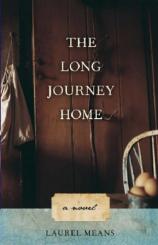
The Long Journey Home
A Novel of the Post-Civil War Plains
by Laurel Means
List Price: $16.95
Pages: 250
Format: Paperback
ISBN: 9780897335690
Publisher: Academy Chicago Publishers
A war-shocked Civil War veteran returns to find his homestead on the Mississippi River bluffs in ruins, his wife dead, his grown children seeking lives of their own. When an unexpected government land grant of 160 acres of Minnesota prairie land promises Henry Morton a new life, filled with dreams of a second family, new home, and prosperity, he packs up his wagon and treks west toward Todd County. His paths, however, soon cross with those of Agnes Guyette, the young, naïve, and illiterate daughter of a French Canadian settler. Their suspenseful journeys now take them in different directions across the wild beauty of the prairies and threatening Badlands to dramatic and unexpected challenges. There are some giddy moments of happiness --- Agnes galloping through fields of wild prairie flowers; some comical conversations --- Henry sharing confidences with his horse, Major; and some ingenious sequences --- Charles Bertrand springing Henry from jail. Yet, over all, the result is a pilgrimage of the soul forcing the main characters to recognize their own identity, both the good and evil of the human spirit and, finally, the power of friendship and love.
top of the page

1. Readers have commented on the novel’s suspenseful plot. What, if any, elements of suspense did you find in the way the story unfolded?
2. Did the story end as you expected?
3. Readers have also commented on the story’s strong, accurate, and occasionally brutally realistic depiction of pioneer life. Do you agree?
4. The author’s original title for the novel was Journey by Another Name, which the publisher changed to The Long Journey Home. Which title would you consider more appropriate, the one emphasizing “names” or the one emphasizing “home”?
5. What is the significance of the chapter titles? What are their thematic links?
6. How does Henry Morton’s character change in the course of his “journey”? Was he justified in marrying Agnes? In rejecting baby Rose? What do you think are the key moments of change? If you disliked him through the first few chapters, did you change your mind as you read further? Would you go so far as to consider him “redeemed” or should Agnes leave him?
7. How does Agnes’ character change? Did she really intend to drown herself and her baby? How did she justify her marriage to Matthew Creighton? What do you consider her more important influence – Henry or Matthew? Find one or two examples which signal maturing, either through her language or actions.
8. What role does the French Canadian blacksmith, Charles Bertrand, play? What is the significance of his being a “blacksmith/farrier”? Is he Henry’s friend or foe?
9. Why is the band of crooks after Henry’s homestead? What is the first clue to their intent? What steps do they take to destroy him? How are they foiled?
10. The “rose embroidered shawl” is an important symbol, tying much of the story together. What was it, why was it significant, and how does it achieve this linkage?
11. Imagery is also important throughout the story. Select your favorite passage to read aloud to the group describing the use of “water,” or “prairie landscape,” or “food.”
12. Although this is not overtly a religious novel, the author’s subtle use of John Bunyan’s Pilgrim’s Progress and the Bible as literary subtexts offer additional narrative dimensions. Discuss how these as themes and symbols are woven into the story. For example, Henry quotes Bunyan in several moments of despair. And, although he doesn’t actually read his family Bible, he finds it useful (think "names")..
13. Family life is depicted in various ways throughout the story, sometimes positive in showing the happiness of loving families working together, at other times illustrating the tragic effects of betrayal and loss. Discuss several examples of both.
14. Many of the geographic locations in the story are real, for example, Minneapolis, St. Cloud, Alexandria, Lake Osakis, Ft. Abercrombie (all in Minnesota), Jamestown and Ft. Rice (North Dakota), and Glendive, Montana. The publisher opted not to include the map provided by the author, but is it possible to trace the routes taken by Agnes and Henry? (Clues: for “Riverbend” read Shakopee; for “River Bluffs” read Red Wing; for “Green Prairie” read Long Prairie.) Why do you think some place-names were fictionalized?
15. Pioneer life seems fascinating if not romantic to our present age --- consider the popularity of Little House on the Prairie. Did your view change after reading The Long Journey Home?
top of the page

"Finished the book --- so hard to put down --- and liked it very much! It has a strong plot and a heroine who grows on one; also a solidly constructed physical world that makes one feel yes, the settler experience must have been very like that (guess that's why I like the cover shot of a very simple interior). Liked the use of Bunyan: it connects . And that's a great last line. Would make a wonderful movie!"
Jay Macpherson, author of The Boatman and other works, noted Toronto writer and critic
"Filled with shifting landscapes and graphic action, the novel’s suspense-filled pace never slows. Its final scene celebrates the survival of the human spirit, a testimony as valid today as it was a century ago --- testimony perhaps even more welcome in our time."
G. Miller, Academy Chicago Press, January 2008
"The characters are not always likable --- Morton is harsh and rather unpleasant at times --- but they are certainly realistic. The situations that Morton and his family face are often dramatic, but the events do not seem heavy-handed or exaggerated. Settling the American west was treacherous, and The Long Journey Home captures the danger and risk at the heart of the settlers’ experience."
Nanette Donohue, Historical Novels Review, August 2008
"Ms. Mean's has written a wonderful post-Civil War story of life on the plains. The novel strives for historical accuracy over easy stereotypes, realism over cheap sentimentality and the author makes the wise choice of portraying her characters as fully realized human beings with all of their strengths and weaknesses helping to shape their fate. A reader is given an accurate and inspired journey through the hardships and struggles of a family trying to survive in an often harsh and difficult environment. Within these struggles, there is also a tale of the power of hope, faith and love. Well done!"
TGB, Amazon Reviews, November 2008