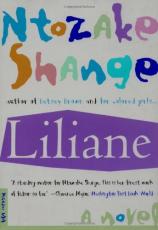
Liliane
by Ntozake Shange
List Price: $12.00
Pages: 288
Format: Paperback
ISBN: 0312135599
Publisher: Picador
Ntozake Shange's highly acclaimed plays, poetry, and fiction have established her as a major figure in contemporary American literature. Her latest novel, Liliane: Resurrection of the Daughter, stems partly from her own segregated childhood in St. Louis, partly from the double-edged realization that, in her words, "we knew we came from something, somewhere, and had watched as 'The Other' removed us from ourselves, our lands, our language, and each other, at will or on a whim. Nevertheless . . . the intermingling of people of color on these shores revitalized an African-American community that was numbed by the violence of the sheer task of living here."
top of the page

1. The author has said, "Liliane's story could never be told omnisciently, from on high," and the novel is told from several different points of view, instead of a traditional, linear narrative. What effect does this multi-voiced storytelling have on the reader's understanding of Liliane? How does Liliane's community of voices reflect the events of Liliane's life, or the lives of African-Americans?
2. What is the significance of Shange's subtitle: "Resurrection of the Daughter?"
3. Ntozake Shange has said that in writing Liliane, she "wanted to create a character who was free to travel, open to new ideas, and committed to bringing something to the world that had never existed before: her art." What might the act of artistic creation symbolize to Liliane? What various kinds of art function in the narrative?
4. The novel is punctuated by Liliane's sessions with her psychoanalyst. What effect do these rhythmic punctuations/ interruptions have on the narrative as a whole?
5. Much of the novel, and Liliane's own artwork, concentrates on female sexuality. How does Liliane's sexual identity change through the course of the book? How does it mirror the way she comes to terms with her mother's sexuality?
6. On page 164, Liliane's friend Bernadette says of Liliane: "I always figured she was some other kinda white girl. "What does this statement signify about Liliane's behavior? How do Bernadette's feelings change during the course of the racial violence they experience together? What is "some other kinda white girl?"
7. The chapters in Liliane have detailed titles ranging from "I Know Where Kansas City Is, But Did Wilbert Harrison Ever Get There?" to "'Happy, Happy Birthday, Baby' or Wouldn't It Be Great If the Lead Singer of The Crests Wasn't a White Boy and I Could Be My Mother?" What do these chapter titles have to do with the individual chapters? The work as a whole? What role do music and musical artists play in these titles?
8. Discuss the nature of Liliane's character. Is she exceptional? Ordinary? Purely fictional? Is she sympathetic? Reliable? How do Liliane's experiences compare to those of the "ordinary" African-American woman? How does being an artist shape and define Liliane's character?
9. The book brings together the voices of people of various ethnic backgrounds: Creole, Latino, French, Portuguese, and African. Liliane herself wants to master every language ever spoken by slaves. What is the effect of this bending of languages? What does it mean that Liliane finds herself "incomplete" in English, her first language?
top of the page

" Brilliant and brave. "
Vibe
"A dense, ambitious, worthy song. "
The New York Times Book Review
"A Wealth of convincing and true African-American voices talking love and pain, survival and renewal. "
Washington Post Book World
"Distinctive, rich in its language and compelling in its revelations. "
Philadelphia Inquirer
"Flamboyant, passionate, and richly textured -- an original and memorable work. "
Kirkus Reviews