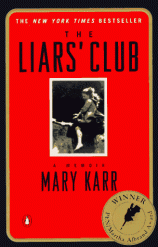
The Liars' Club


About the Book
The Liars' Club




The Family Sideshow
When I set out on a book tour to promote the memoir about my less than perfect Texas clan, I did so with soul-sucking dread. Surely we'd be held up as grotesques, my beloveds and I, real moral circus freaks. Instead I shoved into bookstores where sometimes hundreds of people stood claiming to identify with my story, which fact stunned me. Maybe these people's family lives differed in terms of surface pyrotechnics – houses set fire to and fortunes squandered. But the feelings didn't. After eight weeks of travel, I ginned up this working definition for a dysfunctional family: any family with more than one person in it.
Maybe coming-of-age memoirs are being bought and read by the boatload precisely because they offer some window into other people's whacked-out families, with which nearly everyone born in the fractured baby-boom era can identify. They also guarantee a central character emotionally engaged in a family narrative. Any writer's voice – even an omniscient, third-person narrator's in fiction – serves as a character in the text. But in memoir, the alleged "truth" of a given voice makes it somehow more emotionally compelling. It announces itself as real. Because family memoir lodges us in a writer's personal history, we can almost see the voice being shaped by factors of geography, socio-economics, psychology. Like a ghost that assembles itself from mist, so the writer's self seems to appear from her voice. Believe this, the autobiographer says, it's real. If metafiction has been working double-overtime to explode the lie that fiction is true, memoir somewhat reestablishes the reader's dream.
Of course, most readers doubt the absolute veracity of a memoir's reconstructed dialogue and so forth. Tobias Wolff noted in a recent lecture at Syracuse University that all memory involves imagination and vice-versa. Some memoirs also clearly wander into the realm of the fantastic to construct what read like family myths – Maxine Hong Kingston's Woman Warrior, for instance. There the author steals her Chinese mother's method of "talking-story" to meld her own somewhat conflicting Chinese and American selves.
Still, we presume that the truth's skeleton underlay Hong Kingston's tale. So the character speaking to us from those events also feels, in some way, like a more real escort through the drama than a fictional narrator's. However "real" Ishmael may seem in Moby Dick, Mary McCarthy offers me as a reader what feels like greater intimacy with a living character in Memories of a Catholic Girlhood.
Don't get me wrong. Greater intimacy with a narrator isn't always what a reader wants: I haven't given up reading novels. But in the cocooned isolation we occupy at this millennium's end, a friendly voice on a page has value.
A child's voice or perspective can also open the often firmly locked door to a reader's own memories of youth. When I read in Harry Crews's A Childhoodhow that backwoods Georgia boy made up stories about models in the Sears catalog, I identified with it wholesale, even though I grew up far from the savage poverty Crews lays out:
"Nearly everybody I knew had something missing, a finger cut off, a toe split, an eye clouded with blindness from a glancing fence staple.... I knew that under those [Sears models'] fancy clothes, there had to be swellings and boils of one kind or another because there was no other way to live in the world."
Anybody would twig to some universal truth about the childhood Crews describes here, I think. We all lose our innocence in part by coming to marvel at the rift between one's private life – family fights, say – and the glossy families sold by the media. Crews's voice conjures that innocence for us, the time when a family universe was still so colossal that you could project that reality onto the lives of strangers. Crews's private experience ultimately overrode the lie of the Sears catalog. The stories he made up with his friend gave him, he later wrote, "an overwhelming sense of well-being and profound power."
Crews's survival is also encouraging, a testimony of sorts. In a class on memoir I taught at Syracuse University last year, my students puzzled me at the term's end by praising the genre's sense of hope. Of the dark and dire stories we'd read – mental institutions for Susanna Kaysen and rape for Maya Angelou – hope didn't seem the leading emotion (except perhaps in Henry Louis Gates's Colored People). "They lived to write books," one student said. "They grew up and got away from their parents," said another. The fact that the writers outlived their troubled pasts, walked out of them into adulthood, ultimately served as empowering for that class of readers.
Not everyone's so wowed by what memoir offers up. William Gass took a hard swipe at the whole genre in Harper's last May ("Autobiography in the Age of Narcissism") primarily scolding the genre's lack of truth. "The autobiographer is likely to treat records with less respect than he should.... Autobiographers flush before examining their stools."
For "truth" Gass favors history without bothering to note – as Tobias Wolff did in the aforementioned lecture – that historians are no more neutral toward their subjects than memoirists are. Nor can such primary sources as letters and diaries be construed as "objective." Gass also neglected history's glaring failures. My high school history text cheerfully described the westward migration without a glance at the native peoples whose bones got plowed under in the process.
Gass also praised fiction for veracity because it doesn't announce itself as true. I could borrow that same reasoning to defend memoir for its blatant subjectivity. In our time we've watched most great sources of "objective" truth – churches and scientific studies and presidents among them – topple in terms of their moral authority. So any pose of authority can seem the ultimate fakery. In this way, Michael Herr's psychedelic memoir of Vietnam,Dispatches, seems way more authentic to me in describing that war than the Defense Department's records "objectively" assembled under Robert McNamara.
In our loneliness for some sense that we're behaving well inside our very isolated families, personal experience has assumed some new power. Just as the novel form once took up experiences of urban, industrialized society that weren't being handled in epic poems or epistles, so memoir – reliant on a single, intensely personal voice for its unifying glue – wrestles subjects in a way that readers of late find compelling. The good ones I've read confirm my experience in a flawed family. They reassure me the way belonging to a community reassures you.
My bookstore chats did the same. On the road, I came to believe – despite the dire edicts from Newt Gingrich and the media about the moral, drug-besotted quagmire into which we've all sunk – that our families are working, albeit in new forms. People have gone on birthing babies and burying their dead and loving those with whom they shared troubled patches of history. We do this partly by telling stories – fictional and non-fictional ones – in voices that neither deny family struggles nor make demons of our beloveds.


The Liars' Club
- Publication Date: November 19, 1998
- Paperback: 336 pages
- Publisher: Penguin (Non-Classics)
- ISBN-10: 0140179836
- ISBN-13: 9780140179835