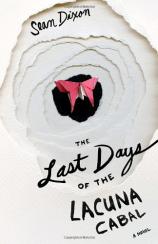
The Last Days of the Lacuna Cabal
by Sean Dixon
List Price: $15.95
Pages: 304
Format: Paperback
ISBN: 9781590513125
Publisher: Other Press
The girls of the Lacuna Cabal Montreal Young Women’s Book Club are at a crossroads. One of their founding members is dead, they’ve made a few unfortunate compromises to their membership, some of them aren’t getting any younger, and they’ve been stuck on a single weepy tome for six long months. Resident maverick Runner Coghill decides to shake things up by introducing a cherished family heirloom to the group --- ten pristine stone tablets, carved in cuneiform, telling the oldest story in the world: The Epic of Gilgamesh. Because their new book is written in an ancient language, the group must take the unprecedented step of allowing Runner to translate the whole story for them. But Runner’s narration is not of a common vein. Before they know it, the Cabalists have been thrust out to sea, on a journey in search of answers that extends halfway across the world to the war-torn land of this oldest story’s birth.
The Last Days of the Lacuna Cabal is an offbeat rites-of-passage novel whose characters live out literature with ferocity and passion. It is a funny, quixotic debut that follows the members of a shallow, squabbling, time-wasting, protracted-adolescent book club as they find themselves transformed through the alchemy of the storyteller’s art.
-Enter for a chance to win $500 and a signed copy of Sean Dixon's novel The Last Days of the Lacuna Cabal here.
top of the page

1. Runner and Neil “wondered how a piece of text written six thousand years ago could speak so eloquently to them about their loss and grief, until eventually they stopped wondering and accepted that it was so.” How does the modern interpretation of ancient texts help them and the members of the Lacuna Cabal Book Club deal with Ruby’s death and their own lives?
2. Coby had been traumatized as a teenager by reading a book “in which the male protagonist, unable to perform, had been thrown out of his paramour’s apartment” (page 93), and Dumuzi secretly reads Chinese poetry and cares about the ninth-century poet Yu-Xuanji in a way that mystifies him (page 97). Emmy is so heartbroken about a breakup that she loses her love of literature (page 24), while Runner insists that the discussion of books can change the world (page 159). What do these experiences of the Lacuna Cabal members say about the power and limits of literature? Do you believe reading can change lives?
3. Sexuality plays a big role in the lives of the members: Runner’s lack of it, Coby’s initiation by Emmy, Romy’s feelings for Emmy, Missy’s attempts to get pregnant, Anna’s forays into prostitution, Dumuzi’s desire for Anna. What do you think about the complications and some of the resolutions of their experiences?
4. Why does the group break their cardinal rule of having no male members (except for Neil who was not a true member but “present to the membership” (page 29). How do the men deal with their second-class status?
5. Romy agrees to play Humbaba, tempted to experience violence and annihilation, but regrets it. After the struggle and Romy’s traumatic loss of her hair, Dumuzi asks, if a woman invented this task, then why should a woman get the short end of the stick? (page 151) What are some other examples of self-destructiveness on the part of the female members of the club?
6. How do the group dynamics work in the Lacuna Cabal Book Club? What are the different ways that Runner and the other members react to Missy’s wielding of her power as the founder and head of the group? How do you understand Missy’s increasing self-awareness and understanding of her desire for power by the end of the book?
7. Even though Aline is a cross-dresser struggling with illusion and reality, it is he who looks at violence and masculinity and tries to bring attention to the war in Iraq. What do his conflicts illustrate? How does recalling the “old secret feelings of beautiful androgyny” effect Aline? (page 178)
8. Aline suggests the group read a blog next: “I move that if we embrace the past then we must also embrace the future. I move that if we accept books of stone then we should be able to propose blogs…a relevant blog” (pages 62–63). This book refers to many different forms of writing, from the ancient texts to children’s books, plays, e-mail, and blogs. How do you relate to these formats? Do you agree or disagree with Aline?
9. Neil tries to keep his sister Runner from courting death, but she lives out the myth of the sisters who were “so close as to be almost the same person” (page 183) and rejoins her sister Ruby. How does the Baghdad Blogger act as the wise man and use the Inanna myth to reinterpret Neil’s destiny for him as himself, Neil Coghill the Real McCoghill?
10. Coby is first described as seeming “barely human” (page 71), attached only to his artificial intelligence project, which was supposed to be designed to become “intelligent through exploration and a sense of touch” (page 70). However, Coby programs his fitzbot to seek cover and comfort in the shadows and avoid humans. He has a breakdown when he thinks the fitzbot is stolen, but once he gets involved with Emmy he forgets about it. How do you think Coby finally works out his feelings for Emmy and his work with the fitzbot, body and mind?
11. Each character seems to have his or her own self-made myth. Describe how they see themselves. Do these perceptions change by the end of the novel? How do you see these characters?
12. Humor and wit is all-pervasive in this book. Do you think it merges well with the difficult and sad events that take place?
13. The final message to Gilgamesh and to Neil is the same: The best way to honor the dead is to live the best life you can. Do you believe that this is a universal truth that provides us with the strength to accept our mortality?
Suitability Questionnaire for the Lacuna Cabal Young Women’s Book Club
1) What is your favorite book? ____________________
2) Second favorite? ____________________
3) How do you rate your acting skills?
Poor Fair Good Superior
4) Rate your willingness to act out the story of a book.
Poor Fair Good Superior
5) Can you imagine yourself as a character in a novel?
Poor Fair Good Superior
6) What about an epic?
Poor Fair Good Superior
7) Are you a good liar?
Poor Fair Good Superior
8) a) Can you project?
Poor Fair Good Superior
b) Histrionics?
Poor Fair Good Superior
9) Can you be trusted with a secret?
Poor Fair Good Superior
10) Do you consider yourself flexible regarding,
a) Hours? Poor Fair Good Superior
b) Locations? Poor Fair Good Superior
c) Temperature levels? Poor Fair Good Superior
d) Willingness to travel? Poor Fair Good Superior
e) Out of the country? Poor Fair Good Superior
f) Breaking the law?* Poor Fair Good Superior
g) Necessary risk? Poor Fair Good Superior
11) How do you feel about Margaret Atwood writing science fiction? (Some of us don’t approve.)
12) Please write a short autobiographical sketch, including plausible theories on why literature has gained a place close to the center of your life.
14) Do you eschew unluckiness?
Poor Fair Good Superior
*E.g., spying, kidnapping, B&E… nothing more serious than that.
top of the page

"A sort of Tristram Shandy for the twenty-first century, Dixon’s first novel is an intellectual, sexual, logorrheic, bibliophilic, cryptological, political, and archaeological rant of the first order. It’ll blow your mind."
Michael Redhill, author of Consolation
"Sean Dixon is a worthy successor to some of Canada’s foremost authors. He is in possession of an imaginative gift akin to Timothy Findley, the erudition and style of Robertson Davies and the off beat humor of Mordecai Richler. And like them, he is deserving of recognition and a following south of the border."
Bruce Bauman, author of And The Word Was
"This sweet, unpredictable novel is fun to read and quietly undemanding. Dixon’s writing has a good comic assurance and he adroitly conjures all manner of strangeness in his tale of an elite, eccentric women’s book club in Montreal... Ingenious."
Time Out
"[An] ambitious book... Dixon has fashioned his make-believe to be relevant, offered a satisfying harvest from early planted seeds, and embedded some fine intellectual levity."
The Globe and Mail
"The Last Days of the Lacuna Cabal is a darkly comedic paen to friendship, love, and, most of all, books... Linguistically, thematically, emotionally --- every facet of The Last Days of the Lacuna Cabal sprawls and is loaded with inter-textual references and winking narrative play that’s fun and engrossing."
Russ Marshalek, BabyGotBooks.com