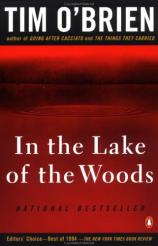
In the Lake of the Woods
by Tim O'Brien
List Price: $12.95
Pages: 303
Format: Paperback
ISBN: 0140250948
Publisher: Penguin USA
On its surface, In the Lake of the Woods suggests the
classic locked-room mystery turned on its head. Sometime between the night
and late morning of September 19, 1986, a woman vanishes near Lake of
the Woods in northern Minnesota, "where the water was everything,
vast and very cold, and where there were secret channels and portages
and bays and tangled forests and islands without names." While the
traditional locked-room mystery presents investigators - and readers -
with the seemingly impossible, the disappearance of Kathy Wade poses too
many possibilities, a wilderness of hypotheses. There are too many places
she could have gone, too many things that could have happened to her.
As Tim O'Brien gradually reveals
in this haunting, morally vertiginous novel, there were too many reasons
for Kathy to vanish. All of them are connected to her husband, John, an
attractive if morally confused 40-year-old politician whose career has
lately ended in a defeat so humiliating that it has driven the Wades to
an isolated cabin in the Minnesota woods.
A long-buried secret has resurfaced
to bury John alive; perhaps it has buried Kathy along with him. John's
disgrace originated in "a place with secret trapdoors and tunnels
and underground chambers populated by various spooks and goblins, a place
where magic was everyone's hobby...a place where the air itself was both
reality and illusion, where anything might instantly become anything else."
Its geographic epicenter is
the village of Thuan Yen in Vietnam. It was there, eighteen years before,
that John Wade was transformed from a boy with a gift for performing magic
tricks (his platoon-mates knew him as "Sorcerer") into an entranced
killer.
What happened at Thuan Yen
was not fiction. The events that took place there were widely reported
and documented in official U.S. Army hearings and are known today as the
My Lai massacre. At the heart ofIn the Lake of the Woods is its
brutal re-creation of this wound in John Wade's history and his country's.
Because Wade was one of many killers, Tim O'Brien intersperses his narrative
with the testimony of real figures like Lieutenant Rusty Calley and U.S.
Army Investigator William V. Wilson--not to mention Presidents Richard
Nixon and Woodrow Wilson. Just as John's and Kathy's associates--his mother
and campaign manager, her sister and co-worker--try to decipher the events
at Lake of the Woods, those historical witnesses posit partial
explanations for America's mysteriously aligned obsessions with politics
and violence.
Clausewitz observed that war
is the continuation of politics by other means. Tim O'Brien suggests that
politics, at least in its American variety, is a continuation of needs
more basic and more terrible even than the need for power. The craving
for love, he reminds us, can drive the human soul toward acts of desperation,
deceit, and even violence.
For O'Brien, as for the unnamed
investigator who is his narrator, all explanations are hypotheses rather
than proofs. Beyond the mystery of Kathy's disappearance and John's role
in it, and even beyond the mystery of My Lai, are other riddles: What
predisposed John to become a murderer? What sort of magic enabled him
to make his past vanish for twenty years, and what disappeared along with
it? How could he love Kathy with such self-annihilating ferocity while
keeping an essential part of himself hidden from her? Was Kathy a victim
of John's deceptions or a participant in them? Is John an autonomous moral
agent or another victim-of a bad childhood or a bad war or the murderous
pastel sunlight of Vietnam? With In the Lake of the Woods, O'Brien
has reinvented the novel as a magician's trick box equipped with an infinite
number of false bottoms. Kathy's disappearance remains a "magnificent
giving over to pure and absolute Mystery." John believes that "to
know is to be disappointed. To understand is to be betrayed." This
brave and troubling novel neither betrays nor disappoints, but brings
the reader into a direct confrontation with the insoluble enigmas of history,
character, and evil.
top of the page

1. Almost from this novel's first page we know that Kathy Wade will vanish, and it is not long before we discover that her disappearance will remain unsolved. What, then, gives In the Lake of the Woodsits undeniable suspense? What does it offer in place of the revelations of traditional mysteries?
2. Instead of a linear narrative, in which action unfolds chronologically, Tim O'Brien has constructed a narrative that simultaneously moves forward and backward in time: forward from John and Kathy's arrival at the cabin; backward into John's childhood, and beyond that to Little Big Horn and the War of Independence. It also moves laterally, into the "virtual" time that is represented by different hypotheses about Kathy's fate. What does the author accomplish with this narrative scheme? In what ways are his different narrative strands connected?
3. What does O'Brien accomplish in the sections titled "Evidence"? What information do these passages impart that is absent from the straightforward narrative? How do they alter or deepen our understanding of John as a magician, a politician, a husband, and a soldier who committed atrocities in wartime? What connections do they forge between his private tragedy and the pathologies of our public life and history? Does the testimony of (or about) such "real" people as Richard Nixon, William Calley, or George Custer lend greater verisimilitude to John's story or remind us that it--and John himself--are artifices?
4. Who is the narrator who addresses us in the "Evidence" sections? Are we meant to see him as a surrogate for the author, who also served in Vietnam and revisited Thuan Yen many years after the massacre? (See Tim O'Brien, "The Vietnam in Me," in The New York Times Magazine, October 3, 1994, pp. 48-57.) In what ways does O'Brien's use of this narrator further explode the conventions of the traditional novel?
5. One of the few things that we know for certain about John is that he loves Kathy. But what does John mean by love? How do John's feelings for his wife resemble his hopeless yearning for his father, who had a similar habit of vanishing? In what circumstances does John say "I love you"? What vision of love is suggested by his metaphor of two snakes devouring each other? Why might Kathy have fallen in love with John?
6. Although it is easy to see Kathy as the victim of John's deceptions, the author at times suggests that she may be more conscious (and therefore more complex) than she first appears. We learn, for example, that Kathy has always known about John's spying and even referred to him as "Inspector Clouseau," an ironic counterpoint to John's vision of himself as "Sorcerer." At a critical moment she rebuffs her husband's attempt at a confession. And in the final section of "Evidence," we get hints that Kathy may have planned her own disappearance. Are we meant to see Kathy as John's victim or as his accomplice, like a beautiful assistant vanishing inside a magician's cabinet?
7. Why might John have entered politics? Is he merely a cynical operator with no interest in anything but winning? Or, as Tony Carbo suggests, might John be trying to atone for his actions in Vietnam? Why might the author have chosen to leave John's political convictions a blank?
8. John's response to the horrors of Thuan Yen is to deny them: "This could not have happened. Therefore it did not." Where else in the novel does he perform this trick? How does John's way of coping with the massacre compare to the psychic strategies adopted by William Calley or Paul Meadlo? Do any of O'Brien's characters seems capable of acknowledging terrible truths directly? How does In the Lake of the Woods treat the matter of individual responsibility for evil?
9. Each of this novel's hypotheses about events at the cabin begins with speculation but gradually comes to resemble certainty. The narrator suggests that John and Kathy Wade are ultimately unknowable, as well; that any attempt to "penetrate...those leaden walls that encase the human spirit" can never be anything but provisional. Seen in this light, In the Lake of the Woods comes to resemble a magician's trick, in which every assertion turns out to be only another speculation. Given the information we receive, does any hypothesis about what happened at Lake of the Woods seem more plausible than the others? With what certainties, if any, does this novel leave us?
top of the page

" A risky, ambitious, perceptive, engaging, and troubling novel...a major attempt to come to grips with the causes and consequences of the late 20th century's unquenchable appetite for violence, both domestic and foreign. "
Chicago Tribune
"A relentless work full of white heat and dark possibility. "
The Boston Globe
"At bottom, this is a tale about the moral effects of suppressing a true story, about the abuse of history, about what happens to you when you pretend there is no history. "
The New York Times Book Review
"A memorable mystery story charged with haunting ambiguity...If any American novelist is creating more beautifully written, emotionally harrowing tales than Tim O'Brien, I don't know who it could be. "
Entertainment Weekly
"An unrelenting exploration of the darkest recesses of the human heart and psyche. O'Brien's approach is bold, ambitious, and intriguing. "
Houston Chronicle
"This remarkable book is about the slipperiness of truth, the weight of forgetting, and the way two people disappear into themselves, and, ultimately, into the Lake of the Woods. "
The New Yorker
"O'Brien's clean, incantatory prose always hovers on the edge of dream.... No one writes better about the fear and homesickness of a boy adrift amid what he cannot understand, be it combat or love. "
Time