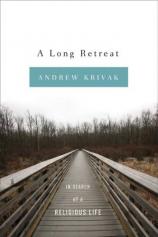
A Long Retreat
In Search of a Religious Life
by Andrew Krivak
List Price: $25.00
Pages: 336
Format: Hardcover
ISBN: 9780374166069
Publisher: Farrar, Straus and Giroux
In 1990, the fledgling poet and classics student Andrew Krivak embarked on a literally soul-searching journey that would transform his understanding of faith, love, and, most of all, himself. He entered the Society of Jesus, committing the next years of his life to intensive Jesuit training that called for periods of extended silence and self-reflection as well as a deep immersion in impoverished communities around the world.
A memoir that captures an essential quest for meaning and fulfillment --- a universal quest that everyone must at some point face --- A Long Retreat brims with stirring anecdotes and provocative observations about the very heart of a religious life. Within the Jesuit community, Krivak discovered a path that often posed dif?cult choices. After eight years, the obligation to remain unmarried posed the greatest dilemma, although religious obedience was an equally challenging vow to live. Krivak ultimately left the Society and married the woman he describes falling in love with in the book, a woman who shared his love for God and with whom he would create a joyous family. Yet the awakenings he experienced as a Jesuit, while traveling to inner cities and faraway locales, ministering to AIDS patients, or testing his wings as a college professor, would spur in him a keen, lasting awareness of his fellow human beings. The result was a perspective of in?nite hope, which his personal story imparts to all who read it.
top of the page

1. How did your understanding of the prologue shift as you read subsequent chapters of A Long Retreat? What were your initial impressions of the author and his approach to faith in the aftermath of his father’s death?
2. How do the author’s gifts as a poet affect the way his memoir unfolds? In what way did his poetic agility enhance his experience of scripture?
3. Discuss the meditative weeks Andrew Krivak describes beginning on page 82. What psychological journey do they appear to follow? What is the impact of their sequence? What images would you have focused on throughout these protocols?
4. The author is very open about his past “sins” in the ?rst week of the spiritual exercises. What are the best ways to relieve ourselves of a burden of conscience? Are any actions impossible to forgive? What roles do time and memory play in how a person might live with “what I have done, and . . . what I have failed to do”?
5. Krivak doesn’t include a great deal about his brothers and sisters in the book, writing on page 28, “You’ll not hear much about them in this story.” Why? When he does evoke them, what does Krivak recall most strongly about his brothers Matthew and John? How would you characterize these relationships?
6. Discuss Krivak’s meditation during the long retreat, taken from Luke: “Put out into deep water.” When did this message become most signi?cant to Krivak? At what points was he venturing into the deepest waters? In what way could this directive be useful in your life?
7. In Part III, particularly beginning on page 182, Krivak confronts foundational questions of faith, with references ranging from Anselm’s proof of God’s existence to Thomas Aquinas’s Five Ways and Descartes’s idea of a perfect being. How did the prism of philosophy, and Krivak’s role as a philosophy professor, shape his approach to these questions? Ultimately, what is the best way to answer them?
8. On page 209, the author begins to feel deep exasperation with the demands --- real and imagined --- of his religious life and tells Jeff, “There’s no beauty in any of this.” Have you ever experienced frustration in your own routine? What are your de?nitions of beauty, in spiritual and concrete terms?
9. Which of the author’s travels, domestically or abroad, would have been the most challenging for you? How did his intended missions compare to the reality of his work after he arrived in these locales, ranging from the Caribbean to Eastern Europe?
10. How did you respond to Krivak’s observations about human sexuality and the priesthood on pages 283 and 284? Should one’s sexuality matter if he or she has taken a vow of chastity? Why or why not?
11. Which aspects of the Society of Jesus surprised you the most? Which aspects seemed to surprise the author the most? Do you know any Jesuits? How do contemporary Jesuits re?ect the legacies of their forebears?
12. In what way do the epigraphs appearing on the ?rst page of each part mirror Krivak’s transformations? What thread of wisdom weaves these quotations together?
13. In any life we lead --- spiritual, family, social --- what is the best way to balance the need for solitude with the need to serve others and be in a community?
14. What religious memoirs --- classical or contemporary --- is Krivak conscious of in his writing? How is the form of his book similar to or different from others?
15. What is the role of literary allusion in this book? How and when does Krivak turn to the authors he has read as guides? How is scripture understood on the literary level?
top of the page

“Here is a personal remembrance and reflection become an instrument of summoning spiritual witness --- and an account of a soul’s progress amid the possibilities offered by our contemporary secular world --- all told incisively and with a haunting candor that will reach and touch the grateful reader.”
Robert Coles, author of The Call of Stories: Teaching and the Moral Imagination
“This is the best spiritual memoir I’ve read since The Seven Storey Mountain --- and that was a long time ago. Andrew Krivak conveys his own ardent search while also capturing the fragmented spirit of our times, making his ‘long retreat’ the occasion for a wise, tough, and sometimes refreshingly comic meditation on faith. I read it like a detective story, unable to put it down --- and then unable (and unwilling) to stop thinking about its lingering questions.”
Patricia Hampl, author of Virgin Time: In Search of the Contemplative Life