IndieBound Independent Bookstores

Barnes & Noble

Loading
Reading Group Guide
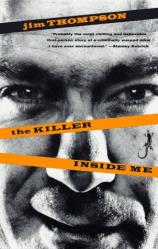
The Killer Inside Me
by Jim Thompson

List Price: $10.00
Pages: 256
Format: Paperback
ISBN: 0679733973
Publisher: Vintage

Click here to buy this book from Amazon.com.
Click here to buy this book from Amazon.ca.


About This Book


The Killer Inside Me
is a chilling portrait of Lou Ford, the twenty-nine-year-old deputy sheriff of a small town in the oil fields of West Texas. Ford is experiencing a recurrence of "the sickness" that triggered a crime in his youth, a crime that his doctor father, now dead, covered up for him. Now Ford spends his days enforcing the law in Central City and his nights with his schoolteacher girlfriend, Amy Stanton, who also comes from a "good family." Ford's goal is to seem normal--"I've stood like that, looking nice and friendly and stupid" but something is seriously off-kilter, because "all the time I'm laughing myself sick inside" [p. 121]. The sickness that returns is worse this time, manifested in a series of sadistic murders. Jim Thompson brilliantly created a first-person voice for Lou Ford, rooting deep inside the warped psyche of this distinctive character to tell his story. Jim Thompson wrote The Killer Inside Me in 1952 for Lion Books, a publisher of paperback originals. Lion gave him a synopsis to work from, but Thompson radically changed the formula to his own, and astonished his publisher by writing the book in four weeks.

top of the page


rgg_discuss.gif (1294 bytes)


1. In a first-person narration, Deputy Sheriff Lou Ford comments to himself, "If there's anything worse than a bore, it's a corny bore" [p. 4]. How does Thompson use dialogue to dramatize Ford's character? When Lou gazes in the mirror, he describes what he sees: the Stetson, a pinkish shirt, a "typical Western-country peace officer, that was me" [p. 28]. In another context, this would be a mundane description, but what more does it tell us about Lou Ford?

2. Lou says he reads German, French, and Italian medical journals. "I couldn't speak any of those languages worth a doggone, but I could understand 'em all" [p. 27], he says. Is his claim credible in the context of what we learn about him? In what incidents is his self-taught education in evidence, and how is it perceived by others? What would erudition represent to a Lou Ford? The journals are in his father's library. What role does his father play in his psyche?

3. Lou's recollections are often ambiguous, more implied than specific, such as his traumatic boyhood involvement with his family's housekeeper, Helene. What is Helene's transgression in Lou's mind, and what role does he ascribe to it in the context of his "sickness"? Is this thought process a recurrent pattern in Lou's pathology?

4. Early in the story Sheriff Bob Maples suggests to Lou, "Watch youself. It's a good act but it's easy to overdo" [p. 25]. Later, at the hotel in Fort Worth, he drunkenly repeats his caution: "Wash--watch y'self.... S-stop all a' stuff spilt milk n' so on. Wha' you do that for, anyway" [p. 85]. Is he implying that Lou's "act" has not been as convincing as Lou thinks? How does Ford react? What is Bob's relationship to Lou, and why does he ultimately resolve it the way he does? Is the relationship credible as portrayed by Jim Thompson?

5. In his treatment of Central City and its citizenry, how does Thompson characterize small-town America?

6. As Lou kills his girlfriend, Amy, he pauses to notice what she's wearing, he sits down to read the paper, he makes puns on her penny-pinching. How do these actions serve the description of a violent act? How important are descriptions of violence in the story of Lou Ford? How, overall, are violent sequences presented?

7. At the novel's end, Lou has set fire to the library and probably the rest of the house. To what extent is this a biblical, spiritual climax? Or is the fire an act grounded in psychological pathology? It is, after all, Lou's father's house. Is the elegiac final paragraph an extension of the spiritual theme, or is it a chilling reminder of the nihilism that has subsumed Lou Ford up until that moment?

top of the page

Critical Praise

" Probably the most chilling and believable first-person story of a criminally warped mind I have ever encountered. "
Stanley Kubrick


"Jim Thompson is the best suspense writer going, bar none. "
The New York Times
 
Facebook Fan Page  Follow us on Twitter


Add Your Guide to ReadingGroupGuides.com!

Bookreporter.com Bets On...: Books We're Betting You'll Love


Privacy Policy | Contact Us | Advertising | About Us

© Copyright 2001-2012, ReadingGroupGuides.com. All rights reserved.
The Book Report, Inc. • 250 West 57th Street • Suite 1228 • New York, NY • 10107
Ph: 212-246-3100 • Fax: 212-246-4640

Bookreporter.comReadingGroupGuides.comGraphicNovelReporter.comFaithfulReader.com
Teenreads.comKidsreads.comAuthorsOnTheWeb.com