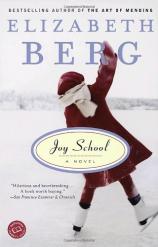
Joy School
by Elizabeth Berg
List Price: $11.95
Pages: 240
Format: Paperback
ISBN: 0345423097
Publisher: Ballantine
Thirteen-year-old Katie is new to her Missouri town, living alone with
a stern, inaccessible father following her mother's death. Unable to fit
in at school, she forges alliances where she can: with her housekeeper,
with a pimply fellow misfit named Cynthia, and with the gorgeous Taylor,
who gets her kicks out of shoplifting. Most frustrating of all is Katie's
imperfect friendship with the proprietor of a local gas station, a handsome
23-year-old who shares her love of checkers but doesn't return her crush.
With humor and an eye for telling detail, Berg conveys the way each unpromising
element of Katie's life ultimately offers her more than she had anticipated.
top of the page

1. Joy School is set in the late 1950s or early '60s. Why do you think Berg chose this time-frame as the setting for her story?
2. Joy School is a pre-feminist, baby-boomer coming-of-age story. How do the role models that young women grow up with today compare to the role models of Katie's time? How are young women today equipped differently to cope with the whole first-crush experience. How are first-love fantasies of young girls different today than they were when Katie was growing up?
3. With a dead mother, a father who flies into sporadic rages, and a sister who has fled to Mexico, Katie has every excuse for withdrawing into herself. And yet she continues trying to make connections with those around her. What keeps Katie from closing herself off to others? What would you do under similar circumstances?
4. At one point Katie tells Jimmy that she'll come see him again the next day, and he says he'll be there. "This shocked me," Katie says, "that he has been there for a while, and that he will be there tomorrow, just like that." Why do you think Katie is so shocked that Jimmy will "be there" the next day and the next?
5. Do you remember your own first crush or first love? How did your experience compare to Katie's experience with Jimmy?
6. In describing Taylor, Katie says "Taylor is a funny person who doesn't see any right and any wrong and is too strong to be around." What do you think she means by this? Have you ever had a friend like Taylor?
7. One reviewer has said that Berg "completely nails down the entire universe of teenage experience in a single high school freshman." Do you agree?
8. What does Katie mean when she says "Jimmy will be the place for me to learn the real happiness. He will be my Joy School."
9. How does Berg's portrayal of Katie compare with portrayals of other girls her age that you might have read about?
10. Katie, talking about trying to settle into her new surroundings, says "I have never had such a hard time getting my place in a school. You wish you could bring a book of directions to yourself that everyone would read." Why do you suppose she's having such a hard time with this particular school? What might Katie have done to fit in better?
11. Katie tries to talk to Ginger about some of the problems she's having in school. Katie says "I want to say, 'Did you have any trouble in school with kids being kind of mean to you? If so, what did you do about it?' Like an essay question. But when I start to ask, all that comes out is 'Did you like high school?' " Why do you think Katie has such a hard time talking to Ginger about her problems?
12. What do you think of the peripheral characters Berg brings into her story: Taylor Sinn--the beautiful model with a penchant for shoplifting; Cynthia O'Connell--the classmate with an overbearing control freak for a mom; and Nona, Cynthia's dying grandmother who sneaks down to the kitchen in the dead of night to cook pasta by candlelight?
13. What does Katie learn from her experience with Jimmy? In what way is sorrow a kind of teacher for Katie?
14. What do you see in Katie's future?
15. What's your opinion about Jimmy's behavior toward Katie? Do you feel he was sensitive and caring of her feelings, or rejecting? When Katie tells him she's in love with him, he says "I didn't know..." Should he have realized that Katie was developing a crush on him? Was she sending signals that he failed to notice?
16. Do you think Katie's crush on Jimmy might have been less heartbreaking if her mother had been there to help her through it?
17. What do you think was going through Jimmy's mind when Katie tells him she loves him? And when he sees the realization in her eyes that he considers her only a child?
top of the page

" Elizabeth Berg conjures the ordinary and consequently outrageous life of a twelve-year-old girl in the early '60s in Joy School...[She] perfectly recalls the popular culture of that time...Berg has a way of picking the choicest words for the smallest of events...As always, her style works beautifully--deceptively simple, conversational, and hip. "
--USA Today
"Much to the delight of Elizabeth Berg fans, Katie, the adolescent Army brat at the center of Berg's first novel, Durable Goods, returns as the focus of [Joy School]. In this latest work the author takes great care in exposing the loneliness that trips up her beloved character while also revealing the people and moments that truly do make this awkward age a 'Joy School.'... The adolescent internal monologue offered by Berg--with Katie second-guessing herself, fantasizing and exaggerating--is both hilarious and breathtaking. The teacher descriptions alone...deliver a book worth buying. "
--San Francisco Chronicle
"An opalescent...tale...Berg handles Katie's mystification with sweet aplomb, tracking surges with a meteorologist's delight.... The lesson of Joy School is not that weeping endureth a night, but that ordinary young humans must learn to endure themselves. "
--Boston Magazine
"Katie is funny, imaginative, irreverent, idiosyncratic, and deeply, unusually charming. She works her charms upon the reader, but perhaps more interesting, she works them upon the other characters in the novel....Though this is a story built around the theme of first love...Berg also manages to show how her narrator is looking for human connection in different ways and in different places. Through all these encounters, we see Katie trying to regain a faith that she lost upon the death of her mother, so that Joy School is, among other things, a meditation on the way early loss can radically shift a child's understanding of the world. "
--The Boston Sunday Globe
"Berg's characters are a treat: Vivid and quirky, they do more than fill in the background. These are people who encourage the reader to imagine what their own stories would be. "
--St. Louis Dispatch
"Berg's stories have a way of making you remember things you never thought you'd forget. She gives us all a voice and company through the trial we face. Her stories are powerful, true, and speak straight to the heart without ignoring the head. "
--Nomad
"Katie's guileless candor delights throughout the novel....One of the best things about this book is how funny it is. Don't read it anywhere you're not willing to risk being caught laughing aloud. "
--Milwaukee Journal Sentinel As she has demonstrated in previous books, Berg can conjure character with a minimum of words and
"a rainbow of nuance. The reader misses Katie the instant the book ends. "
--Publishers Weekly (starred review)