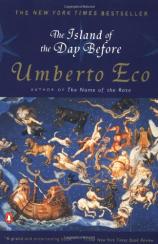
The Island of the Day Before
by Umberto Eco
List Price: $14.95
Pages: Format:
Format: Paperback
ISBN: 0140259198
Publisher: Penguin USA
The Longitude Problem
by Dava Sobel
Umberto Eco's "romance
of navigation and science in the mid-seventeenth century" traces
a tale of love and longing across two oceans at a time when the sea posed
terrible perils to travelers. The story opens in 1643 at what turns out
to be the "antipodal meridian," or the international date line,
where Roberto finds himself shipwrecked on shipboard. Halfway around the
world from the Paris meridian and at the furthest possible remove
from his beloved lady he is a victim of the longitude problem.
The longitude problem, or, as Eco more poetically terms it, "the
mystery of the longitude," embroils Roberto in international espionage
and launches him on his fateful voyage.
For want of a practical method
of determining longitude, every great captain in the Age of Exploration
became lost at sea despite his charts and compasses. From Vasco da Gama
to Sir Francis Drake they all got where they were going willy-nilly,
by forces attributed to good luck or the grace of God. Any sailor worth
his salt could gauge his latitude well enough by the length of the day,
or the height of the sun, or certain guide stars above the horizon. Longitude,
in contrast, had to be measured by time.
As early as 1514, navigators
well knew that the secret to determining longitude at sea lay in comparing
the time aboard ship to the time at the home port at the very same
moment. They could then convert the hour difference between the two places
into a geographical one: Since the Earth takes twenty-four hours to complete
one full revolution of three hundred sixty degrees, in one hour it completes
one twenty-fourth of that, or fifteen degrees. Each hour's time difference
between the ship and the starting point therefore marks a progress of
fifteen degrees of longitude to the east or west. Unfortunately, although
navigators could figure out their local time at sea by watching the sun
every day to see when it reached its highest point in the sky (at noon),
they could not keep track of time at another place. For that they would
have needed a clock or watch set to the home port. But pendulum clocks
went haywire on the decks of rolling ships: they slowed down, or sped
up, or stopped running altogether. Pocket watches from that period fell
far short of the accuracy required for navigation. Astronomers tried to
give mariners a way to tell time in two places at once by the moon and
stars. Indeed, the great observatories in Paris and London were founded
(in 1666 and 1674, respectively) not to conduct pure research in astronomy,
but to perfect the art of navigation.
Ignorance of longitude killed
untold numbers of sailors whose destinations suddenly loomed out of the
sea, taking them by surprise. In one such accident, on October 22, 1707,
at the Scilly Isles near the southwestern tip of England, four homebound
British warships ran aground and two thousand men drowned. Long voyages
waxed longer for not knowing longitude, as a captain might search weeks
for the island where he hoped to find fresh water, or even the continent
that was his destination. Extra time at sea condemned sailors to the dreaded
disease of scurvy, caused by a lack of vitamin C, and expressed as the
fatal deterioration of their blood vessels.
Beyond this potential for human
suffering, the longitude problem wreaked economic havoc on the grandest
scale. It confined ocean traffic to a few narrow shipping lanes, where
whaling ships, merchant ships, warships, and pirate ships all clustered
and fell prey to one another. So insuperable was the challenge of finding
longitude at sea that it consumed the greatest minds of the European scientific
establishment, including Galileo Galilei. In fact, the brass helmet with
attached spyglass that Roberto helps Father Caspar don aboard the Daphne
was invented by Galileo in 1616 to help sailors use the moons of Jupiter
as a heavenly clock.
No wonder the French court
was so eager to steal longitude secrets from state enemies. Coerced by
Cardinal Richelieu, Roberto sails aboard a Dutch ship to spy on a British
scientist who, navigating unknown waters by the cries of a wounded dog,
seems to have unlocked the secret of the longitude.
Although this technique of
navigation by canine vivisection may sound like the purest fiction, it
was actually proposed as a solution in London in 1688 whether in
desperation or in jest is not known. The anonymous author relied on the
same Powder of Sympathy that dusts Eco's pages. This quack cure, brought
to England from France by Sir Kenelm Digby, was a powder that could purportedly
heal at a distance when applied to some article from an injured person.
As Roberto learned at the siege of Casale and later during his sojourn
in Paris, the treatment was not painless: Patients jumped or swooned when
practitioners powdered the swords that had cut them or the cloths that
had dressed their wounds.
To apply the Powder to the
longitude problem, a wounded dog was to be put aboard a departing ship,
and a trusted individual was left ashore to dip a bit of the dog's discarded
bandage into Sympathy solution every day at a pre-arranged hour. The dog
could be counted upon to yelp in pain at that instant, thereby announcing
the crucial home-port time to the crew. Despite the wounded dog, however,
and even a wounded human enslaved in the same service, The Island of
the Day Before ends before the longitude problem meets with its solution.
In 1714, the British Parliament
passed the famed Longitude Act, offering a handsome reward (the equivalent
of several million dollars in today's currency) for a solution. Many hopeful
contenders competed for the longitude prize. Scientists perfected a workable
astronomical technique by the middle of the eighteenth century, but it
proved unwieldy and complicated. It fell by the wayside after John Harrison,
a self-educated English clock maker, built an accurate sea clock that
could carry the home-port time, like an eternal flame, to any remote corner
of the world. Harrison, who devoted four decades of his life to this endeavor,
finally succeeded in 1759 more than one hundred years too late
to guide Roberto safely back into the arms of his faraway love.
Dava Sobel is
the author of the New York Times bestseller Longitude.
An award-winning former science reporter for The New York Times,
she writes frequently about science for several magazines, including Audubon,
Discover, Life, and The New
Yorker.
In the character of Roberto
della Griva, Umberto Eco presents one of his most charming and unlikely
heroes: a passionate, impressionable youth with a raging imagination and
a hunger for knowledge. And during the Age of Exploration, in the middle
of the seventeenth century, there is much for Roberto to learn. The
Island of the Day Before teems with the science, philosophy, and social
mores of the Baroque Era, when the rulers of the Catholic Church grappled
with the powerful technological advances that questioned heretofore undisputed
facts. In Paris salons, ladies and noblemen flirted with sophisticated
notions of philosophy and semantics as well as with each other.
And the seas surged with explorers as all of Europe raced to complete,
understand, and dominate a new map of the world.
At the center of the novel,
Eco offers a fascinating conundrum that places Roberto within sight of
an island he cannot reach physically, because he is not able to swim,
and theoretically, because it is located on the other side of the international
date line. This central conflict echoes the intellectual and scientific
quandaries of the era, at a time when the pursuit of knowledge was hindered
by fundamental misconceptions about the physical world. Yet it also serves
to humanize Eco's characters. Faced with all that is unknowable and all
that it is within their power to know, they become at once humbled and
arrogant, fearful and emboldened, heroic and cowardly. Indeed, faced with
the awesome evidence of nature's ultimate power, we are all merely characters
in a story. We are each marooned on our own deserted ship with only our
hopes, dreams, and minds to carry us to the next shore.
Whether you are a student of
philosophy or semiotics, a lover of literature, or a reader seduced by
the notion of a revel through history, The Island of the Day Before
provides a cornucopia of fortified facts, colorful figures, spicy
adventure, and plenty of intellectual questions to savor.
top of the page

1. Roberto is naive, impressionable, impulsive, loyal, honest, and self-deluded. What do you think of him as a hero of the story? Is he an everyman? Do you think Eco wants the reader to identify with Roberto?
2. Eco describes Roberto as absorbing knowledge "as if he were a sponge, and was not distressed at believing in contradictory truths. Perhaps it was not that he lacked a taste for system; his was a choice." What does Eco mean by this? What do you think of Roberto's various teachers Saint-Savin, Padre Emanuel, Salazar and Saletta, Father Caspar and the way Roberto acquires and uses his knowledge?
3. What do you make of Ferrante, Roberto's imagined brother? How do his escapades shape and move the story along? Do you think Eco is making a point about the creative process? The imagination's vital role in our lives?
4.Roberto becomes the willing disciple of a number of teachers but takes much of what they say at face value learning, as it were, in a vacuum. Yet, once stranded on the ship, he must put his own intellect to use. What is Eco telling us about knowledge gained through intuitive versus empirical reasoning?
5. In matters of romantic love, Roberto is a naive but willing pupil. What do you think of the advice he is given on how to win the hearts of the women he desires? How real is his devotion for Lilia, a woman he doesn't really know?
6. Eco claims that all his novels are detective stories. How does he present this novel as a mystery? Is there a resolution? Is it satisfying or frustrating that Roberto never reaches the island?
7.How does Eco's use of comedy e.g., in the battle scenes during the siege of Casale; in the way Roberto pursues romance; and during his attempts to construct the Instrumentum Arcetricum with Father Caspar offset the more sober issues of war, love, and science?
8.When asked about the multiple layers of meaning and obscure references found in his work, Eco, in a 1995 interview, likened his novels to "club sandwiches.... You can decide to eat only one part." His apparent meaning is that a reader can appreciate many different facets of his books, that a reader need not be a scholar to "get" the meaning. What layers of this particular sandwich are most effective? Why?
9. How does Eco pit science against nature in the novel? What do you think of the many devices his characters invent are they technological advances or foolish attempts at understanding and gaining control over their world?
10.Father Caspar argues that he rather than Roberto should attempt to reach the island. "After all, I have the faith, and you not.' Roberto understood that this was not by any means the last consideration: it was the first, and surely the most beautiful." Yet Father Caspar's last invention and his mission are fatally flawed. What do you think Eco is condemning?
11. Why does Eco dedicate an entire chapter to the explication of the Orange Dove? What meaning does this symbol have to the story and to Roberto, stranded, alone, and with little hope for survival?
12. Roberto is within sight of an island he can't reach physically, because he can't swim, and theoretically, because the island exists the day before and he can't go back in time. What do you think the island's real and imagined inaccessibility stands for in the novel? How does Roberto's desire to reach the island compare with that of Father Caspar?
top of the page

"Every age gets the classics it deserves. I hope we deserve The Island of the Day Before. If we do, we will not only know the pleasures of a profound and ingenious story artfully told but will experience Renaissance battles, love poems, and sea journeys in the age of exploration. Shipwrecked among archaic scientific nightmares and failed beginnings and dead ends of technology, we will recover the perennial hope of making sense of what happens to us. This novel belongs in the great tradition of the conte philosophique, like Swift's Gulliver's Travels, Johnson's Rasselas, and Voltaire's Candide. "
The New York Times Book Review
"A masterpiece...intellectually stimulating and dramatically intriguing. "
Chicago Tribune
"A gripping concoction of mystery, political intrigue, and adventure with generous doses of romance and comic relief.... Mr. Eco is a master storyteller. "
The Baltimore Sun
"This is high art that has not forgotten its origins in the tale told around a campfire.... Eco gives us, as we rarely get it, the novel as comedy, as adventure tale, as romance, above all as wellspring of ideas. "
Newsday
"As wonderfully exotic as only Eco can contrive, with his encyclopedic knowledge and his captivating storytelling skills. "
San Francisco Chronicle