IndieBound Independent Bookstores BRC Facebook Fan Page
Coming Soon
Reading Group Guide
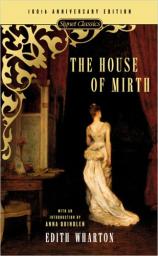
The House of Mirth
by Edith Wharton

List Price: $4.95
Pages: 368
Format: Paperback
ISBN: 0451527569
Publisher: Signet Classics

Click here to buy this book from Amazon.com.
Click here to buy this book from Amazon.ca.


About This Book


The House of Mirth, published in 1905, marks Edith Wharton's emergence as one of America's greatest writers. Although Wharton had previously published two collections of stories, The Greater Inclination (1899) and Crucial Incidents (1901) and the novel The Valley of Decision (1902), her decision to write about fashionable New York, a world she "had been steeped in since infancy," brought her immediate success and recognition. As she wrote in her autobiography, A Backward Glance (1934), her goal in The House of Mirth was to uncover the true nature of society's power and to answer the question: "in what aspect could a society of irresponsible pleasure-seekers be said to have, on the 'old woe of the world,' any deeper bearing that the people composing such a society could guess?"

By 1905, the genteel milieu of Wharton's childhood was rapidly disappearing. Fashions—and economics—had changed, and Old New York society was forced to recognize the power of "new money" and even to accept the newly rich, with their tremendous wealth earned in a suspect marketplace, into their circle. It was a concession that would not only corrode their sense of style and decorum, but allow them to sacrifice the members of the "old" society who could not keep pace. Lily Bart, the heroine of The House of Mirth, is a victim of a large, unstoppable shift in the ways of the world.

Launched into society at a glorious and very expensive debutante ball, Lily sees a world of unlimited possibility before her. But her father's announcement that he is financially ruined, followed quickly by his death, leave Lily and her mother with only one "asset"—Lily's extraordinary beauty and charm. At the age of 29, now orphaned, Lily lives with an aunt who offers minimum, often grudging, hospitality and financial support. A wealthy husband could satisfy her craving for luxury and admiration, but Lily is reluctant to consummate this kind of "deal." In a chronicle that richly details the follies of shallowness, and cruelties of society as it illuminates Lily's own ambivalence about who and what she wants, Wharton traces her heroine's decline from her elite position as a much-desired guest in exclusive social events, to her role as a liaison between rich "outsiders" eager to be accepted in society but ignorant of its ways, to her piteous existence when the homes of both old and new society are firmly, finally, closed to her.

On one level a devastating satire of a world devoid of moral scruples, The House of Mirth is also a stringent critique of the particular restrictions and limitations such a world imposes on women. Lily is a woman not only of charm, but of intelligence; her outward beauty matched by a genuine, if undeveloped, appreciation of art and of nature's beauty. By succumbing to society's definition of her as a beautiful object and nothing more, however, Lily in many ways authors her own fate. Woven throughout the novel are threads of Wharton's own experience. Born in 1862, Wharton spent her childhood in the staid brownstones of New York and the elegant country houses to which the rich retired during the summer, and was intimately acquainted with the styles of entertaining, of dress, and of conspicuous consumption favored by the people who inhabited them. She married five years after her own debut, late enough to have contemplated the likely fate of an unmarried woman in the latter part of the nineteenth century. Though her husband, Edward, was well-enough off to avoid working in the despised business world, the two were fundamentally incompatible. Edward admired Edith's brilliance, but he was far from her intellectual equal and shared few of her interests. The critic Edmund Wilson speculated that Wharton turned to fiction to ease the tensions of her marriage; certainly the world she created through her writing must have been a welcome haven from the tedium and disappointments of life with Edward. But it is the very act of writing that separates Wharton from her fictional creation. Unlike Lily, Wharton took an active role in defining herself, becoming a masterful writer, and establishing that a woman need not depend on others to achieve dignity and a sense of worth. The world is much richer for it.

top of the page


rgg_discuss.gif (1294 bytes)


1. Wharton took the title for her novel from a verse in Ecclesiastics—"The heart of the wise is in the house of mourning; but the heart of fools is in The House of Mirth." Does Lily Bart's allegiance to the follies and superficialities of society mean that she has the "heart of a fool" or is she trapped by the dictates of her upbringing and the expectations of the times?

2. What does Wharton mean when she describes Lawrence Selden as a man with "the stoic's carelessness of material things, combined with the Epicurean's delight in them" [p.152]? Are his scorn and aloofness attitudes only a man could assume in the society Wharton depicts? How genuine are they? Does his readiness to attend certain social events and to indulge in gossip and flirtations with Lily belie his chosen role as a "spectator"?

3. The people in Lily's circle disdain the "new" millionaires who acquired their money in business rather than through inheritance, yet in many ways their social world is predicated on a business ethic. How does the language of the novel reflect this? In what ways do the social "exchanges" among the characters mimic business dealings, even when they don't involve the actual exchange of money?

4. Lily rejects both Sim Rosedale, a fabulously rich man of "unacceptable" lineage, and Selden, a man she clearly admires who cannot support her in style. Do these rejections represent an unrealistic, perhaps inflated, view of her own worth and potential? Are they purely selfish or do they reflect an underlying sense of morality on Lily's part?

5. Even early in the novel, Wharton offers hints that foreshadow Lily's public humiliation by the Trenors and the Dorsets, her abandonment by Carry Fisher, and her aunt's decision to disinherit her. What events alert you to the true nature of the other character's feelings and attitudes toward her? Is Lily too naive to grasp the significance of these events? Does she genuinely misunderstand her financial arrangement with Gus Trenor or simply choose to ignore its "obvious" implications? When she agrees to accompany the Dorsets on the cruise, is she unaware of her role as a mask for Bertha's affair with Ned Silverton?

6. What does Lily's great success in the tableaux vivants symbolize within the context of the novel? Does it reveal, as Selden believes, "the real Lily Bart"? [p. 134] Why does Lily respond to his enthusiasm and his confession of love afterwards by saying, "Ah, love me, love me—but don't tell me so "? [p. 138] What other examples are there of Lily's consciously adopting a pose, either literally or figuratively, to please an audience?

7. Both Lily's cousin, Grace Stepney, and Selden's cousin, Gerty Farish, live in genteel poverty on margins of society. How are their attitudes about their positions reflected in the way they treat Lily?

8. Lily and Selden have five intimate conversations: at his apartment in the opening chapter; at Trenors' country home, Bellomont; at the Brys after Lily's stunning performance in the tableaux vivants; in Mrs. Hatch's hotel room; and once again at Selden's apartment, on the day before Lily dies. How do the tone and contents of their conversations change as Lily's circumstances change, and what does this reveal about their feelings for one another? Are either of them really capable of loving and being loved?

9. Are all the women in the novel passive "victims," dependent on the power and money of men? Who really creates the rules in Lily's circle and how do they wield their powers? Why does Rosedale ultimately turn Lily away, despite his previous persistence in courting her and his aggressiveness in making his way into society? Is he right in believing that his money alone is not enough to rescue her reputation?

10. Is Lily's descent inevitable? What opportunities does she have to turn things around and why does she reject them? Does her decision not to use Bertha Dorset's letters to regain her social standing make sense in society that unquestioningly accepts the manipulations of Gus Trenor, Carry Fisher, and Bertha herself?

11. Edith Wharton wrote "A frivolous society can acquire dramatic significance only through what its frivolity destroys. Its tragic implications lie in its power of debasing people and ideas." Do you think The House of Mirth is primarily a portrait of the frivolous and corrupt social world of New York or is it the story of Lily Bart's personal tragedy?

top of the page


Privacy Policy | Contact Us | Advertising | About Us

© Copyright 2001-2010, ReadingGroupGuides.com. All rights reserved.
The Book Report, Inc. • 250 West 57th Street • Suite 1228 • New York, NY • 10107
Ph: 212-246-3100 • Fax: 212-246-4640

Bookreporter.comReadingGroupGuides.comGraphicNovelReporter.comFaithfulReader.com
Teenreads.comKidsreads.comAuthorsOnTheWeb.comAuthorYellowPages.com