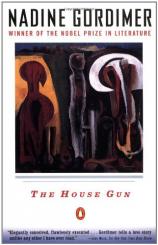
The House Gun
by Nadine Gordimer
List Price: $12.95
Pages: 294
Format: Paperback
ISBN: 0140278206
Publisher: Penguin USA
The House Gun is
Nadine Gordimer's twelfth novel, her second set in post-apartheid South
Africa. For Harald and Claudia Lingard, the passively liberal, white couple
at the center of the story, not much has changed in the political transition
from apartheid to majority rule, from F.W. de Klerk to Nelson Mandela.
Harald and Claudia live in comfort and safety until one evening when they
discover "something terrible has happened." Their only son, Duncan, has
been arrested for killing one of his housemates. There is never a question
of his guilt -- he has confessed to the crime -- but Harald and Claudia
cannot understand how Duncan could abandon his belief in the sanctity
of human life, nor can they believe that the violence that had always
affected "other people" has found a way into their world. The House
Gun records with remarkable precision the psychological transformations
that Harald and Claudia undergo as they search for the truth.
In this novel, as in most
of Gordimer's books, the personal becomes political. While Duncan's crime
was surely one of passion, the repercussions force Harald and Claudia
to snap out of their oblivion and face the legacy of South Africa's bloody
history: since the end of apartheid the murder rate in South Africa has
skyrocketed, and, as a result, guns are "kept for protection" in almost
every household. Harald and Claudia also must face their own prejudices
as they put their faith in Hamilton Motsamai, the black lawyer Duncan
has hired to defend him.
With stunning grace and clarity,
Nadine Gordimer seamlessly intertwines the self with society as she tests
the boundaries of love and intimacy. Readers will find, like Harald and
Claudia, that even within the most complicated frameworks, these boundaries
are resilient. The House Gun is a portrait of powerful awakenings -- of
a father and mother, a husband and wife, a parent and child, a nation
and its citizens. But it is also an affirmation of the will to reconciliation
that starts where it must, with individual men and women.
top of the page

1.The narrative of The House Gun is divided into two parts. Why do you think Nadine Gordimer chose to do this? Is the narrative style of the two parts different? How? Do you think this is effective?
2.The murder that Duncan commits functions as a prism through which to explore the many types and faces of intimacy: intimacy between husband and wife, parent and child, lovers (hetero and homosexual) and friends -- even attorney and client. Often, we assume that intimacy is inherently good in relationships, but consider Duncan's relationships with both his girlfriend and housemates. While these relationships may have been intimate, they were not necessarily good. Why do you think Duncan chose to stay involved with these individuals? Does Nadine Gordimer judge him for doing so?
3.Throughout the novel, Claudia refers to a note that she and Harald wrote Duncan after one of his classmates committed suicide. It said, "There is nothing that you cannot tell us." But as the novel develops, it becomes apparent that Harald and Claudia really know very little about Duncan's life. Did this strike you as a failure as parents on their part? Why or why not?
4.Think about Harald and Claudia's marriage. What facet of their relationship was transformed the most by the murder? How and why?
5.Do you think that Harald and Claudia's relationship improves during the course of the novel, or just changes?
6.While there are sections in The House Gun that give us glimpses into Duncan's perceptions of intimacy, love, and justice, he remains, for the most part, an opaque character. How did you find yourself responding to Duncan: with empathy, with disgust, or with anger?
7.Did you believe Hamilton Motsamai's defense that Carl's murder was a spontaneous act of passion? What are the specific circumstances of the crime that make you believe that it was, or wasn't, premeditated? Is that truth -- whatever it may be -- irrelevant? Why or why not?
8. Duncan, like his father, is an avid reader. Duncan recognizes that writers are "dangerous people" because they know how to murder without picking up a weapon. Do you think that Natalie bears as much of the responsibility for the murder as Duncan? Why or why not?
9. Nadine Gordimer strongly believes in the symbiotic relationship between a novel and the time and place within which it was created. How did she place The House Gun in a larger political context?
10."Guns don't shoot people, people shoot people." After reading The House Gun, do you agree with this statement? Would Duncan have committed the murder if the gun had not been so readily available?
11. Did Duncan receive a fair sentence? At the end of the novel, was justice served?
top of the page

"Elegantly conceived, flawlessly executed... Gordimer tells a love story unlike any other I have ever read. "
Jack Miles, The New York Times Book Review
"A memorable blend of the topical and the timeless, at once a profound, lingering meditation on the human heart and a story so gripping you can scarcely bear to put it down. "
San Francisco Chronicle
"With the scaffolding of a courtroom drama and the moral underpinnings of the state's responsibility, the novel infuses an isolated crime of passion with the atmospheric pressure of a country reeling from its own past. "
The Boston Sunday Globe
"The House Gun ... is a tense post-apartheid family drama as vital as anything [Gordimer] has ever written. "
Time magazine