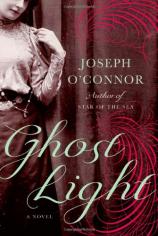
Ghost Light
by Joseph O’Connor
List Price: $25.00
Pages: 256
Format: Hardcover
ISBN: 9780374161873
Publisher: Farrar, Straus and Giroux
1907 Edwardian Dublin, a city of whispers and rumors. At the Abbey Theatre, W. B. Yeats is working with the talented John Synge, his resident playwright. It is here that Synge, the author of The Playboy of the Western World and The Tinker’s Wedding, will meet an actress still in her teens named Molly Allgood. Rebellious, irreverent, beautiful, flirtatious, Molly is a girl of the inner-city tenements, dreaming of stardom in America. Witty and watchful, she has dozens of admirers, but it is the damaged older playwright who is her secret passion despite the barriers of age, class, education, and religion.
Synge is a troubled, reticent genius, the son of a once prosperous landowning family, a poet of fiery language and tempestuous passions. Yet his life is hampered by conventions and by the austere and God-fearing mother with whom he lives. Scarred by a childhood of immense loneliness and severity, he has long been ill, but he loves to walk the wild places of Ireland. The affair, sternly opposed by friends and family, is turbulent, sometimes cruel, yet often tender.
In 1950s postwar London, an old woman walks across the city in the wake of a hurricane. As she wanders past bomb sites and through the forlorn beauty of wrecked terraces and wintry parks, her mind drifts in and out of the present as she remembers her life’s great love, her once dazzling career, and her travels in America. Vivid and beautifully written, Molly’s swirling, fractured narrative moves from Dublin to London via New York with luminous language and raw feeling.
We hope that the following guide will enhance your reading group’s experience of this tour de force.
top of the page

1. How were you affected by the voice of the novel and its structure? O’Connor chooses not to tell the story in straight chronological order. What does he gain by unspooling Molly’s memories in the course of a single day?
2. What portrait of Molly emerges in the opening scenes, as she copes with severe hunger while anticipating recording a radio play? How did your image of her change as you read about her marriages and the death of her son? What traces of her teenage personality remain to the end?
3. What were your initial impressions of John Synge? What fuels his attraction to Molly? What gives her the nerve to refuse his stage directions, despite the sixteen-year difference in their ages?
4. Synge’s mother plays a pivotal role in his life and in his romance with Molly. Why is his mother so against Molly? Discuss your reactions to the scene where she meets Molly in person.
5. What is Molly’s relationship with her sister Sara? What might account for Sara’s greater wealth and Hollywood success?
6. How does O’Connor depict the Irish poet and founder of the Abbey Theatre W. B. Yeats? Does Yeats mentor Synge, or does Synge defy mentoring?
7. Discuss the novel’s portrayal of the making of The Playboy of the Western World, which features an Irish farm boy called Christy Mahon, who glories in the belief that he has killed his father. Girls (including Pegeen Mike, played by Molly) find it attractive to hear him brag about this. Protestors rejected such a brutish portrayal of the Irish. What might have motivated Synge to create such an irreverent hero?
8. What did you think of Lady Augusta Gregory and her part in Synge and Molly’s lives?
9. As Molly retraces her life, from her Irish girlhood to the awkward meeting about Synge’s estate to her life on New York’s Lower East Side and her impoverished final chapters in London, where does she feel most at home? Was she at home with Synge? What was the easiest role for her to play in life?
10. Synge blames illness and poverty for keeping him from marrying Molly. In some ways, did it help their commitment to have a lack of commitment (she breaks off the relationship more than once, yet she also asks for marriage)? Had he survived his illness, would he have eventually married Molly? If so, would it have been a happy marriage?
11. Despite the sadness of Molly’s story, does she strike you as defiant and still in love with life? How does O’Connor manage this?
12. In the novel, is alcoholism a cause of Molly’s suffering, or the reaction to her suffering? How did you respond when you read about her final tragedy? Why was it fitting to end not with an image of her hospitalization but with a vivacious love letter from the Changeling to her Tramp?
13. What did you discover about the nuances of Irish history and culture, including the role of a Protestant aristocracy, by reading this novel?
14. In his acknowledgments and caveat, the author reminds us that “certain biographers will want to beat me with a turf-shovel.” O’Connor proceeds to tell us that letters featured in the novel are fictional, the chronology has been tinkered with, Synge and Molly did not holiday in Wicklow, and it’s even possible that their romance was never consummated. Does historical fiction sometimes do a better job than biography in bringing the past to life? Do all biographies contain a dose of fiction?
15. Joseph O’Connor’s best-known previous novels include Star of the Sea, depicting passengers crossing the Atlantic from Ireland to New York during the potato famine, and Redemption Falls, set during the U.S. Civil War. What themes of the human condition run through each of his novels, including Ghost Light? What makes his approach to history unique?
top of the page

"As I read Ghost Light I found myself going more and more slowly, because I didn’t want to miss a single sentence . . . It is a rare and wonderful book."
Michael Cunningham, author of The Hours and By Nightfall
"A brilliant novel."
Joseph O’Neill, author of Netherland
"I can’t imagine many better --- or braver --- novels than Ghost Light coming out this year."
Colum McCann, author of Let the Great World Spin
"A spellbinding read."
Aisling Foster, The Times (London)