|
|
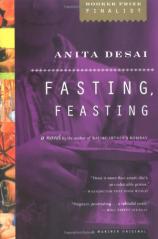
Fasting, Feasting
by Anita Desai
List Price: $13.00
Pages: 240
Format: Paperback
ISBN: 0618065822
Publisher: Houghton Mifflin
Anita Desai's new book, hailed as "unsparing, yet tender
and funny,"* brilliantly confirms her place among today's foremost Indian
writers. FASTING, FEASTING takes on Desai's greatest theme: the intricate,
delicate web of family conflict. It tells the moving story of Uma, the
plain older daughter of an Indian family, tied to the household of her
childhood and tending to her parents' every extravagant demand, and of
her younger brother, Arun, across the world in Massachusetts, bewildered
by his new life in college and the suburbs, where he lives with the Patton
family. Published in Britain to rave reviews, FASTING, FEASTING is "rich
in the sensuous atmosphere, elegiac pathos, and bleak comedy at which
the author excels" (The Spectator). From the overpowering warmth of Indian
culture to the cool center of the American family, it captures the physical
-- and emotional -- fasting and feasting that define two distinct cultures.
*(Times Literary Supplement)
top of the page

1. In what ways do the two terms of the title"fasting" and "feasting"apply to family life and society in general in India and the United States?
2. What kinds of freedom and what specific freedoms do the characters seek? In what ways is the "total freedom of anonymity" that Arun experiences in his university dormitory similar to the freedom that Uma seeks?
3. What is the significance of Uma's experiences at, on, and in the sacred river? What does Desai mean when she writes of Uma's near-drowning (in chapter nine), "The saving was what made her shudder and cry ..."? What mysteries and "golden promises" does Uma seek within the convent school, with Mira-masi, and in her Christmas-card collection?
4. In what ways does spirituality enter the novel? What characters have authentic spiritual leanings or capacities? Are Uma's seizures, for example, instances of spiritual possession or eruptions of suppressed frustration and rage?
5. What roles and expectations are open to women and men in the India and America of Fasting, Feasting? What do the details of Anamika's and Aruna's marriages reveal about women's lives in traditional India?
6. What rebellions and attempts at escape, successful or not, occur? How do they suggest the significance of Uma's vision of escape as "a huge and ancient banyan tree" and a river? (131)
7. Arun "ponders these omens and indicators" of life in Massachusettsthe objects that adorn the interiors and exteriors of the houses. What do these "omens and indicators" reveal to Arun and to us as his summer stay with the Potters proceeds?
8. What differences and similarities are there between the Indian and American families, between corresponding members of the two families (for example, Mama and Mrs. Potter), and between the their communities?
9. "I've always been aware of food as an obsession," Desai has said. What function does food play in the novel? How does food provide both "focus and continuity" in both societies?
10. What instances and images of imprisonment and entrapment occur in the novel's two parts? To what extent is entrapment of one kind or another envisioned as an inescapable fact of life?
11. What are the purposes of the various rituals, ceremonies, traditions, and routinespersonal, social, and religiousthat are observed in the novel's two parts? What are the consequences of ignoring tradition and custom and of disrupting established routine?
12. Arun takes up jogging, having recognized the American joggers' struggle "to free themselves and find, through endeavor most primitive, through strain and suffering, that open space, that unfettered vacuum where the undiscovered America still lies ..." Why does Arun partake of this American struggle?
13. How does Desai establish Mama and Papa's identities as separate persons and, at the same time, as the single, and singular, MamandPapa? In what ways do "they have the comfort of each other," as Uma later realizes?
top of the page

"Certain novels seduce us with invitations to visit distant places and participate vicariously in the thrill of exploration. Others manage to sensitize us to some aspect of our ordinary lives that we may never have fully appreciated. Set mostly in India amid a colorful milieu of arranged marriages, bride murders and ascetic ashrams, Anita Desai's new novel, 'Fasting, Feasting' which was a finalist for the 1999 Booker Prize would seem to fit into the former category. But soon enough we realize we're mistaken. For beneath its trappings of foreign customs and cultures, the novel's claustrophobic domesticity begins to look very familiar...What distinguishes Desai's novel from countless other depictions of airless and repressive households is the subtle and original way in which she makes us understand how much of our lives is encoded in and determined by tiny, repetitive, deceptively trivial decisions about what we will and won't eat...As in her previous novels, Desai employs a rich and subtle palette to convey her crisp, unsentimental view of character and behavior. 'Fasting, Feasting,' makes the apparently exotic destinies of Uma, Arun and their family seem as universal, as vital and familiar, as the food on our plates. "
The New York Times
"Anita Desai's latest novel is a poignant, penetrating look at the travails of the eldest daughter and the only son of a strict couple in a provincial Indian town. In Uma, the aging, oppressed daughter No. 1, Ms. Desai ('Journey to Ithaca,' 1995) has created a marvel. Bullied by her parents, whom she thinks of as a single unit ('MamaPapa'), her eyes failing and her hair graying, Uma finds pleasure in small things: a hoard of old Christmas cards she treasures for their garish decorations, banal tea parties at the home of a Baptist missionary, volunteer work at a convent school she attended before her parents, hoping to marry her off, yanked her out. Moments of unexpected visits from two relatives: her odd, exuberant cousin Ramu, who, in a memorable episode, takes her out to dinner and gets her tipsy; and an older relative, Mira masi, a perpetual pilgrim who lugs icons around the countryside. The closest Uma gets to true contentment is when she accompanies Mira masi to a remote ashram -- indeed, she would stay there forever, but her parents send her brother and cousin to bring her home. About the only time Uma feels liberated is when she's under water, unable to swim but somehow sprung loose in the black depths: 'It was not fear she felt, or danger. Or rather, these were only what edged something much darker, wilder, more thrilling, a kind of exultation it was exactly what she had always wanted, she realized... "
Gabriella Stern The Wall Street
Journal
"Fasting, Feasting posits food as a metaphoer for emotional sustenance. Everything centers around food. Desai, who teaches writing at the Massachusetts Institute of Technology, tells the story with lapidary prose, creating intimate scenes as detailed as Indian miniature paintings. An accumulation of small details as steady and fine as drops of small rain create and eventual flood that drowns the happiness and the hopes of both Arun and Uma. "
The Seattle Times
|
Oprah's Book Club Selection
Contest
Win Copies for your Book Group

This month's prize:
The Cottage at Glass Beach by Heather Barbieri
Click here for more


|