|
|
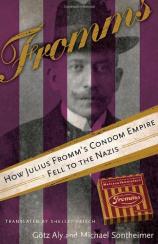
Fromms
How Julius Fromm’s Condom Empire Fell to the Nazis
by Götz Aly and Michael Sontheimer, Translated from the German by Shelley Frisch
List Price: $23.95
Pages: 240
Format: Hardcover
ISBN: 9781590512968
Publisher: Other Press
If you wanted to buy a top-quality condom in prewar Germany, you bought Fromms Act, the first brand name condom and still a leading brand in the German market. The man behind this “pure German quality product” was Julius Fromm, a Jewish entrepreneur who had immigrated from Russia as a child. Fromm was in the right place at the right time: he patented Fromms Act in 1916, when the combination of changing sexual mores, awareness of sexual health, and the lack of reliable prophylactics created a market primed for his product. In 1922 he began mass production and opened international branches. Sixteen years later, after building the brand into a best seller and the company into a model business, he was forced to sell Fromms Act for a fraction of its worth to a German baroness. In 1939 he and his family fled to London.
Through the biography of this businessman and the story of his unusual and fabulously successful company, prominent Holocaust historian Götz Aly and Der Spiegel’s Michael Sontheimer recount the fascinating history of the first branded condoms in Germany and the sexual culture that allowed them to thrive, the heretofore undocumented machinations by which the Nazis robbed German-Jewish families of their businesses, and the tragedy of a man whose great love for the adopted country that first allowed him to succeed was betrayed by its government and his fellow citizens.
This captivating account offers a wealth of detail and a fresh array of photographic documentation, and adds a striking new dimension to our understanding of this dark period in German history.
top of the page

1. The Fromms Act company was so successful that “Fromms” had become the word everyone in Germany used to refer to condoms, comparable to the way “Kleenex” is often used today to refer to tissues. What were the factors contributing to Julius Fromms’s tremendous success in this business?
2. In his attempt to attain German citizenship Julius Fromm stated that he was “devoted to my second homeland, and for me, a return to Russia would be worse than death.” (Page 36) He had such faith in the German people he believed he would be able to return to Germany to recreate his business or receive full restitution after the war. Why do you think his feeling for the German identity was so strong?
3. Julius Fromm chose the architects Arthur Korn and Siegfried Weitzman to
design and build his factory. How did the modern vision of these men fit with Fromm’s values and ideas about the ideal conditions both for workers and the creation of his high-quality products? (Pages 53-63)
4. As a businessman above all, Fromm initially ignored the Nazi threat and “even welcomed” (Page 64) as protection having the two directors of his company become members of the Nazi Party. Directors Berthold Viert and Karl Lewis assured their employer, “Herr Fromm, we don’t mean you. You’re an exception.” (Page 65) Why do you think the directors made that choice?
5. By the end of 1937, Fromm finally faced the fact that he would have to leave Germany and sell his business, losing almost everything. This instance of the massive theft of Jewish property involved Hermann Göring, known for his “pleasure in amassing grand manors” and “reveling in historical kitsch.” (Page 81) How do you view his role in the takeover of Fromms Act?
6. How did the British react to the arrival of Jewish immigrants and the Fromms in particular? What aspects of the British behavior during the war does the story of the “Dunera affair” reveal? Were you surprised by this?
7. The heirs of Julius Fromm worked to receive restitution for the large-scale theft of their father’s company. How did the German communists fight against this? As countless Jewish families were affected by the enormous theft by the Nazis, do you believe the pursuit of restitution by any one family can have an important symbolic value?
8. Edgar Fromm, Julius’s youngest son, said, “I felt rather sorry for most Germans after the war. They went along with their holy Führer and paid such a heavy price for having done so.” His sister Ruth also said, “I do not hate the Germans. Even so, I no longer think of myself as German, although I did grow up in Berlin.” (Page 151) What do you think about their feelings about the Germans and being German? How do you imagine you would feel in similar circumstances?
9. The life and career of Max Fromm, Julius’s actor son, was shaped by the war and by his marriage to a French woman. He said toward the end of his life,”When all is said and done, I have accomplished very little.” (Page 149) Nevertheless, do you think during the war he showed some of the strength of character his father exhibited?
10. Raymond Fromm, one of Julius’s grandchildren, states that he knew relatively few details about his forebears’ past, as it was too painful both for his parents to talk about their experiences during the war and for his generation to think about what had happened before they were born. Do you agree with him that it is important and valuable to learn about this past, however traumatic?
top of the page

"The condom --- that lowly, indispensable, and still hotly contested object --- is not only one of the great inventions of all time but also provides a crucial clue to the ultimately devastating triangular relationship between Jews, Christians, and Nazis in 1930s Germany. This riveting, brilliant little book offers profound new insights into the tangled mess of gentile greed, corruption, anti-Semitism, and ambivalence about sexual freedoms that explains so much about the Third Reich’s rise and murderous trajectory."
Dagmar Herzog, author of Sex in Crisis: The New Sexual Revolution and the Future of American Politics
"Serious, ironic, sarcastic, with a deep moral outrage that shines through every page, and does not need to be made explicit through sermonizing. The book traces the history of an East European Jewish family that became German in language, culture, and outlook, and that built a manufacturing empire producing condoms, a salacious detail that makes it possible for Aly and Sontheimer to be provocative, forthright, and convincing. Fromm was serious, responsible, full of social ideals, and at the same time an excellent entrepreneur who looked after his workers well. The slow liquidation of his possessions and establishments by the Nazis is described in well-researched detail. But the second part of the book is no less impressive: it follows, in painful detail, the way postwar German governments in both German states cheated, lied, and prevaricated toward Fromm's heirs, in order to not pay out the restitution that the family quite clearly was entitled to. The book deals with Jews, and with German society before, during, and after the Nazi period. A gem of a book."
Yehuda Bauer, Professor of Holocaust Studies, the Hebrew University of Jerusalem
"A footnote to the history of the Nazi Reich, illuminating and even fascinating."
Walter Laqueur, author of The Last Days of Europe
|
Oprah's Book Club Selection
Contest
Win Copies for your Book Group

This month's prize:
The Cottage at Glass Beach by Heather Barbieri
Click here for more


|