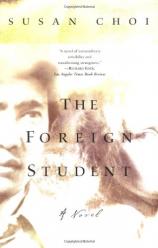
The Foreign Student
by Susan Choi
List Price: $13.00
Pages: 336
Format: Paperback
ISBN: 0060929278
Publisher: HarperCollins
Susan Choi's story of improbable love brings together a displaced Korean
student and a rebellious young American woman, two outsiders who seek
solace and escape from the afflictions of their pasts. Chang Ahn has
experienced first-hand the horrors, political turmoil, and betrayals of the
Korean war. Hoping to leave behind his nightmarish memories, Chang
escapes from his war-torn country and arrives at the University of the South
in Sewanee, Tennessee, in August 1955. Unprepared for the totally different
world of Sewanee, Chang--nicknamed Chuck--takes pride in his carefully
guarded "compact self-sufficiency," practicing his English with the
charismatic Professor Charles Addison and deciphering the rules of
college life, where he does not quite fit. Then he meets Katherine Monroe,
who quickly becomes the unsettling center of his attention.
The brilliant and impetuous twenty-eight-year-old Katherine is something of
a figure in Sewanee. The daughter of a well-to-do Southern family, she has
rebelled since childhood against the conventions of family and society,
settling in her family's old summer house in Sewanee and into an
obsessive affair with Charles Addison, who seduced her when she was
fourteen. Estranged from her mother and unhappy with Addison, Katherine
is as much a loner and outsider as is Chang. As Katherine and Chang
struggle with their respective histories and move toward love and mutual
understanding, alternating chapters reveal the details of their pasts.
Harrowing accounts of Chang's experiences in Korea are juxtaposed with
troubling revelations of Katherine's childhood and young adult years; both
contribute to our understanding of who they are and where they may be
going between the autumn of 1955 and the summer of 1956. And as their
stories unfold, we gradually come to understand both the seemingly
impassable differences and the surprising affinities between them as well.
top of the page

1. How are Katherine and Chang similar in terms of family, education, social class, and other factors? What kinds of experience and influences do they have in common? In what way is each a refugee?
2. What losses do Chang, Katherine, and other characters suffer? How does each deal with his or her losses? How do their losses affect their subsequent lives and expectations?
3. Choi writes that it was his past "against which Joe [Monroe] defined
himself, and which in Katherine's family set the standard for everything." (pg.
24) To what extent is this also true of Katherine, herself, of Chang, of
Addison, and of other characters? How does it relate to Chang's being
"used to the constant pressure of the future"? (pg. 41) At what point do
Katherine and Chang, in fact, permit the present and possible futures to
provide the standards for their thoughts, feelings, and behavior?
4. In what ways are Katherine and Chang independent? In what ways are
their lives constricted or determined by society, other people, and other
outside forces? What does each learn about independence and
dependency?
5. Through his work as a translator, Chang learns that "you wanted one
thing to equal another, to slide neatly into its place, but somehow this very
desire made the project impossible. In the end there was always a third
thing, that hadn't existed before." (pg. 67) To what extent does this also
apply to cultural and personal issues confronted by both Chang and
Katherine? To what extent are Chang and Katherine each "the third thing . . .
Translation's unnatural byproduct"? (pg. 84)
6.Katherine tells Chang, "In my family you never could move a muscle
without it being a declaration of loyalty to somebody and war to somebody
else." (pg. 150) What loyalties and betrayals, actual and imagined, are
important in Katherine's and Chang's lives? What is the impact of each? To
what extent does a fear of betraying and of being betrayed hinder each of
them in their relationships?
7. What borders and boundaries--for example: geographical, emotional, cultural--are crossed or transgressed? What are the consequences of each crossing or transgression?
8. To what extent is the "total, irresolvable uncertainty" that Chang carries with him after his release from torture characteristic of life itself? How do Chang, Katherine, Addison and others deal with the "total, irresolvable uncertainty" of life?
9. What are Chang and Katherine each looking for that each finds in the other?
10. What are the implications of Choi's setting her story of an interracial love in the American South of the mid-1950s? Why do you think she makes only muted and indirect references to racial prejudice and condescension?
top of the page