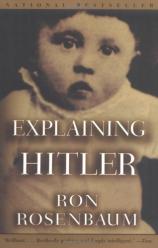
Explaining Hitler


About the Book
Explaining Hitler



"These people must not know where I come from," Adolf Hitler once purportedly said. "Nobody must know who I am." This disquietingly prophetic imperative has been borne out by half a century of ardent, contentious and often contradictory inquiry into the origins of Hitler's singular, unsurpassable evil. In Explaining Hitler, Ron Rosenbaum undertakes an exhaustive study of the myriad scholarship and conjecture of the many historians, psychologists, and others who have tried to solve the puzzle of what made Hitler Hitler.
Rosenbaum acknowledges early on that a consensus can never be reached about why Hitler orchestrated the Holocaust (or even, in the minds of some scholars, if he did) because key historical evidence is either missing, was destroyed, or never existed. Nonetheless, he seeks "if not the truth about Hitler, then some truths about what we talk about when we talk about Hitler. What it tells us about Hitler, what it tells us about ourselves."
The catalog of Hitler theories leads Rosenbaum to those like Hugh Trevor-Roper, who feel the Fuehrer was convinced of his own rectitude in the mission to exterminate the Jews, and to others like Alan Bullock, who feel he was an accomplished actor and a schemer who responded to and manipulated European anti-Semitism for political gain.
Rosenbaum wades through long-debated speculations of the origins of Hitler's anti-Semitism, including the notion that Hitler had a Jewish grandfather or that he held an irrational, if monumental grudge against all Jews because of some transgression, real or imagined, in his youth. He also examines the work of those who seek a psychosexual explanation for Hitler's evil in an abused childhood, or in shadowy rumors of some sexual dysfunction or aberration. Rosenbaum looks at theories that view Hitler as a blackmailing hood, resurrecting the mostly forgotten history of a courageous band of Munich-based journalists, the "Poison Kitchen," who tried to expose Hitler's venal intentions and scandalous involvement before he rose to power in the early 1930s.
In face-to-face interviews he tries to ferret out the true beliefs of controversial Hitler interpreters, including those of George Steiner, whose fictional The Portage to San Crisobal of A.H., seems to place the onus of the Final Solution on the Jews themselves; Daniel Goldhagen, who controversially views Hitler as merely a midwife in the birth of long gestating German anti-Semitism; and Holocaust denier David Irving, who refutes everything. Struck by filmmaker Claude Lanzmann's edict that we must never ask why because any attempt to explain Hitler, to some degree, exonerates his actions, Rosenbaum turns to Israeli theologian Emil Fackenheim who has decreed the 614th commandment: Jews are forbidden to grant posthumous victories to Hitler.
From Fackenheim, Rosenbaum ultimately extrapolates what he comes to see as the best mandate we can adopt when trying to explain Hitler: "Not to resist all or any inquiry, not to resist thought, but to resist...the way explanation can become evasion or consolation, a way of making Hitler's choice to do what he did less unbearable, less hateful to contemplate.... To resist making the kind of explanatory excuses for Hitler that permit him to escape, that grant him the posthumous victory of the last laugh."


Explaining Hitler
- Publication Date: July 1, 1999
- Paperback: 496 pages
- Publisher: Harper Perennial
- ISBN-10: 006095339X
- ISBN-13: 9780060953393